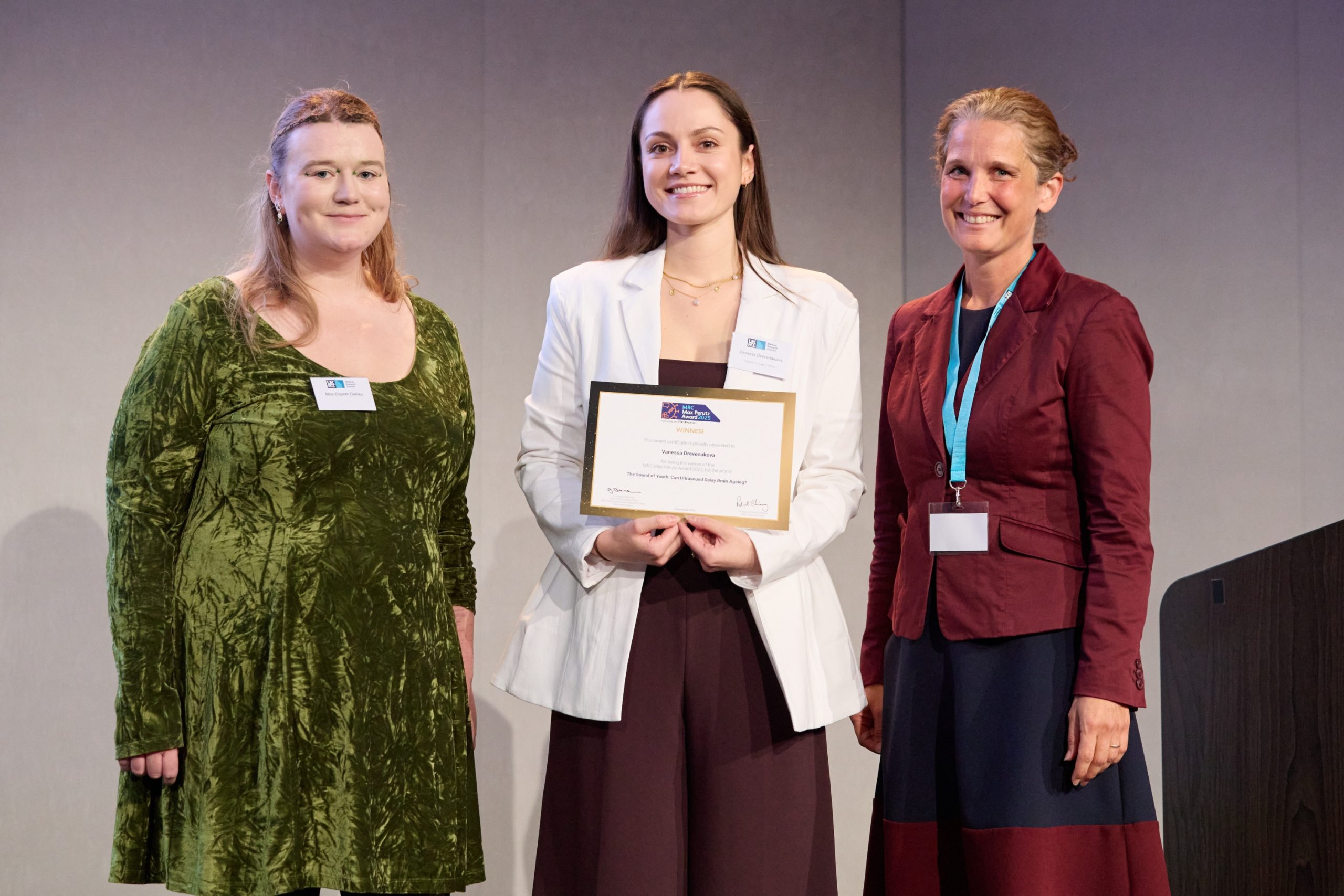
An award-winning Bioengineering PhD student’s science writing has driven growing public and media engagement with brain ageing research, creating new opportunities to communicate emerging technologies beyond the lab.
Vanessa Drevenakova, a PhD researcher in the Morse Lab in the Department of Bioengineering, has seen her research reach new audiences following the publication of an award-winning science communication piece in The Observer. The article, which won the MRC Max Perutz Award for Writing, explores how emerging technologies could help support brain health as we age.
The piece introduces readers to microglia – small but vital immune cells in the brain – and explains their role in maintaining brain function over time. Vanessa’s research investigates whether gentle sound waves, delivered through focused ultrasound, can help “reawaken” ageing microglia so they behave more like they do in younger brains. By restoring their function, the work aims to better understand how cognitive decline associated with ageing might be slowed or prevented.
Writing to reach new audiences
Vanessa entered the MRC Max Perutz Award to challenge herself to explain her research to a non-academic audience.
“I loved the idea of explaining why my research matters to people outside the lab,” she said. “Focused ultrasound can sound very futuristic, so this felt like a great opportunity to show what it actually does and why it could be important.”
Although writing was outside her comfort zone, she deliberately chose the writing category.
“This was a chance to step away from scientific writing and focus on the story behind the research,” she said. “It was surprisingly enjoyable and refreshing.”
At the heart of her article was a desire to highlight the importance of microglia, which she feels are often overlooked in discussions about the brain. She hoped readers would come away with a deeper appreciation of how complex the brain is, and how new ideas are emerging that may help people stay healthier for longer.
Growing public engagement through national media

Since the article was published, Vanessa has attracted significant media and public interest, particularly from people living with the conditions her research aims to address.
In December, she was invited to speak on Sky News’ morning programme, where she discussed how focused ultrasound could help slow or prevent aspects of brain ageing. During the interview, she explained how dysregulated microglia can contribute to inflammation, cognitive decline, and neurodegeneration, and outlined how non-invasive focused ultrasound could provide a new approach to supporting long-term brain health.
She described the experience as “surreal in the best possible way” and said she was grateful for the opportunity to share her research with a broad public audience.
The value of science communication in Bioengineering
Vanessa believes science communication is particularly important in fields such as bioengineering, where technologies can feel unfamiliar or difficult to visualise.
“Sharing science in a clear and accessible way helps people understand how these ideas work and builds trust,” she said. “When people understand what we’re doing and why it matters, it sparks curiosity and helps correct misconceptions.”
The writing process also gave her space to step back from the day-to-day detail of laboratory work.
“It reminded me that behind all the experiments, the real aim is to help people age in a healthier way,” she said. “It made me think more about the people who might eventually benefit from this research.”
Shaped by public engagement
Vanessa’s approach to communication has been shaped by her time in the Department of Bioengineering, including opportunities to engage with the public at events such as the Great Exhibition Road Festival.
“People are genuinely curious about what we do,” she said. “Those conversations really highlight how important outreach is and shape the way you communicate.”
When she found out she had won the award, Vanessa said she was initially shocked.
“It meant a lot to know that the story resonated not only with scientists, but also with members of the public.”
She hopes readers will come away feeling hopeful about the future of brain health, and curious about how emerging technologies could shape it.
Vanessa also acknowledged the support of the Medical Research Council, The Observer, and the MRC Max Perutz Award for championing science communication, as well as her supervisors, collaborators and funders for creating the environment that makes this work possible.