Blog posts

CSEP Cross-Institutional Partnerships: University of Sussex Business School

Finding and fixing leaks in the UK’s pharmaceutical pipeline

Professor Michael Hopkins (SPRU, University of Sussex Business School)

Dr Philippa Crane (SPRU, University of Sussex Business School).

How did you come to this topic?

We began working together over 15 years ago at the Science Policy Research Unit (SPRU), University of Sussex, researching trends in the financing of the UK’s emerging small innovative life sciences firms and publishing on this topic for academic and policy audiences. At the time, soon after the 2008 financial crisis, the UK was just putting together its first sector-specific industrial strategies. Last year, when we heard about CSEP’s research programme, we thought our deep sector-specific experience and prior research could be of interest in understanding the progress of the sector and how well the latest iteration of the Government’s industrial strategy might support these firms.

What is the focus of your project under this collaboration with CSEP?

Our research looks back to the emergence of the UK’s very first “biotech” firms, in the early 1980s, and follows the growth of what are now well over seven hundred firms that all share a common purpose – the desire to bring innovative new medicines to market. Our data captures whether these companies are still active, and if not, what happened to them, thereby charting the dynamics of the industry, including how the introduction of successive industrial strategies has impacted these dynamics.

For instance, while scaling up of UK based SMEs is an explicit objective of successive UK Life Sciences industrial strategies (2016 and 2025), which direct policy levers can policy makers use in the face of the many acquisitive overseas firms that pick off the UK’s leading firms through acquisition?

How does this research align with CSEP’s mission?

A key theme in CSEP’s mission is to show how the UK can build on science, engineering and technology capabilities to improve the competitiveness of the economy. Our research is situated within the context of the UK’s aspiration for R&D-driven economic growth, which rests disproportionately on the nation’s ability to translate biomedical research into new pharmaceutical products and retain value within the UK.  CSEP’s 2024 report on the performance of the Life Science sector notes that ‘while the UK performs well on basic science, attention is needed to grasp the opportunities and translate potential innovations into commercialised products and services’ (CSEP 2024:39). Our study takes a pipeline perspective to determine how and why potential UK economic returns from the life sciences ‘leak away’, and what could be done to improve the situation for the benefit of UK PLC, economic growth and productivity.

What makes this work innovative or timely?

The latest UK Industrial Strategy sets out a ten-year goal for the country to become Europe’s foremost life sciences hub and to rank third globally, behind only the US and China. Yet there is little longitudinal research that has actually looked at how the cohorts of UK firms emerging over the years have performed. Our research can show this performance, which we will share with stakeholders and together we can develop lessons based on previous governments’ attempts to improve the performance of the UK biotech sector, and seek to influence how the present industrial strategy could be further developed.


Meet the CSEP Team Series: Dr Diego Freire Ordonez

Could you summarise your career journey so far?


I’m a Chemical Engineer with a background in process systems engineering, specialising in the techno-economic and environmental assessment of low-carbon technologies. My career has centred on understanding how we can design and scale sustainable production pathways for fuels and chemicals, particularly those derived from CO₂ and renewable energy. Before joining Imperial College London, I worked across both industry and academia—supporting projects in oil and gas, environmental regulation, and energy transition technologies for organisations in the UK, Europe, and Latin America. I hold a PhD in Chemical Engineering from Imperial and postgraduate degrees in energy and industrial management.

How do you see your work at CSEP contributing to real-world net-zero energy solutions? 

At CSEP, I have started working on the techno-economic assessment of different pathways for renewable syngas production. My work involves developing detailed process models and analysing the economic viability of emerging technologies that could replace fossil-based syngas in the future. What excites me most is the opportunity to explore pathways that are not only technically innovative but could also make a real contribution to a net-zero energy system. Seeing how small changes in design or integration can dramatically affect cost and sustainability is incredibly motivating.

What specific research topics or areas are you most passionate about?

I’m particularly passionate about CO₂ utilisation and the broader field of e-fuels—technologies that convert renewable electricity and captured carbon into low-carbon fuels and chemicals. I enjoy working at the intersection of engineering, economics, and environmental impact, where decisions are informed by a full systems perspective. Understanding how emerging technologies can scale, integrate into existing infrastructures, and ultimately compete with fossil-based processes is a challenge I find essential for the energy transition.

How does your focus on scale-up and integration of emerging technologies reflect CSEP’s vision of enabling sectors to innovate and grow?

I see my role as helping to deepen our understanding of the technologies that could shape the next generation of low-carbon fuels and chemicals. By analysing how emerging processes perform in practice—economically, technically, and environmentally—I hope to provide clarity on what is genuinely feasible as we transition away from fossil-based systems. My aim is to help generate insights that support better decisions, encourage innovation, and ultimately move us closer to a cleaner and more sustainable energy landscape.


Meet the CSEP Team Series: Dr Semra Bakkaloglu

Could you tell us a bit about your current role and how your previous experiences have shaped your research focus?

I am the Lord Sainsbury Fellow (Fine Chemicals) at CSEP, with a background in environmental and chemical engineering. My work bridges academia and industry, focusing on methane emissions, negative emission technologies, life cycle sustainability assessment (LCSA), and energy systems modelling. Before joining CSEP, I worked on assessing methane emissions, conducting sustainability assessments of olefin production, and developing market-based mechanisms for decarbonising the chemical industry — experiences that have shaped my broader interest in driving systemic change across energy and chemical value chains.

How do you see your work influencing not just sustainability outcomes, but also the economic competitiveness and global position of the fine chemicals industry?

At CSEP, I’m developing frameworks to accelerate the transition of the fine chemicals industry, focusing on industry-led sector strategies that address immediate challenges while creating a supportive ecosystem for long-term growth. I’m particularly excited about connecting rigorous research with practical industrial applications — building evidence to support cleaner, more circular fine chemical manufacturing and to guide future policy that fosters innovation and competitiveness. I’m also passionate about exploring how economic and business environments can be strengthened to enhance the industry’s GVA and global positioning.

How does your role at CSEP align with the Centre’s broader mission ?

My role at CSEP allows me to contribute to the Centre’s mission of advancing evidence-based sustainability strategies. Through my work on fine chemicals sector strategy, I aim to bridge scientific research, technology development, and policy design — ensuring that our insights not only inform but also enable real progress toward a sustainable and resilient fine chemical industrial future.

Looking ahead, what kind of impact do you hope your work at CSEP will have on the fine chemicals sector?

I hope to further strengthen the link between academic research and its practical implementation in the fine chemical sectors. CSEP offers a unique platform to collaborate across disciplines and engage with industry leaders, which I believe will help me grow as both a researcher and a change-maker in sustainable innovation.

How do you unwind or recharge outside of work?

Outside of research, I enjoy creative and outdoor activities that help me recharge. I’ve loved skiing since childhood and find theatre and drama to be powerful ways to connect and express ideas beyond academia. I also enjoy long walks, photography, and exploring new places, which often inspire fresh perspectives and creativity in my work.


Meet the CSEP Team Series: Dylan Booth

Could you share more about your current research projects and highlight the part that you find most engaging or innovative?
The work I am conducting at the moment entails spatial modeling the Bristol Channel – a body of water that I grew up alongside off the coast of Clevedon. Once simply a familiar sight, I now view it as a remarkable natural resource bisecting England and Wales. If we harness its enormous tidal range, the Bristol Channel could generate gigawatts of predictable renewable energy.

My research focuses on enhancing the environmental compatibility of tidal range infrastructure, by modeling opportunities of coastal habitat conservation, particularly for saltmarsh development. One of the most exciting aspects of this work is estimating carbon sequestration over time across vast sections of coastline. By linking these findings to carbon-credits valuation, the project highlights how tidal energy schemes can economically incentivise conservational practices, making them a transformative opportunity for green-financing.

How do you envision tidal range energy shaping the future of sustainable energy policy?

Among the many research topics of CSEP, tidal range is among the most pertinent for offsetting national carbon emissions. It is important to remember that the benefits of having a robust economy are diminished if we cannot maintain the health and productivity of our natural heritage. For this reason, I believe it is important to research mechanisms that support both economic and ecological stability. My research combines these objectives, providing economic incentive into a scalable industry through the lens of environmentalism.

What attracted you to working at CSEP?

While studying the MSc in Environmental Technology, the word ‘Interdisciplinary’ cropped up countless times. Initially, I was dubious about the significance of this concept, having come from a background in Palaeontology, I was used to working in my comfortable silo. However as the weeks went by it was clear to see that wicked problems required global, multi-sectoral perspectives. Interdisciplinarity inspired my MSc thesis, which thankfully was recognised by CSEP. Despite the transition from the ‘Centre of Environmental Policy’ to the ‘Centre for Sectoral Economic Performance’, interdisciplinarity maintains its position in the faculties agenda.

What experiences outside of your career have had the biggest impact on your personal growth?

I have been playing guitar for most of my life and I particularly enjoy recording songs for my friends and family. I am also an avid rower, having been a rowing coach for two crews at varying ages on the coast of Hampshire. I enjoy long hikes, having recently summited Kilimanjaro with a group of students for Teenage Cancer Trust. Raising money for charity isn’t new to me however, as of June 2024, I set up a fundraiser for Pancreatic Cancer Research for a cycle from London to Paris. I believe being creative in your personal life is directly proportional to a healthy and productive work life, therefore I aim to further integrate my creativity here at CSEP.

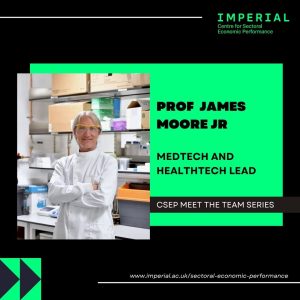
Meet the CSEP Team Series: Prof James Moore Jr

Can you tell us a bit about your background and how you became involved in the CSEP project on the UK MedTech sector?

I trained as a mechanical engineer and then pursued a PhD in biomechanics. Specifically, looking at the role of blood flow in disease development and treatment. That led me into inventing and developing cardiovascular implants. I was part of a few start-ups early in my career and continue to develop devices. Most of my research and development efforts these days is focused on the lymphatic system. For example, we are developing a device to prevent/treat lymphoedema in the arms of breast cancer survivors (lymphamotus.com). I teach medical device entrepreneurship and fluid mechanics in the Department of Bioengineering at Imperial. All this provided some good background to get involved in CSEP to analyse the UK MedTech Sector.

What inspired your involvement with CSEP? 

The potential to have a positive impact on the UK MedTech sector is exciting, and my main motivation for working at CSEP.  It is a strong but under-appreciated sector of the UK economy, so there is a lot of potential already.

What drew you to take on the challenge of analysing the UK MedTech sector, and how did that experience shape your perspective on the intersection of technology, business, and policy?

I was fortunate to be invited to lead the analysis of the UK MedTech sector back in 2020.  That work was generously supported by Lord Sainsbury.  I had to climb quickly up the learning curve on economics!  Along with others at Imperial that did reports on the BioPharma and Telecomms sectors, those projects led to the establishment of CSEP.  I am intrigued by the vision to have technical and business experts collaborate to improve productivity and societal benefit.  The MedTech activity has led to the formulation of a strategy to grow the entire HealthTech* sector, written in collaboration with the Association of British HealthTech Industries.  That is the first strategy document produced by CSEP, and I look forward to seeing more strategies being developed for other sectors.

*HealthTech refers to technologies that might enable anyone to monitor or improve their health, whereas MedTech refers to the subset of those technologies that claim medical benefit and therefore require regulatory approval.

Could you share some of the major inspirations that have guided your career and intellectual interests?

My career has benefited from the influence of many scientific discoveries, technological developments, and even other musicians.  It’s difficult to name a single one but a fantastic book that combines all these interests is “This is Your Brain on Music” by Daniel Levitin.

What are your interests outside your work?

Music is my main hobby.  I’ve wanted to be a musician since I was about 10 years old, so you could say that I am still trying!  I play several instruments and sing in two different bands.  One is a group of biomechanics profs that has been playing at conferences for over 20 years.  The other is our departmental band that plays at functions like the Christmas party.  It’s all good fun.  I’m also working on an album of mainly original music.  Otherwise, I used to play Ultimate Frisbee competitively.

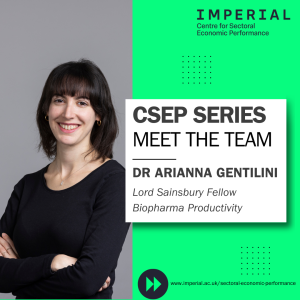
Meet the CSEP Team Series: Dr Arianna Gentilini

Can you describe your research journey and the key themes that define your work in health economics and public policy?

I am a Research Associate in the Economics and Public Policy department at Imperial College London, jointly affiliated with the Centre for Sectoral Economic Performance (CSEP) and the Centre for Health Economics & Policy Innovation (CHEPI). I completed a PhD in Health Policy and Economics at the LSE, where my dissertation examined how patient organisations shape pharmaceutical innovation and access. Methodologically, that work combined quantitative analyses with qualitative evidence to capture how incentives, information, and advocacy intersect across the R&D and reimbursement lifecycle. I also interested in how governance processes can be embedded within the pharmaceutical sector, particularly around transparency requirements and where they fall short. My research has been published in The Lancet Oncology, Social Science & Medicine, Value in Health, and BMJ Open, and I continue to collaborate with colleagues across disciplines to address policy-relevant questions in this space.

Your work bridges health economics and innovation policy—how are you currently exploring the role of emerging technologies, like AI, in shaping pharmaceutical R&D productivity and access to medicines? 

I am currently working in a CSEP–funded programme on pharmaceutical R&D productivity that analyses how technology adoption and market structure shape drug development performance in the UK life sciences sector and internationally. I am also supporting a European Commission–funded project, called Hi-PRIX, which investigates how incentives for innovation can be aligned with equitable and timely patient access to effective medicines. A particularly interesting aspect of this agenda is the opportunity to explore the rapidly evolving AI tools landscape in the pharmaceutical sector, for example, evaluating how different AI tools are being integrated across target identification, trial design, and evidence synthesis, and what this implies for productivity. The sector is experiencing a period of rapid change, and I feel it is extremely important to think how the research we produce can be translated into recommendations that regulators and policymakers can act on to improves people’s health.

Your work touches on several aspects of the pharmaceutical sector. Can you tell us about the key themes or focus areas of your research, and how they inform policy and practice in health economics?

My work spans three interlinked strands: (i) pharmaceutical innovation and R&D productivity, including the drivers of success and attrition across the pipeline; (ii) regulation and health technology assessment (HTA), with an emphasis on evidence standards, uncertainty, and value for money; and (iii) the commercial determinants of health, particularly how market power, pricing practices, and strategic behaviour shape access and affordability. I am especially interested in how emerging biomedical technologies and stakeholder incentives interact to determine which medicines are developed, how they are evaluated, and how quickly patients can access them.

How do you see your role contributing to CSEP’s mission?

CSEP’s mission is to generate sector-level insights that inform policy and practice. My contribution is to bring an applied empirical toolkit, econometrics, document and text analytics, and policy evaluation, to help diagnose bottlenecks in drug development and to understand which policy levers are most likely to improve innovative output and patient access. I also enjoy collaborating across disciplines and supervising junior researchers, which helps grow CSEP’s capacity to deliver timely, policy-relevant research.

In what ways do you hope your work at CSEP will contribute to improving how health systems balance innovation, affordability, and access to medicines?

First, to deepen the evidence base on how technology, organisational capabilities, and market design impact biopharma productivity in ways that are compatible with affordability and equitable access. Second, to strengthen the bridge between research and implementation by working closely with partners in government and industry so that our findings inform regulation, HTA processes, and funding models. An additional benefit of being at CSEP is exposure to diverse methodological approaches across sectors. For instance, AI-enabled techniques employed by colleagues analysing firm-level data in the aviation sector have proven directly transferable to one of our pharmaceutical projects, which I believe is a great example of how cross-sector collaboration advance research.

Meet the CSEP Team Series: Dr Joachim Taiber

We’d love to hear a bit about you — could you share your background and professional experience?

My name is Joachim Taiber and I was born and raised in Germany.

All my academic training was performed in Switzerland at ETH Zurich where I studied Mechanical Engineering and Computer Science resulting in a PhD degree for technical sciences. After my studies I spent some time in a software start up in Zurich and then joined BMW Group in Munich to work as an automotive engineer. This career path led me to work in the US to engage in the development of an automotive engineering campus in South Carolina where BMW was a key investor which resulted in an academic engagement with Clemson University as a research professor. As a spin-off from working at Clemson University I led the development of the International Transportation Innovation Center (ITIC) which is an automotive proving ground for connected, automated and electrified vehicles. The center became the founding member of the International Alliance for Mobility Testing and Standardization (IAMTS) which I developed in the role of a managing director which brought me back to Europe as the organization is headquartered in Vienna. Imperial became a member of IAMTS which helped to develop the relationship to work with Dyson School of Engineering. I joined Imperial first as visiting professor in 2024 and became a advanced research fellow at CSEP shortly after where I am responsible for automotive affairs.

What are you working on right now, and what part of your work do you find most exciting?

I just completed working on the Automotive Sector Study and truly enjoyed learning more about the UK’s role how it could engage in transforming the future of mobility.

What drew you to work at CSEP, and how do you see your role contributing to its mission?

I was attracted by the opportunity to leverage my knowledge in the sector and contribute to its future in collaboration with colleagues that share my passion for mobility.

I’m particularly motivated by the chance to engage in mobility-related projects that create added value for the UK and its people as key source for innovation.

What do you hope to learn or gain from your time here?

I am eager to learn as much as possible for the excellent research and academic environment and help build meaningful relationships with industry and academic partners to work on transformative projects.

Do you have a favourite paper, study, book or project that has influenced your career path so far?

The Feynman lectures on physics.

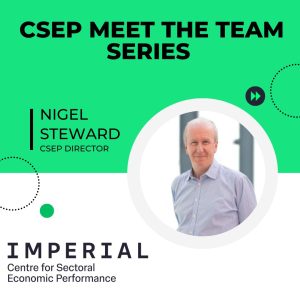
Meet the CSEP Team Series: Dr Nigel Steward


Welcome to the CSEP team! Could you tell us a bit about yourself and your professional background?

I have recently joined the CSEP team after spending 36 years in industry where I worked in the fields of R&D, Energy and Climate Change, Supply Chain, and Technical Capability building, as well as Operations Leadership and Management where, I ran global businesses in Technology Transfer and Equipment Manufacturing, Electrode manufacturing for the aluminium industry, and Copper and Diamonds production. I am a Materials Scientist by training and studied for my degree and doctorate here at Imperial.

What projects are you working on currently and what part of your work is most exciting for you right now?

At CSEP we have been studying the HealthTech, Aerospace, Fine Chemicals, Telecom, Cyber Security, Automotive, BioPharma, Clean Energy, Data Centre, AI Assurance, and Insurance sectors. What I find exciting is learning about these sectors that are very new me, the new breakthroughs that are being made in technology, and business models and the market disruptions and opportunities that they bring. What I especially enjoy is learning from the brilliant academics and business leaders all over the country who are making these things happen. If all this wasn’t enough what brings the greatest satisfaction is seeing our business-led, sector growth strategies come to life and be delivered. Our first sector strategy plan has been created with the HealthTech Sector in collaboration with the Association of British HealthTech Industries (ABHI) and we have recently had success in seeing one of our growth actions being implemented. Making a difference in the world is what is most exciting.

What attracted you to working at CSEP?

When I retired from industry earlier this year, I was looking for something to do where I could put my skills and experience to good use for a greater good. The role of CSEP is to see how science, technology, market and business model disruptions can be used to find new growth pathways and competitive advantage for key sectors of the UK economy, all with the overarching goal of stimulating more growth for the UK economy. The work is very much aligned with the UK Government’s Industrial Strategy goals and aligned with my own goal of contributing to society in a meaningful way.

What specific research topics or areas are you most passionate about?

What I have always been most passionate about is learning and discovery and implementing what I have learned to make the World a better place. The work at CSEP offers these possibilities in bucket loads!


Is the UK biopharma sector at risk of sleepwalking into decline?

James Barlow


For years, the UK has traded on its reputation as a “life sciences powerhouse.” This narrative isn’t entirely false: we have world-class universities, our basic science is strong, and the NHS provides a unique testbed for clinical research. Yet behind the rhetoric, the biopharma sector is facing real and immediate challenges.


Global pharma companies – including Merck, AstraZeneca and Eli Lilly – have recently announced plans to pause or withdraw R&D and manufacturing investment from the UK. Promising British start-ups are often sold overseas before they can scale. Access to innovative drugs is often slower than comparable countries.


Unless government and industry change course, the UK risks becoming a country that generates world-class ideas and early-stage companies but leaves others to capture the economic and health benefits. Innovative drugs will take longer to reach NHS patients. Manufacturing jobs and investment will migrate abroad. The narrative of “life sciences powerhouse” will become a hollow slogan, masking a reality of decline.


The reasons for Big Pharma falling out of love with the UK have partly been framed in terms of a “Trump effect”, the emphasis on domestic manufacturing, and partly on an uncompetitive drug pricing regime in the UK after changes to the Voluntary Scheme for Branded Medicines Pricing and Access (VPAS).


The UK’s difficulties don’t exist in isolation. Across Europe, the biopharma sector is losing ground. Public R&D spending on pharma is less than half that of the US, and private investment is just a quarter of American levels. Regulation is slower and more complex: median approval times for new medicines are nearly 100 days longer than in the US. Fragmented access to health data makes it harder to run efficient trials or fully exploit AI in drug development. The Draghi report has already highlighted Europe’s need to unlock secondary health data and accelerate digitisation, yet progress is slow. Meanwhile, the US continues to dominate private capital flows and China is rapidly translating R&D into patents and new biopharma products.


The UK’s self-inflicted weaknesses


But the UK is not just sharing Europe’s malaise – it may also be amplifying it through its own domestic weaknesses. Several structural issues make the UK a less attractive place for biopharma investment:


1. Start-up strength, scale-up failure.
The UK outperforms its European peers in early-stage funding. But when it comes to growth capital, the pipeline runs dry. Company valuations are low, making the USA a more attractive location for scaling. Promising small UK biopharma firms are often acquired by overseas investors, most commonly from the USA. In short, the UK funds the cost of discovery; others reap the rewards of commercialisation.[1]


2. Clinical trials – a squandered advantage?
The NHS’s voluminous health records could be a global asset for clinical trials. Instead, trial capacity is limited, recruitment slow, and approval pathways often cumbersome. Some other countries are easier and faster places to run trials. What should be a UK strength is in reality a weak spot.


3. Pricing that discourages investment.
The UK is very good at securing low drug prices for the NHS. But from an investor’s perspective, the pricing model looks increasingly hostile. The VPAS is seen as punitive by global pharmaceutical companies, compared to similar schemes in other countries. Companies don’t see a fair reward for their R&D risk and the UK risks being deprioritised as a launch market for new drugs.


4. A complacent narrative.
Successive governments have promoted the UK as a global life sciences powerhouse. While it is true that our science remains competitive, the long-term indicators are less encouraging. Patent filings, research output, and overall R&D intensity show that China and other emerging players are catching up fast.


What needs to happen now


Global pharma companies are not sentimental. They will locate their R&D and manufacturing where conditions are most favourable. Switzerland offers stability, the US offers capital depth, China offers scale and political backing. In contrast, the UK’s science base is still strong, but the downstream environment – scaling finance, trial efficiency, regulatory predictability, and pricing – does not match. Put simply, the UK is no longer seen as offering the right balance of opportunity and reward.


We still have assets worth fighting for, but this requires political will. Policymakers must:


Continue to improve the environment of drug trials. This includes ensuring NHS data is more readily accessible to help provide real world evidence for R&D and virtual trials.
Support scale-ups, not just start-ups. Provide the right tax and investment landscape to build deeper pools of growth capital so that UK firms can mature into global leaders, rather than being sold abroad.
Reform drug pricing. Be bold – move beyond penny-pinching and embrace value-based pricing models that align rewards with outcomes.
Face reality. Stop hiding behind “life sciences powerhouse” rhetoric and treat life sciences as a strategic national priority.


The remedies aren’t just the responsibility of government alone. The biopharma sector can’t simply sit back and wait for policy changes – it needs to:


Be more ambitious. Aim to scale from a UK base rather than defaulting to acquisition as an exit.
Engage proactively with the NHS. Build the evidence base for adoption as innovative technologies are being developed and not after they have been launched; work with clinicians to overcome the system’s inherent risk aversion.
• Tell the value story better. Demonstrate clearly how new drugs save money and improve outcomes, not just what they cost.


A wake-up call


If we keep congratulating ourselves on our science while ignoring the cracks in our industrial base, we will drift into decline. Biopharma is too important to the UK’s economy and health system to be allowed to wither. The choice is clear: act boldly now or accept second-tier status tomorrow.


This blog draws on recent interviews James gave to Nature and CNN’s Marketplace Europe about the state of the UK and European health tech industry.


CSEP’s work on the biopharma and health technology sectors


We have published reviews of the competitiveness of the UK’s biopharma (Biopharmaceutical_Sector_2024_Brochure_Nov2024.pdf) and health technology (348-IMP-Public-Affairs-3-reports_Medtech_AW_DIGITAL_SINGLES_Sept23.pdf) sectors, with recommendations for business and government. In collaboration with the ABHI, we have developed a UK healthtech sector strategy, available here: Lores_Screen_View_Only_HealthTech_Report_Oct2024_v4-FINAL.pdf


CSEP is currently investigating the R&D productivity of UK biopharma and whether this has changed in recent years as new technologies such as AI have become more widely used. Another project is investigating the “long tail” of around 500 smaller biopharma companies and their potential for growth. These projects will be completed in 2026.


[1] More information on the slippage in the UK’s scientific performance and on the challenges faced by small biopharma companies seeking to grow can be found in the CSEP blog “From biopharma innovation to biopharma impact: Can the UK compete globally in 2025?”

UK HealthTech Roadshow Unites Industry, Academia, and Government to Shape MedTech’s Future

The government has placed growth at the heart of its mission and in June of this year
published its Industrial Strategy. One important issue raised by the Industrial Strategy is
the need to better understand the relationship between national sector strategies and
the regional areas where firms are located.

The high-level Sector Plans identified the most important city regions and clusters for
the given sector. In addition, regional authorities are developing ambitious Local Growth
Plans which are supposed to dovetail with the Industrial Strategy Sector Plans. These
local plans need to tackle the critical issues that are constraining growth across sectors
including poor transport connections, skills shortages and housing.

If a sector is to drive growth, it will need to scale up across the regions which means
there needs to be some consistency across locations. For example, there should not be
a diFerent export strategy for HealthTech firms in Yorkshire compared to those in
Scotland; there needs to be one national export strategy for the sector. However,
national sector strategies will have to consider the advantages and disadvantages faced
by each location which will impact multiple sectors. Hence it is critical that national
sector strategies dovetail with regional strategies to support growth across multiple
sectors rather than generating a host of competing strategies which has sometimes
been the case across the UK.

With that in mind, a nationwide series of regional roundtables, jointly hosted by the
Association of British HealthTech Industries (ABHI) and the Centre for Sectoral
Economic Performance (CSEP) at Imperial College London, has brought together
leaders from industry, academia, and government to address the challenges and
opportunities shaping the UK’s £13.5 billion HealthTech sector.

Spanning events in Edinburgh, Oxford, Manchester, and Cardiff, the roadshow
highlighted the sector’s economic strength, innovation potential, and pressing need for
structural reforms to boost productivity, manufacturing, and global competitiveness.


A Sector with Global Potential – and Persistent Barriers

According to CSEP’s research, the UK HealthTech industry employs more than 150,000
people and contributes £13–15 billion in Gross Value Added (GVA) annually—on par
with the biopharma sector, despite receiving 15 times less research funding.

University spinouts in HealthTech rival those in pharmaceuticals, underscoring the
sector’s innovation eFiciency.

However, productivity per employee lags global leaders such as Singapore and
Denmark, and the UK remains a net importer of medical technologies. Much of the
country’s manufacturing capacity has migrated overseas, particularly to the US and
Switzerland, limiting domestic economic returns.


Three NHS Strategic Shifts Driving Urgency

Speakers, including ABHI’s Richard Phillips and Imperial’s Professor James Moore Jr.,
stressed that NHS sustainability hinges on three strategic shifts:

1. Care closer to home and in the community
2. Digital transformation
3. A stronger focus on prevention

Delivering on these priorities will require rapid adoption of innovative health
technologies—an area where the UK has historically excelled in invention but lagged in
deployment.


Policy and Investment Reforms Proposed

Daniel Green, a MedTech entrepreneur and policy adviser, outlined a set of cost-neutral, sector-specific proposals to stimulate growth:

Expand SEIS/EIS limits for life sciences, raising the SEIS cap from £250,000 to
reflect the capital intensity of MedTech ventures.
Reform EMI share schemes so tax benefits remain valid after employees leave,
accommodating long development timelines.
Enhance R&D tax credits for UK-based clinical trials to reverse the UK’s decline
in global rankings (from 4th to 10th).

Attendees agreed these reforms would improve access to capital, attract talent, and
encourage companies to conduct trials domestically.


Local Insights from the Regions

Edinburgh: Participants called for better alignment between NHS priorities and
HealthTech innovation, with a focus on health equity and sustainability.
Oxford: Discussions stressed the UK’s need to match its scientific strength with
faster adoption and value realisation in the health system.
Manchester: Stakeholders showcased integrated health data initiatives and the
CityLabs innovation hub, which has created over 800 jobs and £150m in GVA.
Cardiff: Former Welsh Economy Minister Vaughan Gething urged embedding
innovation as a core NHS function, with empowered local leadership and clear
priorities.


ABHI’s Role as the Sector’s Voice

ABHI, representing over 400 members (80% SMEs), acts as a bridge between industry
and policymakers, advocating for regulatory clarity, market access, and international
trade growth. Its trade missions span the US, Middle East, and beyond, helping UK
firms access new markets and align with global regulatory standards.


Next Steps – From Discussion to Delivery

The roadshow’s findings will feed into a collaborative HealthTech strategy co-authored by ABHI and CSEP, focusing on government policy reform, industry scaling
commitments, and academic innovation pipelines. Attendees were urged to provide
feedback to refine the roadmap.

“This is about more than funding requests,” Moore emphasised. “It’s about a shared
commitment—industry, government, and academia each playing their role—to make
the UK the best place in the world to develop, scale, and export health technologies.”