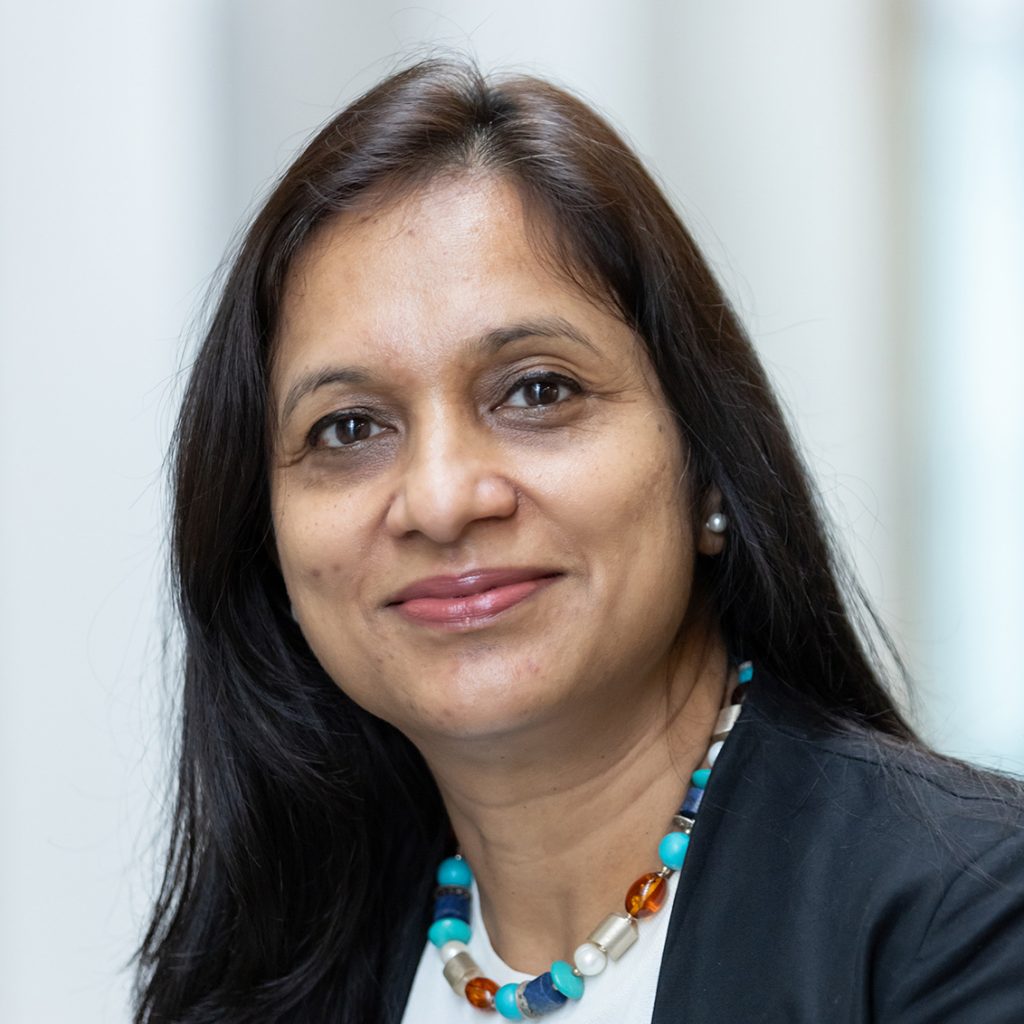
In this Q&A, Dr Shuchi Agrawal Singh discusses her work on epigenetics and biomolecular condensation in acute myeloid leukaemia, and the problem of drug resistance and relapse. She reflects on the rapid technological advances in recent years in her field and shares more about her exciting new work on phase separation.
Tell us who you are and what do you do?
I am a non‑clinical scientist originally from India, where I completed my undergraduate studies and a master’s in biotechnology. I then moved to Germany to do my PhD in Münster, focusing on acute myeloid leukemia and the molecular mechanisms driving the disease.
From early on, I was very interested in cancer research, which motivated my PhD work. During that time, I became particularly drawn to epigenetics. After completing my PhD, I went to Copenhagen for a postdoc at an institute well‑known for epigenetic studies Biotech Research & Innovation Centre (BRIC). I trained there on epigenetics with experts in the field before moving to Cambridge for my second postdoc, returning to blood cancer research and combining both areas of epigenetics and acute myeloid leukemia.
I joined Imperial in 2024, in the Centre for Haematology. I am passionate about understanding the basic epigenetic mechanisms driving drug-resistance in acute myeloid leukemia, particularly the epigenetic changes that might be reversible. If genes are misbehaving, epigenetic changes can sometimes be reverted to correct them, which is what motivates me.
Was there a particular moment you knew cancer research was the direction you wanted to follow?
My interest developed gradually. My master’s project was also in blood cancer research, which drew me in. During my PhD, my work covered two angles. One was related to epigenetics DNA methylation and the other to signalling pathways by Flt3-mutation. Epigenetics intrigued me more because of its reversible nature, which offers the potential to correct unwanted changes.
That motivation led me to pursue my epigenetics postdoc in Copenhagen, which gave me strong training in the field. I could then apply that knowledge back to cancer biology.
What motivates you most in your work?
One of my goals is to find treatments that can improve the lives of patients with blood cancers who are having relapse and became resistant to treatments. I am very motivated by understanding resistance mechanisms and why cancer drugs fail to cure the disease, and why patients relapse or develop resistance.
Resistance and relapse happen across all cancers, blood cancers and solid tumours. In blood cancers, it is easier to detect and monitor because of blood sampling and bone marrow biopsies, which also means research in the field is more advanced. Epigenetic mechanisms play a role across cancers, so what we find here could help us understand other cancers too.
Is there anything else you’d like to share about your research interests?
Yes, besides epigenetics, my lab also focuses on phase separation, a very new field that connects biophysics and biology called phase separation. To explain simply: if you put drops of oil into water, the oil separates into droplets, which is phase separation. Something similar happens inside cells, where proteins form condensates to carry out functions.
In cancer cells, this process becomes abnormal, and cancer cells exploit these droplets for their benefit. My lab is trying to study how these condensates form in acute leukaemia and how we might dissolve them therapeutically. It’s challenging currently because the field is new, techniques are complex, and acceptance is still growing, but it’s an exciting direction. There are already examples in prostate cancer where certain drugs can dissolve condensates. Imperial’s multidisciplinary environment is ideal for this work, so I am currently collaborating with researchers in chemistry, biophysics, and drug discovery, including the Drug Discovery Hub, which has enabled us to screen 2,000 drugs in one go. My drive is to establish this emerging area at Imperial and hopefully be among the first to make significant discoveries.
Epigenetics has grown so rapidly. How has your own understanding and the field changed since you started?
The progress in the last 10 to 15 years has been enormous. Technological advancements have transformed what we can study. When I started my PhD, next‑generation sequencing was new and extremely expensive. Now it is widely accessible, with multiplexing reducing the cost.
Single‑cell epigenomics has been a revolution and allows us to see heterogeneity in cancer at much higher resolution. We can now detect different populations of cancer cells based on gene expression or epigenetic changes, understand why some survive treatment, and link this to relapse. These tools have given us a much deeper understanding of epigenetics and cancer.
You founded a popular Cancer Epigenetics Seminar Series. How did that begin?
The series during the pandemic. Everyone was at home, and I attended many online webinars, and I thought I should start a seminar series focused on cancer epigenetics to bring two big communities, cancer researchers and basic epigenetics researchers, together.
Clinical cancer researchers often lack deep exposure to the basic science of epigenetics, while epigenetic scientists may not work on disease models. Bringing them together benefits both sides. This I noticed when I worked in two separate disciplines: during my PhD at molecular haematology & oncology lab with clinician scientists and during my postdoc at BRIC, Copenhagen with scientists experts in epigenetic mechanisms.
Our first seminar in December 2020 had over 500 attendees. We expected interest to decline after the pandemic, but attendance has remained strong. We are now entering our sixth year, with more than 10,000-15,000 people having attended in total.
Recently, when I went to a conference in the US, people recognised me and said their entire labs attend the seminars monthly, so it has become a valuable educational platform for those in the field.
Outside of work, what are your passions and hobbies?
I’m a mother of two young boys, so when I’m not working, I’m busy with them!
My main hobbies are painting, baking, and I love cooking, following recipes, and trying new dishes. It gives me the same feeling as doing experiments and following protocols. I also enjoy travelling whenever possible, although that’s less frequent these days. I have a keen interest in watching crime series, which motivates me to solve mysteries in my own research and think from the cancer cells’ mind to hide and escape treatment.