by Vivienne Groner, Research Associate in Microclimate Modelling, Department of Life Sciences
Writing sits at the heart of academic life. It is how we shape ideas, apply for funding,
progress in our careers, and share our work with the world. Yet for many of us, writing
feels heavy – something to squeeze in between experiments, meetings, and deadlines.
It is rarely taught as a skill to be practised mindfully or sustainably; more often, it is
something we dread, delay, or approach under pressure. In an increasingly competitive
academic environment, writing can all too easily become a source of stress, burnout,
and self-doubt.
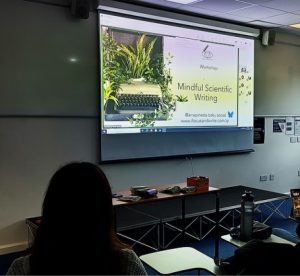
This day-to-day struggle was the motivation behind organising the Mindful Scientific
Writing Workshop on 21 January 2026, generously supported by the Early Career
Research Institute (ECRI) Postgraduate Community Fund. I had previously attended
Ana Pineda’s writing workshops and found them genuinely transformative – not only for
my productivity, but for my relationship with writing itself. Wanting more people to
benefit from this approach, I aimed to create space for Early Career Researchers at
Imperial to step away from the pressure of “just producing words” and instead reflect
on how we write, why we struggle, and how more sustainable and fun habits might be
developed.
The workshop combined a one-hour live-streamed session led by Ana with a two-hour
facilitated group writing session. Ana brought warmth, honesty, and a refreshing
perspective on scientific writing, one rooted in focus, self-compassion, and clarity
rather than perfectionism. As a researcher turned yoga teacher and mindful scientific
writing coach, Ana hits the spot in understanding and supporting scientists in their
writing struggles. She shared practical strategies for managing time, energy, and
cognitive load while still making meaningful progress on writing projects that often feel
overwhelming.
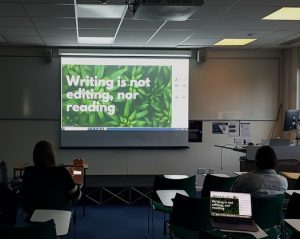
Rainy weather didn’t deter a small, highly engaged group from attending in person at
Silwood Park, alongside an active online presence. The workshop was interactive, with
participants contributing questions and reflections in real time through phone chat and
Microsoft Teams. The resulting atmosphere supported meaningful discussion and more
individualised engagement.
Several participants stayed on after the workshop to continue conversations and write
together, keeping the creative momentum alive. The atmosphere remained relaxed and
supportive (fuelled by a good amount of biscuits) – a reminder that writing does not have
to be a solitary or stressful activity.
I left the workshop with several insights that have stayed with me. A few favourites
included: starting your manuscript with the last paragraph of the introduction; changing
the font colour to white for 15 minutes to prevent over-editing while drafting; and going
for a mindful walk when feeling stuck, using the return journey to think gently but
deliberately about what comes next. Perhaps most importantly, we discussed energy –
how finishing a piece of writing often leaves a sense of emptiness, and how this “void”
is not failure but a necessary pause before new ideas can emerge.
The biggest takeaway for me and for the other participants was a shift in perspective.
Writing is not something separate from our scientific identity; it is how our science
exists in the world. The sooner we allow ourselves to see writing as a practice rather
than a performance, the kinder and more sustainable it becomes. And on difficult days,
it helps to remember that sometimes all you need is a coffee shop, a comfortable chair,
and permission to pretend you’re Hemingway for an hour.
If you missed the workshop or want to learn more about being a mindful scientist,
check out Ana’s website (ifocusandwrite.com); she offers free resources and runs
regular free workshops and bootcamps on mindful writing, productivity and getting
funded. For more advanced and adventurous researchers, you might be interested in
the ‘Thriving scientist’ course.