Fast, effective reflection: Improve your grades and your career!
by Katie Dallison, Imperial Careers Service
 Reflection – what is it?
Reflection is a process where you break down and analyse experiences to help you learn. Being able to reflect quickly and effectively can make you a better student and help you make better, possibly more efficient, decisions about a whole range of things, e.g. your future career, how to manage your time and even which tube to take to get home.
Reflection – how do I do it?
David Kolb (1984) developed a practical way to reflect with his Experiential Learning Cycle. The cycle explains a process where you take an experience, consider what you noticed throughout the process, identify what you learnt and think about what you might do differently next time.
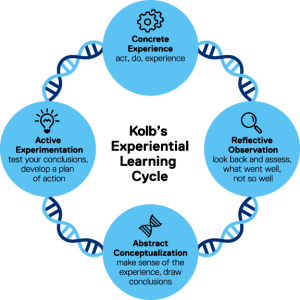
To make this easier, we’ve translated Kolb’s Cycle into four questions which you can use as a template to support your own reflection process:
- What happened? (briefly)
- What stood out or surprised me?
- What did I learn or re-learn?
- What will I try differently next time?
Record your thoughts in whatever way works best for you, e.g. write them down in a journal, make yourself voice notes on your phone, create a spreadsheet to store your answers in.
Reflection – how can it support my studies?
Reflecting on what you’re learning, and the ways you’re going about that learning, can bring a whole range of gains. Top benefits of reflecting on your studies include:
- Deeper learning: Reflection consolidates concepts and bridges theory with practice.
- Building metacognition: Reflection enables you to learn how you learn, allowing you to spot strategies that help (or hinder) your performance.
- Understanding feedback better: Reflection guides you to turn supervisors’ or markers’ comments into actionable improvements that you can put into practice for the next assessment, which will hopefully then lead to better marks.
Adding in reflection to your toolbox of study strategies so that this becomes an ongoing process can genuinely help you to study both more effectively and more efficiently as you continue through your studies.
Reflection –can this be useful in other ways and in other contexts?
Absolutely! Reflecting more broadly on your experiences (in any domain of your life!) can help you to understand what you enjoy (or don’t enjoy), and this can be useful as part of your future career decision-making process. Top benefits for reflecting about your career include:
- Developing stronger evidence-based stories: Reflection produces clear STAR stories (Situation, Task, Action, Result) for applications and interviews.
- Figuring out what you want to do: Reflection enables you to clarify interests, values, and environments where you thrive, guiding smarter career choices and building confidence in your career decision-making.
- Easier transitions: Reflection following participation in real-world experiences (e.g. hackathons, work experience, club and society events) prepares you to be more adaptable so that when the time comes you’ll be able to move into a professional setting more easily.
Ultimately, there’s a lot to gain and really nothing to lose! Adding quick reflections into your routine, e.g. after you finish a project, have an experience or receive feedback, can help you become a better student and understand more about yourself to help you get the future you want. Why not try it today to find out how reflection can help you become a stronger learner and person?
Katie Dallison is a Careers Consultant in the Careers Service and co-authored the Attributes and Aspirations online course which helps students develop transferable skills. She works with all students to help them discover and succeed in the career they want.
References & Useful Resources:
Kolb, D. A. (1984) Experiential learning: Experience as the source of learning and development. Prentice-Hall
For more resources, examples and ideas on how to reflect well, visit the Attributes and Aspirations online course (check out the skills map to discover where the reflection unit is for your version) or visit Imperial’s Careers Service webpage on Self-reflection.
 ALSO: Why not check out the resources page on the Imperial Learning Well Project website – here, you can find a range of materials that can support and enhance your study strategies while also maintaining positive wellbeing. These have been co-created with Imperial students for Imperial students, based on empirical data exploring the lived experiences and tried-and-tested practices of your fellow students at this university.