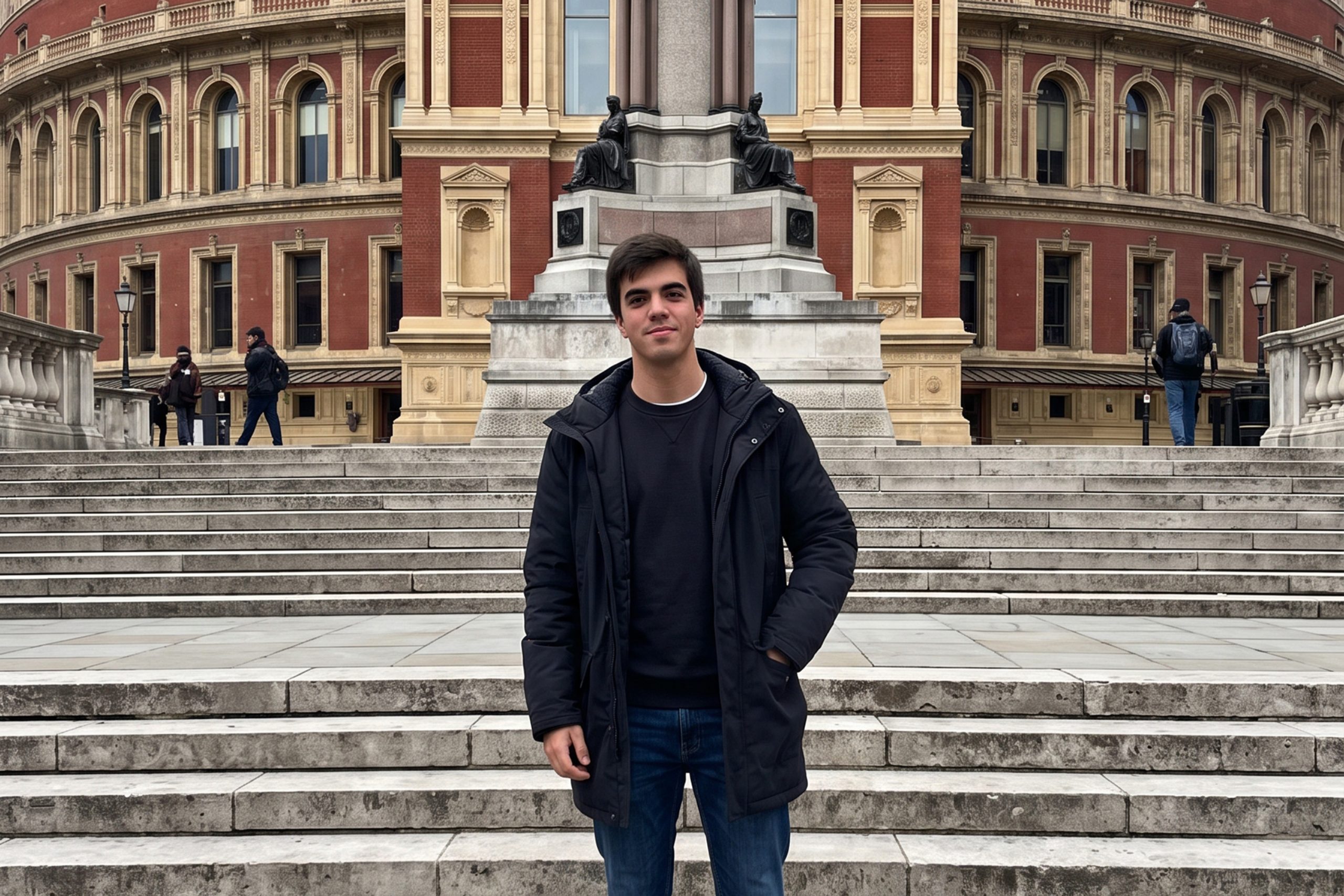
Juan A Trobajo Flecha recently completed the MSc in Advanced Aeronautical Engineering at the Department of Aeronautics, winning the MSc LincoTek Prize for the best MSc student. We spoke to Juan about his year at Imperial, including his MSc project and the next chapter of his career.
Could you briefly introduce yourself?
I’m an aerospace engineer from Oviedo, Spain. I studied Aerospace Engineering at Universidad Carlos III de Madrid, including an exchange year at Georgia Institute of Technology in Atlanta, where I researched propellant sloshing in launch vehicles. I then worked at Airbus Defence and Space on the environmental control system for a future military transport aircraft, where I carried out my final bachelor’s thesis. After the MSc at Imperial, I am now a PhD student at Georgia Tech, funded by a Fulbright grant. The constant throughout has been an enjoyment of learning and of solving hard problems.
Why did you apply for this MSc programme at the Department of Aeronautics at Imperial?
My goal is to contribute to the design of space access vehicles and propulsion systems in Europe, and eventually to return to academia. That path runs through a PhD, and I wanted a master’s that would give me the depth to choose a research direction well. Imperial’s programme allowed me to combine spacecraft propulsion, re-entry aerothermodynamics and spacecraft systems with core aeronautics, taught by people leading research in those areas, all within one of Europe’s strongest aerospace ecosystems. The Department of Aeronautics MSc scholarship, which covered my full tuition, together with the Rafael del Pino Foundation’s support for my living costs, made it possible.
Was there a particular moment or highlight of the programme that stuck with you?
The Aerothermodynamics of Launchers and Re-Entry Vehicles module, taught by Professor Paul Bruce. It made clear why hypersonic flight remains so difficult, from the flow physics to the challenge of reproducing those conditions on the ground, and it shaped how I think about the field. More broadly, what defined the year was being taught by lecturers who are leading researchers in the subjects they teach. Outside the curriculum, the Aeronautics Society’s weekly talks and events such as former Boeing CEO James McNerney’s visit to campus gave a valuable view of the industry.
Could you tell us about your MSc project?
My project, supervised by Professor Sylvain Laizet, assessed whether quantum algorithms can offer an advantage in solving the partial differential equations behind engineering simulation. It was not the topic I had aimed for: my focus was propulsion, and quantum computing was new to me. The scope of the project, however, allowed me to give it an engineering anchor. I chose the Poisson equation, which governs the electric field in Hall-effect thruster plasmas, and implemented and benchmarked HHL, VQLS and QSVT-based solvers in one, two and three dimensions against classical methods, using second- and fourth-order discretisation schemes. Learning the field from first principles, with Professor Laizet’s judicious guidance and considerable autonomy, changed how I understand computation and became one of the most formative parts of my training.
Quantum computing will not be the core of my PhD, but I presented the results at two symposia in the US this September, I am preparing a paper on the work, and I will keep following the field closely. The project introduced me to an area I knew little about, and with it a new range of possibilities for future research and career opportunities.
How did you feel when you learned you had been awarded the LincoTek Prize for the best MSc student, and what does this recognition mean to you?
It was a marvellous feeling: a sense of accomplishment and, above all, of duty fulfilled. The Department of Aeronautics covered my tuition and the Rafael del Pino Foundation my living costs, both based on my profile and the plan I set out before the year began. This prize is a way of showing them that their trust was well placed and that I made the most of the opportunity they gave me. I share it with Professor Laizet, my lecturers, my classmates and my family. It also comes at a crucial point, as a stepping stone into my PhD.
How has being part of Imperial supported your development as a researcher?
Above all, through its people. Learning from researchers at the frontier of their fields sharpened my own ambitions, and Professor Laizet’s supervision gave me the autonomy to frame a research question, choose the right test case, learn a new field and judge what counts as a meaningful result. That is the core of research, and I learnt it here.
I have now started a PhD in Aerospace Engineering at Georgia Tech, in Professor Sedina Tsikata’s group, where I am working on plasma physics for electric propulsion, the same family of systems my MSc thesis was anchored in. Alongside my first doctoral courses, I am preparing my MSc work for publication. In the long term, I aim to contribute to Europe’s space access and propulsion capabilities, and the future space economy in general. Eventually, I would aim to return to academia to push the boundaries of our knowledge and to teach the next generation of engineers.
What message would you like to share with young people looking to pursue a career in aeronautical engineering?
My advice would be to build a solid foundation across the fundamentals before specialising. Aerospace is a broad discipline, and aircraft, satellites and launchers alike only work because aerodynamics, structures, propulsion, control and many other areas fit together, so understanding how your part affects the rest is as valuable as depth in it. Stay open to topics outside your initial plan, as the field keeps absorbing new methods and tools; follow the maxim sapere aude (dare to know). Since it is also a field with little tolerance for error, rigour and the habit of checking things for yourself matter a great deal. And much of the work is done in large teams across organisations and countries, so the people you study with now are likely to be your colleagues later; those relationships are worth looking after.