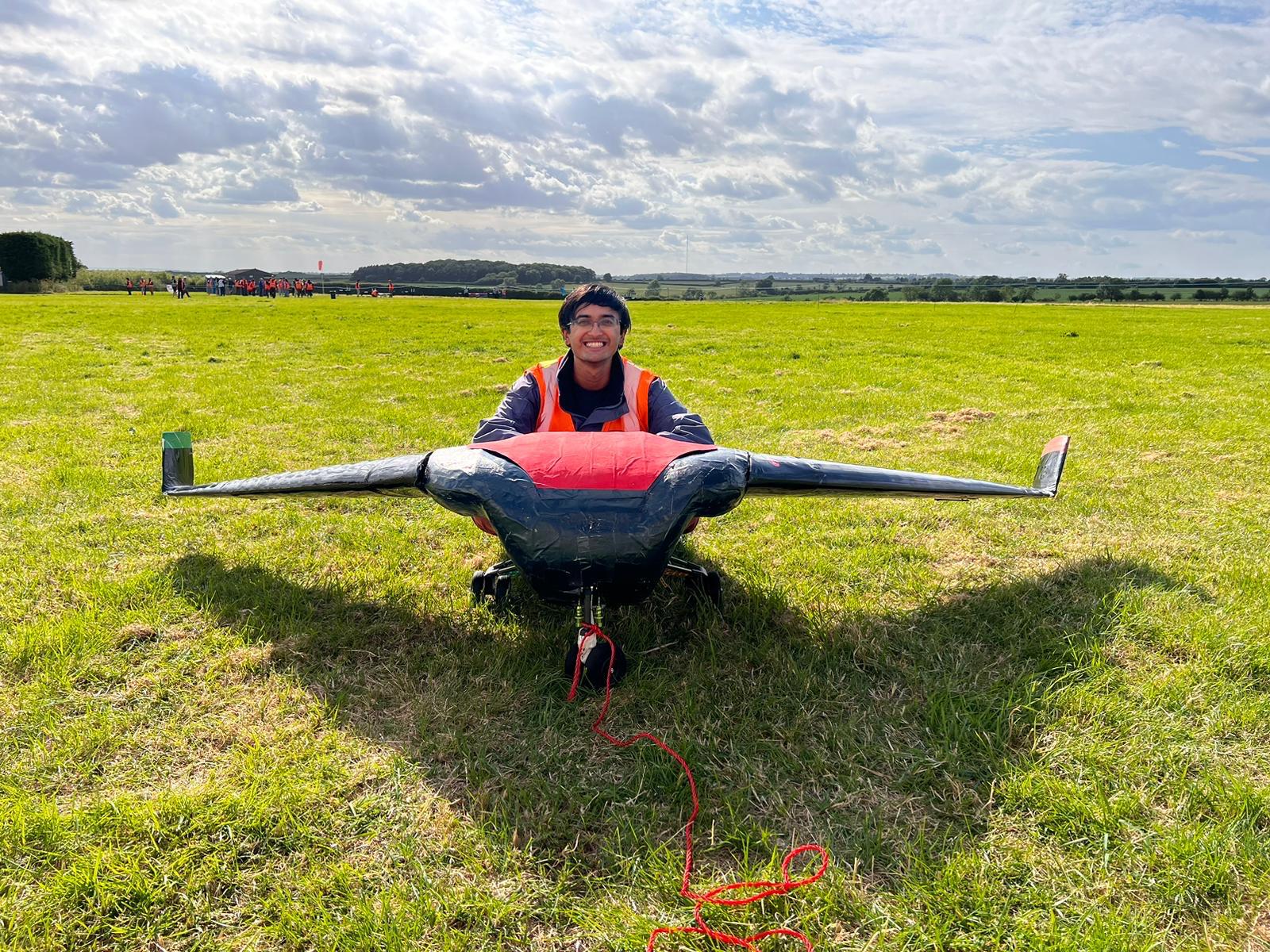
I’m Yash, a class of 2026 graduate from the MEng Aeronautical Engineering with a Year in Industry programme at Imperial College London. I’m a Singaporean who initially joined the course with the goal of learning how to design and build aircraft, but along the way my interests shifted to quite literally shoot for the stars. Now, I’m particularly interested in spacecraft propulsion, orbital mechanics, hypersonics, and computational aerodynamics, with the goal of a career in the space sector.
The interest in computational aerodynamics, in particular, was something that developed gradually in the degree throughout the first two years of the course. Coursework for aerodynamics as well as design work for the Imperial College Aerial Vehicle (ICAV) plane introduced me to Computational Fluid Dynamics (CFD) and I was keen to understand it more in an industrial context. Hence, when I got the opportunity to join Ansys for a year in industry, I gladly accepted. As a Fluids R&D Verification Engineer Intern, I worked on validating CFD tools and ensuring software robustness. This involved simulating a range of aerodynamic, thermofluid, and fluid-structure problems within Ansys products such as Fluent, CFX, and Polyflow and analysing solver behaviour for defects.
Some of my most interesting work was in supporting the development and testing of PyFluent as well as investigating more niche applications of Fluent such as magnetohydrodynamics and chemical reaction modelling. The placement gave me a much deeper understanding of both the capabilities and limitations of industrial CFD tools, while also exposing me to software development practices, version control, and the wider engineering ecosystem at Ansys such as structural simulations. Overall, the experience broadened my perspective on engineering beyond university and strengthened my interest in technically challenging work within the aerospace sector.
Outside of academics and industry, a significant part of my Imperial experience also came through my involvement in student societies. It’s fair to say that I’ve been quite around the block, being involved in a wide range of societies including the Aeronautical Society, Imperial College Aerial Vehicle (ICAV), Imperial Floorball, and Singapore Society. When I was choosing what societies to join, I was intentionally looking to balance different aspects of university life: technical, professional, cultural, sporting, or simply social. Through these societies, I was fortunate to take on a variety of leadership roles, serving as President and Industry Liaison Officer for AeroSoc, Project Lead and Aerodynamics Lead for ICAV, and Treasurer for both Singapore Society and Floorball Club. Each society offered a different perspective on university life and helped me develop in different ways.
As President of AeroSoc, I was able to connect with people in the industry to learn more about their work and gain advice for my own university journey while bringing industrial talks to students. Within ICAV, I worked on aircraft design for both a blended-wing body and a tilt-rotor aircraft, attending the IMechE UAS challenge twice. Meanwhile, Singapore Society and Floorball gave me the chance to engage with different communities across Imperial, from organising large-scale student events and managing society finances to competing in the university floorball league, where our team won the championship three years in a row. Looking back, these experiences added a strong social dimension to my time at Imperial. While juggling committee responsibilities, technical projects, sports, and coursework could be challenging at times, it ultimately taught me how to organise my time effectively and make the most of everything Imperial has to offer.
Since graduating from Imperial, I have joined a startup in the space sector. In a way, its exactly what I was hoping to achieve towards the end of my degree. Although I had initially come to Imperial wanting to design aircraft, the exposure to space-related modules in the course along with Project Svarog with the Space Society and an internship at Space Forge drew me closer to the space sector itself. I’m excited to be working in a field where I can directly translate my academic, technical, and project management skills within a challenging engineering environment. Given how quickly the industry is evolving, I’m looking forward to where the journey takes me and what role I can play in shaping the future of space technology.
Which leaves me with a final piece of advice for any student considering Imperial, and university in general: be fearless, be adaptable. University is about trying new things and pushing yourself beyond what you think you’re capable of. While academics are a key part of that journey, don’t be afraid to explore beyond too! Join that society, take charge of that project, ask about a professor’s research, or simply try something that interests you. Some of the most valuable experiences and friendships can come from unexpected places when you step outside your comfort zone. Sometimes you’ll discover something you never knew you would love. Other times, you’ll decide it’s not for you. But if you don’t take the chance, you’ll never know. University offers an incredible range of opportunities, so pick those that excite you and make the most of them. They can be just as important as what you learn in the classroom.