Essay Competition winners: The future of flight in 2055
We are delighted to announce the winners of the Brahmal Vasudevan Institute for Sustainable Aviation Essay Competition, The future of flight: imagining aviation in 2055.
The competition attracted many high‑quality submissions, each exploring how aviation might evolve in response to climate change, new technologies and policy pressures. As a result, selecting the winners was a challenging task! We thank everyone who took part. The competition was judged by Prof Denis Doorly from the Department of Aeronautics and Ruby Wlaschin, Coordinator of the Brahmal Institute. The three winning essays and author biographies are shared below.
First place: Toby Bryce-Smith
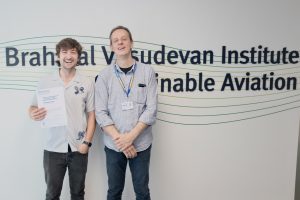
Toby Bryce-Smith is in the final year of his PhD at Imperial. He is supervised by Kostas Steiros, Oliver Buxton and George Papadakis. His research is conducted in partnership with ZeroAvia.
His work focuses on the cooling challenges associated with retrofitting hydrogen‑electric powertrains onto turboprop aircraft. So far, he has carried out particle image velocimetry experiments to study how propeller wake structures interact with enlarged cooling ducts. In the final stage of the project, he is combining experimental results with computational fluid dynamics. Together, this work aims to improve cooling efficiency while reducing parasitic drag.
In his winning essay, Toby presented aviation history as a series of cycles of divergence and convergence. He began with the 1909 Reims air races and contrasted this period with the Jet Age, which converged on the tube‑and‑wing aircraft. However, he argued that the Sustainability Era reopens the design space due to climate policy and regulation. By 2055, he predicted clustered outcomes. These include standardised long‑haul aviation, regionally divergent short‑haul systems and fragmented urban air mobility shaped by local constraints.
Second place: Tanay Gopal
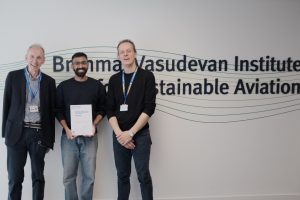
Tanay Gopal is an MSc Advanced Aeronautical Engineering student at Imperial. He works under the supervision of Dr Rhea P. Liem. His MSc research focuses on climate‑constrained aviation and network resilience.
Specifically, Tanay models how contrail‑avoidance policies could affect the structure and capacity of the European air transport network. He uses tools from statistical physics to explore these impacts. At the same time, he maintains a strong interest in sustainable engineering and zero‑emission flight.
Tanay’s essay imagines a future in which aviation decarbonisation is driven by system‑level change rather than entirely new aircraft. He identified three key pathways. These include hydrogen corridors at major hubs, mid‑life aircraft retrofits for regional fleets and climate‑optimised operations. Together, these measures lead to meaningful progress. However, progress is uneven, with advanced regions decarbonising more quickly than others.
Third place: Adrian Fok
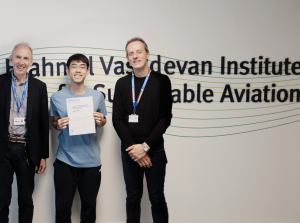
Adrian Fok is a final‑year Aeronautical Engineering undergraduate at Imperial. He is completing his final‑year project on control strategies for anaesthesia processes, supervised by Dr Thulasi Mylvaganam. Outside his studies, he builds drones, captains the ICSM Water Polo First Team and competes in orienteering.
Adrian’s essay argues that sustainable aviation by 2055 will not result from a single breakthrough. Instead, it will depend on coordinated advances across fuels, aircraft design and operations. He suggested that SAFs, hydrogen and battery‑electric propulsion each offer partial solutions. Therefore, hybrid propulsion systems and unconventional aircraft designs are likely to emerge. In addition, he highlighted the importance of materials innovation, manufacturing methods and operational efficiency. He also considered the wider impacts on jobs, costs and infrastructure.
We congratulate all three winners and thank everyone who contributed to the competition. Their essays reflect the depth of thinking and creativity across our community as we work towards a more sustainable future for aviation.