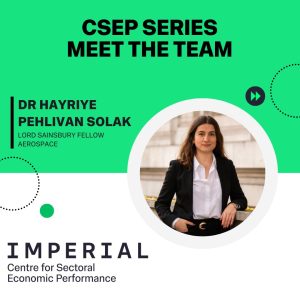
 Could you briefly introduce your background and career to date?
I am a Naval Architect and Marine Engineer with a strong passion for hydrodynamic design optimization. My journey began at Istanbul Technical University (ITU), where I focused on enhancing energy efficiency and sustainability of vehicles in various domains. Before joining Imperial College London, I taught at Piri Reis University and completed two postdoctoral research projects at ITU and École Centrale de Nantes, developing computational frameworks for design optimization and engaging in multinational research efforts. Currently, I am involved in a joint project with CSEP and Brahmal Institute of Sustainable Aviation to further develop my skills while working towards a more sustainable future of aerospace.
How does your work align with CSEP’s mission to support economic growth and long-term competitiveness?
At CSEP, I am responsible for conducting a comprehensive and evidence-based assessment of the UK aerospace sector, focusing specifically on the design, development and implementation of advanced, fuel-efficient aircraft technologies and operations. This assessment aims to provide actionable recommendations regarding the impact of these elements on the UK’s competitiveness and the potential for innovation within the industry. This focus is particularly crucial given the significant technological advancements required by the ambitious UK Jet-Zero strategy and international roadmaps aimed at achieving decarbonized and sustainable aviation. CSEP’s mission centres on identifying strategies to promote economic growth while maintaining the UK’s competitiveness. The fact that the aerospace sector is technology-driven, coupled with the presence of world-leading industrial players in the UK, underscores the importance of the sectoral review currently being conducted at CSEP.
What part of your current research do you find most inspiring, and why?
As a member of a multinational research team, I focused on developing fundamental mathematical frameworks and computational methods to enhance the simulation-based optimization of vehicle designs, aiming to reduce their environmental impact. To speed up the optimization process, we are improving uncertainty estimation, which enables more reliable decision-making in assigning the next candidate and helps identify the most promising solutions more efficiently. This improvement is essential for an efficient design optimization, especially when working with limited, computationally expensive and inherently noisy data. It is inspiring to see how closely the theory aligns with expectations and how it contributes to the project compared to earlier versions. Each step generates new questions to explore, fuelling my passion for discovering more advanced solutions.
What do you enjoy doing outside of work to relax and reset?
Definitely painting! Painting is a way of locating your identity in the universe, thinking, speaking and understanding through the endless layers of shapes and colours. It becomes a philosophical exploration, connecting us to broader questions of existence. It is like digging to find what you would like to see or what you are escaping from, without knowing where this ambivalent cycle will end each time. You begin with uncertainty—since you can’t predict what each session will reveal—but you possess a strong desire to explore. Through trials and challenges, this desire evolves into something unforeseen, which remains a mystery even to you, much like the journey of life itself.