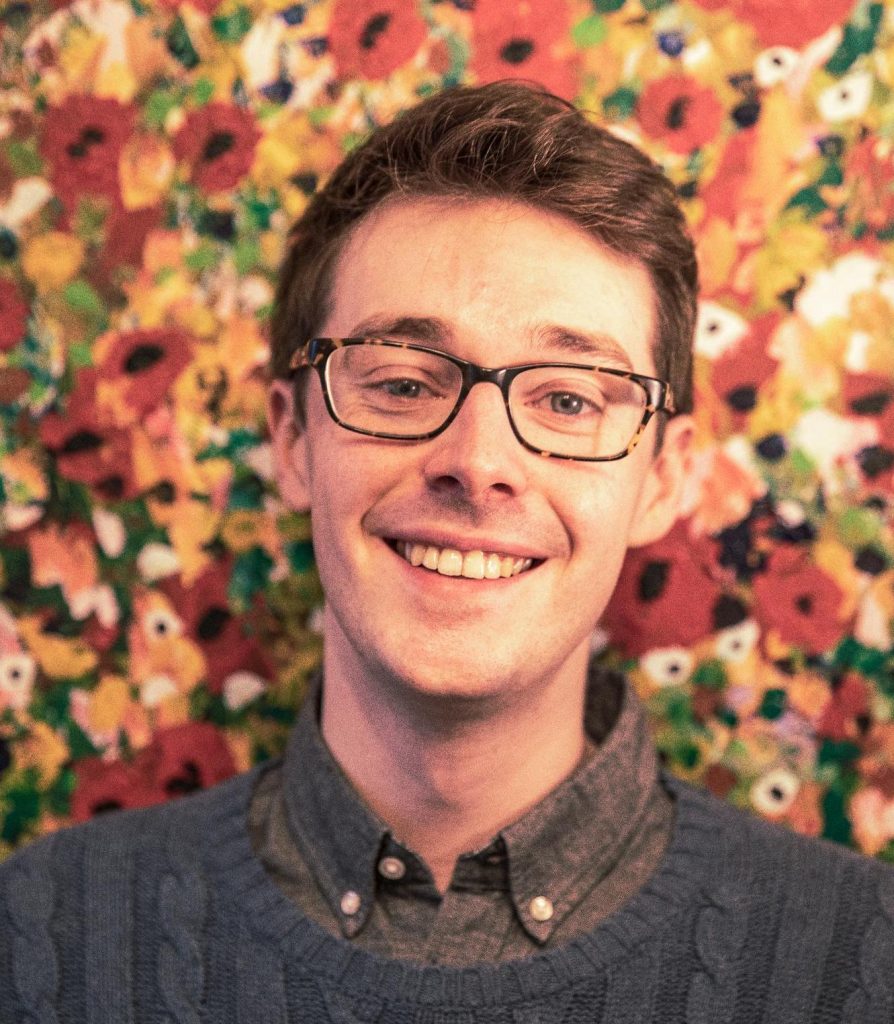
In this Q&A, Dr Calum Gabbutt discusses his journey from physics to cancer research, and how mathematical modelling and machine learning can be combined to better understand cancer evolution. He shares insights into his research as well as his ambitions to improve early prediction of treatment outcomes in blood cancers.
Tell us about your background and how you came to Imperial.
I started with a quantitative background with a physics degree at Oxford. During that, I realised that everyone in the programme had basically done the same A-levels, the same courses, and thought about problems in very similar ways. That made me wonder whether there were other directions I could take.
I moved into biophysics, which sits at the interface between physics and biology, and I found that really interesting. That was when I thought, “OK, biology is probably the way to go.”
For my PhD, I joined a cross-London interdisciplinary programme and rotated through different labs. I was always drawn towards cancer projects, partly because of personal experience. I joined Trevor Graham’s group, working on computational genomics and cancer evolution, and very quickly realised, “This is it. I’ve found the niche.”
After my PhD, I moved with the lab to the Institute of Cancer Research for a postdoctoral position. Later, as I became more interested in machine learning , I became a Schmidt AI in Science Fellow in the maths department at Imperial. It was great being exposed to lots of different disciplines, but after working in biologically focused institutes, being back in a maths department felt a bit strange.
So, I started looking roles where I could combine both. I connected with colleagues here, applied for a role in the Centre for Haematology, and it felt like a perfect fit for my background and skills.
Your work sits between disciplines. How would you explain what you do?
In terms of concrete physics knowledge, electromagnetism, quantum mechanics, none of that really comes up directly. What does come up all the time is the mathematical grounding and the ability to build models.
But more importantly, it’s the physicist’s way of thinking. Physics is inherently reductionist; you try to take a complicated problem and simplify it into something you can model. That model will probably be wrong, but it might be wrong in an interesting way. By iterating, you learn about the key features of the system.
That way of thinking is what I bring into biology.
Can you give an example of a project that illustrates this approach?
During my PhD, I worked on DNA methylation as a lineage marker. Instead of focusing on how methylation switches genes on or off, we used it to understand how cells are related to each other over time, essentially reconstructing their evolutionary history.
Cancer is an evolutionary disease, so understanding how cells evolve within a tumour is really important. Traditionally, people use DNA mutations for this, but those occur relatively rarely. Methylation changes happen much more frequently, which gives you a richer signal.
We developed a simplified mathematical model with a small number of parameters, things like how fast the cancer is growing or how old it is, and fitted that to patient data. We applied this across around 2,000 lymphoid cancer samples.
What was exciting was that we could distinguish between cancers growing rapidly and those growing slowly. When we compared our results with clinical outcomes, the stratification was incredibly strong. That was a moment where we thought, “OK, this really works.”
How do you see AI and mathematical modelling shaping healthcare?
It’s helpful to think about how mathematical modelling and machine learning are similar and different.
With mathematical modelling, you reduce complex data into a few interpretable parameters. With machine learning, particularly neural networks, the model must learn those structures directly from huge amounts of data.
That’s why big datasets are so important for AI, but not everyone has access to that scale. That’s where modelling is still very powerful.
What’s exciting is combining the two. You can use neural networks as function approximators within a modelling framework, what’s sometimes called simulation-based inference. You simulate a system, train a network to learn its behaviour, and then use that trained model to make fast predictions.
There’s a lot of hype around AI. What are the challenges in applying it to healthcare?
A big issue is interpretability or understanding what the model is actually learning.
There’s a good example of this from COVID. Many AI models claimed to diagnose severe COVID from CT scans. But when people carefully evaluated them, most didn’t work. Some models were actually picking up whether a patient was lying down in the scan, or which hospital they were in, rather than whether they had COVID.
In some cases, the model was effectively learning “Is this a child?” rather than anything clinically meaningful.
So while these tools are powerful, we have to be careful. That’s why combining them with interpretable models is important, so we can check that the model is learning the right thing.
What are you hoping to achieve in your research at Imperial?
Broadly, I want to develop methods to understand how cancers evolve, and use that to predict how they might evolve in the future.
One area I’m particularly interested in is applying these ideas to CAR T-cell therapy. It’s been very successful for some blood cancers, but it still fails in about 50% of cases.
The question is: can we predict that failure early? Instead of waiting a year to see whether a treatment works, could we analyse samples within the first week and predict the outcome?
And beyond that, could we understand why it might fail, and use that to guide the next treatment?
More generally, the tools we’re developing aren’t limited to cancer. They apply to any system where the relationships between cells matter – essentially any system with an evolutionary structure.
What are your hobbies outside of work?
I’m probably quite stereotypical for someone with a physics background. I love sci-fi books and films, board games, and things like Dungeons & Dragons.
I also really enjoy cooking. For me, cooking for people is one of the nicest ways to build community and friendships. There’s nothing better than having friends over, cooking dinner, and then playing a board game.
Is there anything else you would like colleagues to know?
I think the work I do, mathematical modelling, cancer genomics, lineage tracing, that’s where my expertise sits. But the reason projects succeed is through collaboration, especially with people who really understand the biology.
So, if anyone is working on problems related to cancer evolution, or more generally how cells relate to each other, I’d be very happy to chat.
I think there’s a lot of interesting space not just in understanding specific mechanisms, but in asking broader questions: is resistance driven by genetic evolution, phenotypic plasticity, or a combination of both?
If evolution is part of the question, then that’s where I’d love to collaborate.