Author and study lead: Dr. Vijesh Bhute
As part of the Royal Society of Chemistry Inclusion and Diversity fund, Dr. Vijesh Bhute conducted in-depth interviews with neurodivergent students as part of the study titled “Neurodivergence through the lens of Neurodivergent university students”. A zine has been designed by Maya Cracknell to capture key information from this project in order to raise awareness about neurodiversity.
This article is aimed to highlight some of the key findings from this study.
Disclaimer: The findings are purely based on interviews with neurodivergent students (N=17). They are based on individual lived experiences and are not supposed to represent views of all neurodivergent individuals. Each lived experience is unique and it may not be the same as those presented here.
Background on Neurodiversity:
We are all different. In appearance, in experiences, and also, the way we process information. Neurodiversity is based on the concept that neurological variations should be recognised and respected just like any other human variation, such as gender, race or sexual orientation.
Objective of study:
- To learn about neurodivergence from lived experiences of neurodivergent university students
- To raise awareness about neurodiversity
Method:
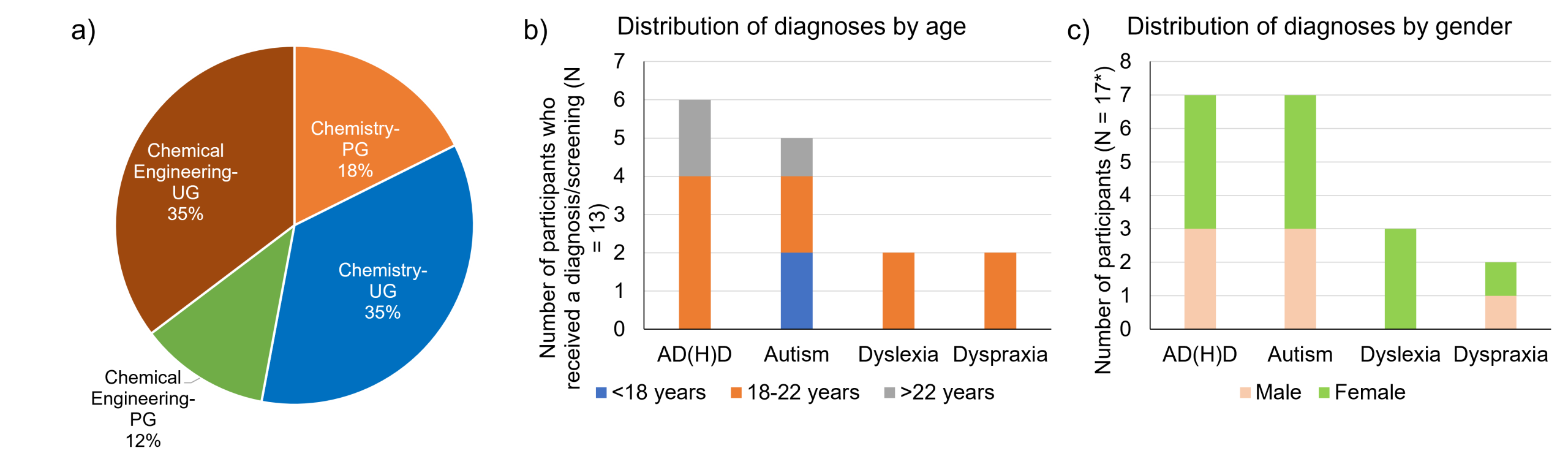
- I interviewed 17 neurodivergent students from Chemical Engineering (N=8) and Chemistry (N=9) department including undergraduate (N=12) and postgraduate students (N=5). (See Figure 1 for distribution of participants by gender, neurotype, and age of diagnosis).
- Hour long interviews were conducted via MS Teams or in-person (recorded via MS Teams for transcription purposes) and textual analysis was performed using Braun and Clarke’s Thematic Analysis method
- 4 main themes were discussed: Diagnosis/Screening, Neurodivergent experiences, University life, and Recommendations
Diagnosis/Screening – Key takeaways
- Majority (15/17) students received diagnosis/assessment after starting university
- Dyslexic students reported to have received support without the diagnosis which helped them through their primary and secondary education.
“In primary school I was offered intervention for English and not everyone had this opportunity, …I think it was helpful and I’m glad I got those support ” – 2893
- Long wait times and misconceptions can be a major obstacle to get a diagnosis through NHS.
“On waiting list for NHS (1 year+).” – 6806
“I did seek the diagnosis last year when I was 27, but my psychiatrist at the time told me you wouldn’t be doing a PhD if you had ADHD” – 2648
“Went to the GP and discussed all the characteristics but GP said it is not a positive diagnostic” – 5332
“The natural response for people was like, are you sure you have ADHD, like you’ve been doing well academically? People usually suffer more.” – 3076
- Lack of self awareness can lead to a lot of negative emotions
“I feel like my hearing is bad, but then I think maybe it’s just my concentration that is not that great because I have to ask people a lot of times to repeat themselves. I feel quite bad about it. I feel like I’m annoying people with it.” – 4668
“I started being very anxious, very rigid because I saw there was something wrong with me. I was like, you’re just lazy and you do this all the time.” – 2648
“Up until like nearly 2021 or 2022, I didn’t know that what I was suffering from was this executive dysfunction where I as much as I wanted to do something I wasn’t able to do. I mislabelled it as procrastination, which is why I had that much self hatred for myself because I thought I was lazy.” – 6696
- Students report to have significant positive impact post-diagnosis/screening
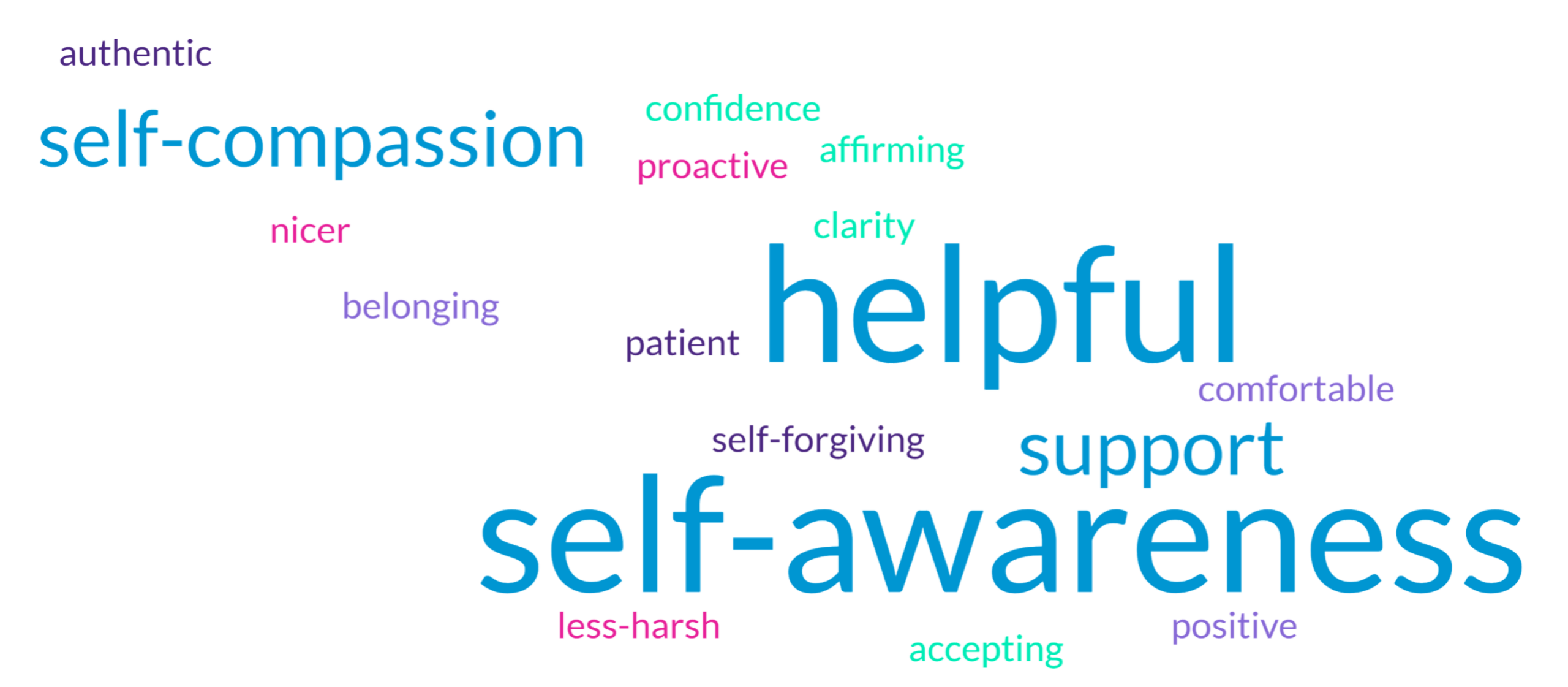
“Overall, I am more patient with myself when I find certain things hard, and I allow myself more down time to recover…. With an official diagnosis I feel like I can be more myself. ” – 1725
“I recommend it because for me a lot of things made sense. Umm, big parts of my life made sense and it wasn’t tied to my self-esteem anymore. Umm, it was tied to my brain chemistry.
And it’s not a fault. It’s the way it is, and while I may be embarrassed about some things and not very happy with them, now I know that I can work on that. Umm it also allowed me to talk to more people that have it. And that makes me feel like a part of something.” – 3009
This link provides details about screening and assessments offered by Imperial’s Disability Advisory Services for specific learning differences (ADHD, Dyslexia, Dyspraxia) and autism: DAS Imperial
Theme 2: Neurodivergent experiences – Key takeaways
ADHD
- They can be high achievers, but it comes at a cost
- Burnout is very common among these students
- Motivation is essential for focus and prioritising tasks
- External accountability can help with staying organised (Body doubling can help)
Autism
- Like structure, routine and clarity
- Some like to socialise (can take effort)
- Lighting and environment in certain venues can make learning challenging
Theme 3: University Life – Key takeaways
- Timed summative assessments don’t allow ND students to show their learning effectively
“I found it really hard to process information under pressure even if it was questions that I would otherwise know how to answer. … it just makes my brain go foggy and cannot think properly” – 8874
“Can be stressful and fixate on the same question.” – 3076
“I find exams difficult just because of how I find it very difficult to sit in one place for three hours and you know because of my extra extensions like a 3 hour exam becomes nearly a four and 1/2 hour exam where I’m sitting in that chair even with the rest breaks. … my grades don’t necessarily reflect my passion for certain subjects …” – 6696
- Group projects with large groups and expectation to work in the same room can be challenging
“I cannot work in a group when there’s other people in the room… it’s overstimulating like it tires me down to be in the room with like 10 people.” – 3076
“If I’m ever in like a group environment and say like, they want to do the lab report, but sitting in a group, I can’t do it. There’s, like, too much going on… I like collaboration. Maybe not like group work. Like I like like working with other people. But I don’t want to be sitting with them constantly” – 5332
“I struggled with a lot with the design projects because the groups were larger, and they required many hours of continuously working with other people.” – 1725
“It would have made it easier for me that I would have felt like more OK with just taking more breaks.” – 5650
Theme 4: Recommendations – Key takeaways
Advice for everyone
“There is a mindset, like if somebody’s doing well, it means that they are, you know, managing everything well. But actually, that may not always be the case.” – 3076
“Have patience. Some might need another approach of explanations or just more repetition.” – 4668
“It’s always good to educate yourself. If you’ve not been diagnosed, it can be really unhelpful to use terms or diagnoses in a joking way.” – 6806
“I think people struggle with talking about disability in general case. They don’t know what they’re they are not allowed to say. It’s just a part of someone’s person.
Another characteristic that doesn’t define that, but it’s part of them kind of thing. …Don’t judge characteristics that you know indicative of a disability, but don’t pretend that they’re not disabled because it’s almost more offensive to be like, you know, just kind of ignore this whole part of you. …
Because there’s a lot of masking which goes on normally, it’s difficult for them to be aware about things. So it’s good to actually see and normalize it a bit and having more conversation. I think that’s quite important as well for awareness.” – 8569
Advice for staff, teachers, and university
“It helps if the meetings are recorded because then I know that I can go back to it.” – 2648
“More signposting and more quiet spaces on campus. Better (compulsory) education for everyone about different conditions ” – 5650
“Make screenings more accessible/advertised for students, especially when they start university” – 8874
“While most neurodiverse people may have a rough idea of what accommodations may work for them, it would be great for the department to have a list of possible accommodations available, while stating clearly that any additional accommodations can be arranged, because that reduces the mental labour for each individual and builds on all accommodations made in the past.
… when asking about accommodations, all the (limited) systems and understanding in place were only for undergraduates (or taught courses), completely ignoring a large cohort of research students.” – 1725
Advice for other neurodivergent students
“I guess my key advice is don’t be too hard on yourself. Umm, definitely find the space to give yourself some grace and time to figure things out and what works best for them as individual and not all advice will work for them” – 6806
Advice for autistic individuals
- Use noise-cancelling headphones
- Use apps (Goblin tools) to check tones in messages
Advice for ADHD individuals
- Use agendas, calendars and shared calendars
- Take notes (whenever possible)
- Ask for deadlines
- Find ways to make learning more interesting
- Pomodoro technique for studying (25 minute study-5 minute break cycles)
- Reduce distractions and lower barriers to action
- Have specific places to keep specific things
- Body double (FLOWN partnership with Imperial College London)
- Wellbeing tip: Exercise regularly
Helpful resources
- National Autistic Society
- Embrace Autism | The ultimate autism resource
- NHS (Signs of autism in adults – NHS)
- BBC Two – Inside Our Minds
- Neurodiversity Zine created by Maya Cracknell for this project can be found here: Neurodiversity at University Zine-Vijesh Bhute_Maya Cracknell_RSC.pdf (If you don’t have access to this link, e.g., external to Imperial, please email v.bhute@imperial.ac.uk and I will send you this file).
Acknowledgement
This work is supported financially through the Royal Society of Chemistry Inclusion and Diversity Fund. The views expressed herein do not necessarily reflect those of the RSC.
Would you like to discuss more about this work? Please get in touch with Dr. Vijesh Bhute (email v.bhute@imperial.ac.uk).