How a London doctor helped to change abortion law in Britain
Dr Adrian Raby, Senior Lecturer in Law and Ethics, discusses a 1938 case that changed the course of abortion law in Britain.
Content note: This blog post discusses sexual violence and rape.

Do you ever wonder about the lives of people who have hospital wards or lecture theatres named after them? Having trained at St Mary’s Hospital Medical School, and later worked as a Senior House Officer (SHO) in obstetrics and gynaecology, I would often pass or see patients on Aleck Bourne ward without giving it much thought. When I studied medical law in 2004, however, his name was mentioned in a class, and I became fascinated by the story that led to his recognition.
On 27 April 1938, Nellie, a 14-year-old girl, was walking near the Horse Guards barracks in central London, when she was asked by one of the Guardsmen if she wanted to come inside to see a horse with a green tail. Having innocently accepted the invitation, she was violently raped by several soldiers, and became pregnant. The law at this time did not permit abortion except in cases where it was necessary “for the purpose only of saving the life of the mother”. The potential penalty for performing an abortion was penal servitude for life.
Mr Aleck Bourne, a gynaecologist, was contacted about Nellie’s case by Dr Joan Mallison. Dr Mallison was a pioneer in the field of family planning, instrumental in setting up the Family Planning Association, and a supporter of abortion law reform. She wrote to Mr Bourne asking if he would perform a termination of pregnancy.
Despite the harsh penalty for performing an unlawful abortion, Aleck Bourne agreed. He did not wish to do so under hushed secrecy but told Dr Mallison, “I have said that next time I have the opportunity I would write to the Attorney General and invite him to take action.” The abortion took place at 10:00AM on 14 June. After carrying out the abortion, two police officers arrived and informed Bourne that under no circumstances should he perform such a procedure. His response was that it was not for the police to decide what was in the best interests of his patient. Mr Bourne was committed to trial at the Old Bailey.
The trial that ensued was to change the course of abortion law in the UK. Justice Macnaghten told the jury that they were entitled to take a broad view of the words “preserving the life of the mother”, going beyond immediate risk to life and including mental and physical suffering. The jury acquitted Mr Bourne, and in doing so changed the course of abortion law in the UK, leading to legal reform and the introduction of the Abortion Act 1967.
What Aleck Bourne had done was arguably a courageous act, born out of a moral conviction that what he was doing was ultimately right: saving a girl from further suffering in having to endure a pregnancy resulting from rape. In his own words,
“I myself never felt an atom of fear because of the inner conviction that I had done right…”
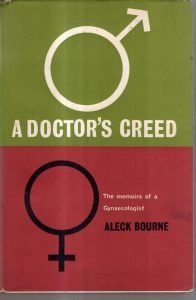
He writes about his experience of the trial, his life as a gynaecologist, and his thoughts on medical education (including the key role of the Humanities), in his 1962 memoir A Doctor’s Creed: The Memoirs of a Gynaecologist.
I use Nellie’s and Bourne’s story as a case study in an Introduction to Law session in the BSc in Humanities, Philosophy & Law, and will be giving away a copy of Bourne’s book in the session this year.

Dr Adrian Raby is a Senior Lecturer in Medical Law and Ethics, and the lead for law teaching in the BSc in Humanities, Philosophy & Law.