Author: Jess Money

5 ways to make your webpages more sustainable

Want to learn how you can make a positive impact as a web editor? Check out our 5 practical ways to reduce unnecessary resource use and support a more efficient user journey.  

5 ways to make your webpages more sustainable 

  1. Delete outdated content: And also set up regular reviews to remove content and pages that no longer serve a purpose. Use the web sustainability content checklist to help you review your content. 
  2. Optimise content: Keep pages short and purposeful with concise text. You can read the writing for the web guide here: Writing for the web.   
  3. Optimise images: Use lighter image formats like JPG rather than PNG and reduce file size as much as possible. A good size to aim for is around 300KB, and no larger than 2MB. You can use a free, open-source software like BeFunky to convert or scale your images.    
  4. Avoid auto-playing videos: Giving users the ability to choose when to play a video helps ensure meaningful engagement, and also reduces the energy needed to run the page. You can read further guidance on embedding videos on the Creating accessible video and audio webpage. 
  5. Improve navigation so information is easier to find: This should result in fewer clicks (fewer emissions from page loads) and less time searching (less energy consumed by the user’s device). For example, you can learn more about adding accessible links to ensure your links help guide the user to where they want to go.  

You can identify areas for improvement by using a tool such as Website Carbon or Ecograder which can provide a sustainability rating for each webpage. After making improvements, you can then retest the page and report on the carbon emissions saved per page load.   

For further guidance you can read the full Web Sustainability Guidelines (WSG) developed by Centre for Environmental Policy students and the digital team, adapted from the World Wide Web Consortium’s (W3C) WSG.

Yunxi Shen, MSc Environmental Technology, one of the students that worked on the project, shares the importance of sustainable web design: ‘Improving the sustainability of our web content not only reduces unnecessary energy use and emissions, but also has several co-benefits, such as improving user-experience, accessibility, and site performance. While the carbon footprint of individual webpages may seem small, this compounds across Imperial’s entire digital estate and the page views it serves.’ 

This set of guidelines also forms part of Imperial’s sustainable communications guidelines, and is part of Imperial’s wider strategy and ongoing efforts to address the challenges of climate change, biodiversity loss and pollution.  

Sustainable Imperial case study 

This year the Sustainable Imperial website was redesigned to align with the new Sustainable Imperial Strategy 2026-2031 and demonstrate application of the WSG. Using page load emissions ratings from the Website Carbon tool, the team calculated that the maximum emissions per page load for the Sustainable Imperial website was previously 1.03 g CO2 and after applying WSG all pages are now under 0.3 g CO2, a 70% difference. The estimated yearly carbon saving from the website changes is 8.18kg CO2, which is as much CO2 as boiling water for 1109 cups of tea! 

Have a go at applying WSG to your pages and see how much you can save! 
Why Veganuary no longer feels like a commitment

By Priyal Pajwani (Sustainable Imperial Student Ambassador)

Veganuary did not arrive on campus as a dramatic lifestyle overhaul. There were no manifestos, no rigid rules, and very little label wearing. Instead, it showed up quietly, in defaults, conveniences, and small decisions repeated often enough to matter. In London in 2026, plant-based living among students looks less like commitment and more like optimisation. 

What changed since 2020? 

Five years ago, Veganuary was framed as a challenge. You tried, you tracked, and you either completed it or you didn’t. That framing now feels slightly out of step with how students actually live. 

For students in London, particularly in a city shaped by costofliving pressure, time scarcity, and constant movement, everyday choices are increasingly shaped by friction rather than ideology. The question is no longer should I eat plant-based? but is the plant-based option already there, affordable, and easy? When the answer is yes, behaviour tends to follow without much deliberation. Most days, this just means ordering whatever’s available between lectures, rather than planning meals in advance. 

From micro switches to meals 

What’s striking about student lifestyles in 2026 is that sustainability rarely begins with food.

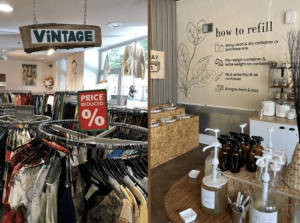
It usually stPhoto of vintage clothing store and refill shop. arts elsewhere, through small, practical adjustments that don’t feel like lifestyle changes at all. 

Before food even comes into it, students are switching to vegan skincare because ingredient lists are easier to understand and prices are competitive. At the same time, second hand fashion has become a rational response to inflated retail costs rather than a stylistic statement. Refill culture, whether for cleaning products or personal care, fits naturally into routines shaped by reuse rather than replacement. 

Once these micro switches feel normal, food choices tend to follow the same logic. If sustainability already exists on your bathroom shelf or in your wardrobe, extending it to your plate feels less like a leap and more like continuity. Veganuary, in that sense, stops feeling like something separate.

Plant-based does not mean expensive

One of the most persistent myths around Veganuary is cost. In reality, for many students, plant-based eating aligns closely with budget conscious living. 

Some of the most affordable meals in the city, from global street food to supermarket staples, are already plantbased by default. Hidden across London are low cost vegan options that prioritise volume and flavour over branding. These meals are filling, familiar, and available, which makes them reliable options rather than deliberate choices.  

On campus, this logic increasingly applies as well. When plant-based options are integrated into standard menus rather than positioned as premium alternatives, cost stops being the main point of comparison. Eating plantbased becomes less about sacrifice and more about sensible spending. 

Designing for better choices 

None of this is especially surprising when you think about how students make decisions day to day.

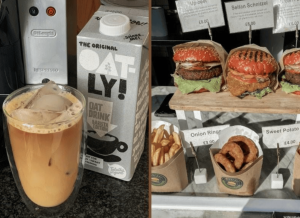
MoPhoto of plant-based milk and foodst of the time, people go with whatever feels easiest and least noticeable in the moment, especially when everyone else is doing the same. 

Defaults play a big role here. When plant milk is already the standard option rather than the exception, choosing it doesn’t feel like a decision at all. The same goes for price, when plant-based meals are priced in line with everything else, there’s nothing to weigh up. 

One example of this on South Kensington Campus is the reusable cup trial at The Roastery. Single use cups aren’t available there anymore, so students either use a ceramic mug to drink in, bring their own reusable cup, or grab a reusable one with a refundable deposit. For most people, it’s just part of buying a coffee. You queue, pick a cup, and head off to your next thing. 

Why these small shifts matter at scale 

While none of these choices are transformative in isolation, their significance lies in how they scale. When large institutions and dense urban populations normalise low impact defaults, from plant-based meals to reuse systems, demand patterns begin to shift in ways that supply chains respond to. This is where everyday habits start to overlap with research, policy, and infrastructure, even if most people aren’t thinking about it that way. 

Reductions in resource use, lower packaging waste, and decreased reliance on animal intensive production systems tend to follow when lower impact options become the standard rather than the exception. Animal welfare, environmental impact, and waste reduction are often discussed separately, but in practice they are shaped by the same mechanisms: how much is consumed, how it’s produced, and what’s incentivised. Small, repeatable changes create space for those systems to adjust over time. 

Veganuary as a mindset, not a deadline 

Seen this way, Veganuary in 2026 no longer needs to be confined to January. It does not need tracking apps, strict rules, or a sense of completion. Instead, it works more as a prompt, a moment to notice how many plant based choices already exist in daily routines, and how easily they can be extended. 

For students, this shift feels realistic. It acknowledges financial constraints, recognises time pressure, and accepts that most people are balancing multiple priorities at once. Veganuary stops being about proving commitment and starts looking more like a collection of small, well designed choices, repeated quietly as part of everyday routines. 

Read more about Imperial’s sustainable food and drink initiatives.