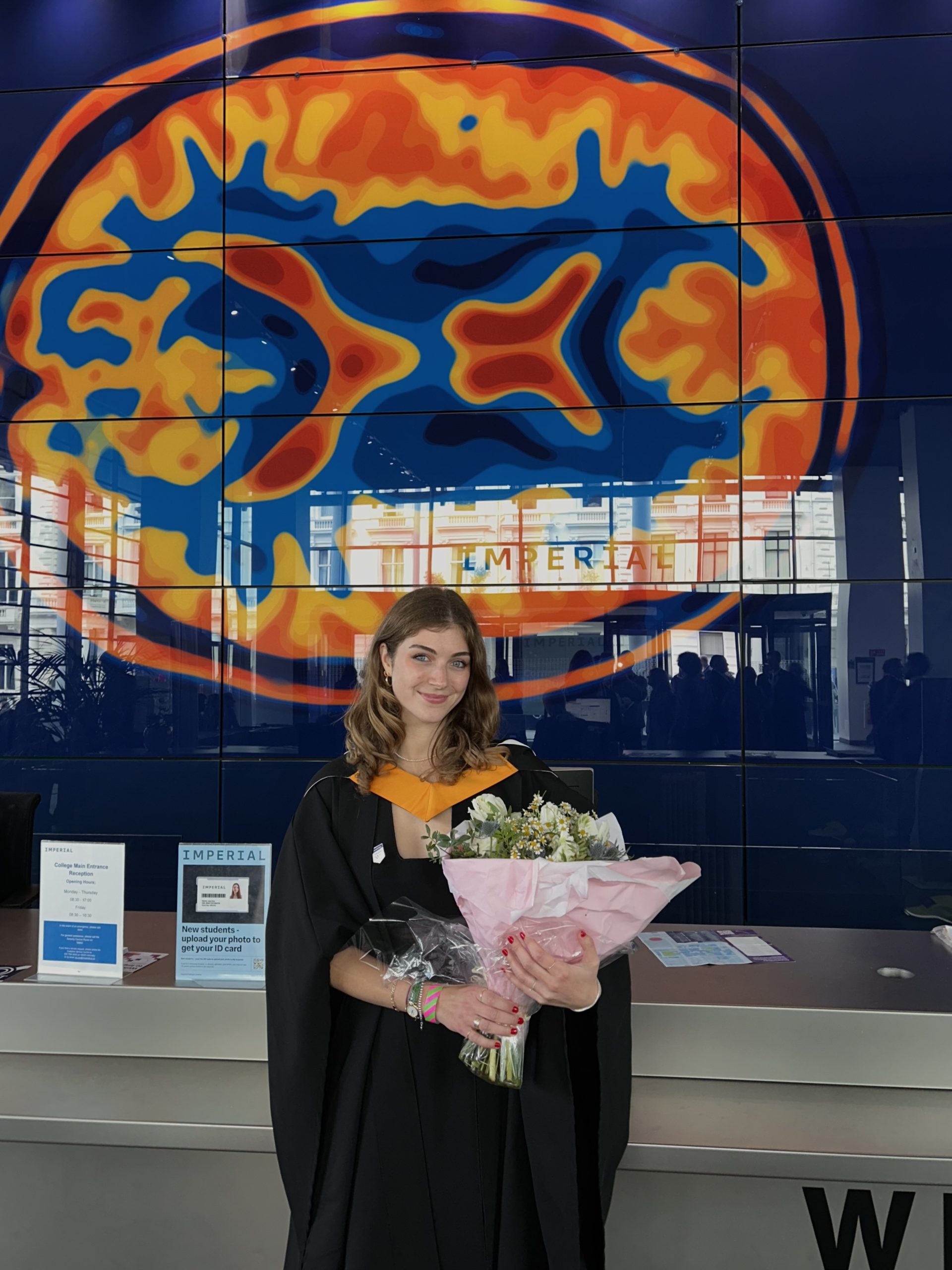
What is your name?
Eliza Munteanu
Where are you from?
I am from Romania and Belgium
Which class do you belong to?
MRes Experimental Neuroscience, class of 2026
Where and what did you study before joining Imperial College London?
I completed the Medical Biosciences BSc at Imperial College London
How did you find your Master’s experience at the College?
My MRes experience challenged me in the best way. Within twelve months, I gained insight across several areas of neuroscience research, expanded my technical skill set and met like-minded people who share my interest in disease mechanisms and translational potential. Even outside the lab, organising my own projects and communicating with prospective supervisors are skills I will carry forward as I pursue a PhD. I am confident this course has equipped me with the tools to thrive in a research-intensive environment while confirming my decision to remain in academia
Which research project did you work on?
My first project took place in the Division of Psychiatry under the supervision of Dr Martina Di Simplicio. There, I investigated the effectiveness of personalised behavioural recommendations delivered through a mental health app, Mindcraft, in improving disordered eating and self-harming behaviours in adolescents in schools. I investigated these outcomes through a three-arm randomised controlled trial over a month-long period.
My second project was at the Francis Crick Institute, in Dr Sila Ultanir’s Kinases and Brain Development Lab. I investigated TANK-Binding Kinase 1 (TBK1). Through this project, I validated two novel TBK1 candidate substrates in a cellular context and characterised their role at poly-GA aggregates relevant to ALS-FTD pathology, helping clarify TBK1’s role in disease onset and progression.
My third project was in Dr Naoto Watamura’s lab, where I optimised an SH-SY5Y reporter cell line to detect seeding-competent alpha-synuclein in tissue samples. Using these reporter cells, I tested whether previously uncharacterised humanised A53T SNCA knock-in mice had any seeding-competent alpha-synuclein at 6 months, informing their pathological timeline.
Where are you now?
I am currently in London, exploring future research directions and PhD opportunities
What are you working on?
I am discussing possible projects with my previous supervisors while continuing to apply to PhD programmes across England focused on gaining mechanistic insight into neurodegeneration and neurodevelopment, with the aim of identifying tractable intervention points for future therapeutic translation
What is the most important lesson you learnt as a Master’s student?
I learned that when research feels uncomfortable, you grow the most as a scientist. There were several times during the MRes when I felt out of my depth, but looking back, those were the moments when I learned the most, because they forced me to leverage the skills I already had
How did the Master’s programme help you get to where you are now?
Beyond technical skills and project organisation, the MRes connected me with a network of leading neuroscientists I can learn from and work with in the future. These connections have proven invaluable during my PhD applications