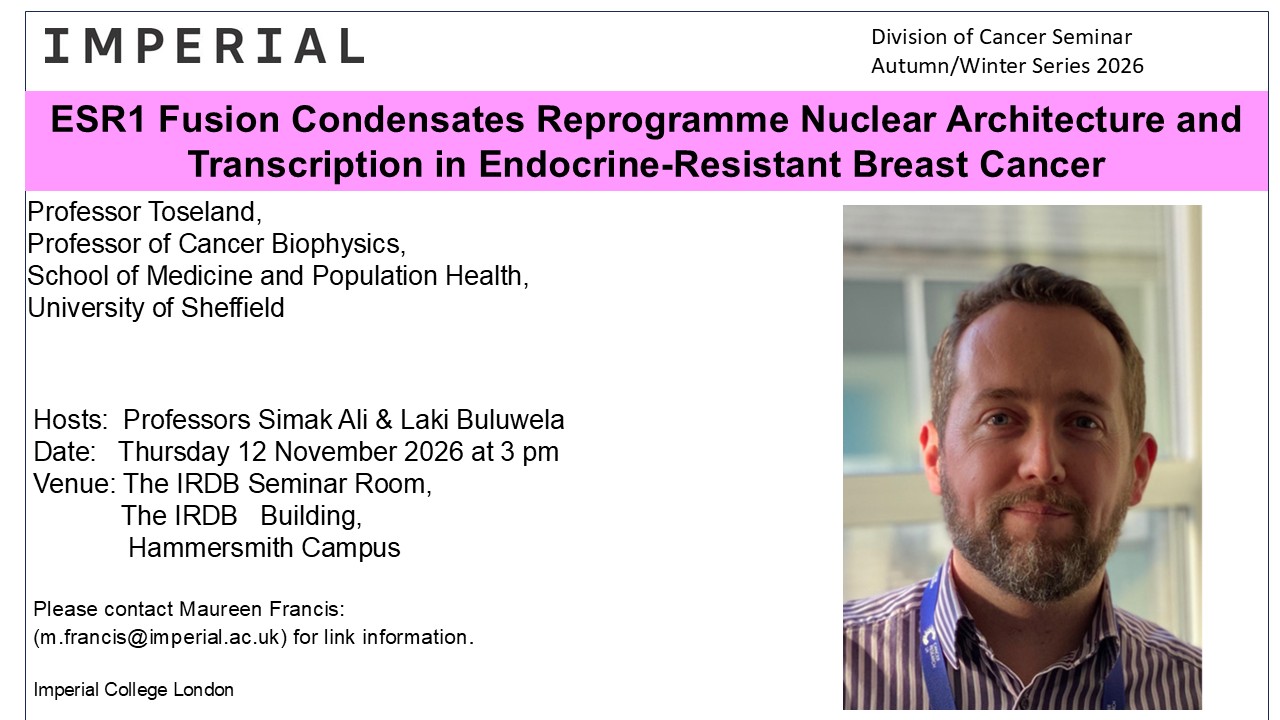
Division of Cancer Seminar – Thurs 12 November 2026
Join us for our next speaker programme in the Imperial Fungal Science Network/Seminar Series on Thursday, 19 November 2026. We are delighted to showcase research by Early Career Researchers across the three Network themes.
The Imperial Fungal Science Network is a hub for the mycology community, providing a leadership, advocacy and communications platform for mycologists and a developmental framework for future leaders in fungal research.
In this masterclass, you will bring your nascent idea and develop it through dialogue and constructive challenge to a level where the strengths and weakness become clear and an action plan to address the weakness can be defined.
The class will be delivered by Jonathan Jeffers who has worked in various roles for Finsbury (acquired by J&J), Embody Orthopaedic (license deal with Zimmer Biomet), Additive Instruments (acquired by Smith & Nephew) and OSSTEC (raised circa £5m equity investment).
Date: 19th November
Time: 12pm – 1.30pm
RESPONSIBLE AI SEMINAR SERIES
Tuesday, 10 November | 9.30 – 11.00am | Ground Floor Lecture Theatre, Dyson Building
“AI Governance for Organisations”
Dr Achim Rosemann, University of Cambridge
The seminar examines key components of organisational AI governance to help leaders and decision-makers implement responsible AI strategies within companies, universities, charities, and other organisations. Designed as an interactive session, the seminar will invite participants to work in small groups to explore the adoption of an AI system in an organisational setting of their choice.
Tuesday, 17 November | 9.30 – 11.00am | Ground Floor Lecture Theatre, Dyson Building
“Emerging Questions in AI Welfare”
Geoff Keeling and Winnie Street, Google
This talk will provide the philosophical groundwork for a scientific, philosophical and ultimately democratic inquiry into the potential for AI welfare, addressing key questions that cut across different arguments: what welfare is, how to interpret behavioural evidence of AI welfare, what kinds of entities might qualify as candidate AI welfare subjects, the potential grounds for welfare in AI and the practical ethical challenges that arise from our uncertainty.
Monday, 23 November | 9.30 – 11.00am | Ground Floor Lecture Theatre, Dyson Building
“In Praise of Local AI Agents”
Dr Juan Pablo Bermúdez, University of Southampton
One of the most intriguing theories in philosophy is the extended mind hypothesis: the view that our minds are so intertwined with parts of our environment that our mind itself extends beyond our skull and into the world. We offload maths to a calculator, memory to our notebooks – and now we offload reasoning and creativity to AI. This talk will explore our relationship with AI through the extended mind lens. Is it possible that our thinking, learning, and creating become so integrated with LLMs that these systems become part of our minds? And if so, what are the practical consequences?
Tuesday, 24 November | 9.30 – 11.00am | Ground Floor Lecture Theatre, Dyson Building
“Rise of the Intention Economy: How Generative AI Transforms the Attention Economy”
Dr Jonnie Penn, University of Cambridge
This talk identifies and names a new economic model emerging from unprecedented investment in generative and agentic AI–one focused not on capturing attention, but on predicting and shaping human intention instead. Drawing on more than a decade of original research with Dr Yaqub Chaudhary, the talk argues that AI systems are already being used to forecast and intervene in ‘intelligent’ decision-making processes across work, politics, markets and everyday life, with far-reaching consequences for democracy and the institutions behind shared reality.
Tuesday, 1 December | 9.30 – 11.00am | Ground Floor Lecture Theatre, Dyson Building
“Governing AI in an Unequal World”
Dr Rachel Adams, University of Cambridge
The talk will consider what a genuinely global system of AI governance would require if it is to do more than manage the risks created by today’s distribution of technological power. It asks how international cooperation might instead help shape an AI future in which the benefits, capabilities and decision-making power associated with AI are more widely shared, and in which responsible AI is understood not only as a technical or regulatory challenge, but as a question of global justice.
Title: A collectivist, economic perspective on AI
Speaker: Professor Michael I Jordan, Director of Research at Inria Paris
Date: Wednesday 18th November, refreshments from 3:30pm, talk from 4:30pm
Location: SAF 16, South Kensington campus
Agenda
15:30 – Refreshments and poster presentations
16:30 – Gabor Lecture
18:00 – Refreshments and research posters
Michael’s talk is highly topical and will focus on how we should all be thinking about AI not just as individual machines designed to imitate human intelligence but as part of a wider system of people, technology, markets and institutions. He will challenge the idea that AI progress is simply about building ever more capable machines but ask how we design AI enabled systems that work effectively for society as a whole, rather than optimising technology in isolation.
Michael is a leading computer scientist and statistician with more than 40 years advancing machine learning, statistics and AI.
This is a timely talk that will be of interest to many so please do register your spot early to avoid disappointment – all welcome!
Full abstract and link to register your place here: https://www.imperial.ac.uk/events/214455/gabor2026/
What happens when medicine and politics intersect in humanitarian settings?
Join the Institute of Global Health Innovation (IGHI) on Wednesday 11 November for the IGHI Special Lecture “Global Challenges, Human Solutions” with Dr Christos Christou.
We’d love to welcome you in person for the lecture and discussion, followed by refreshments and networking. If you’re unable to join us on campus, you can also attend online.
Dr Christos Christou, surgeon and humanitarian leader, will discuss how medicine, leadership and politics intersect in real humanitarian settings. Dr Christou will share what he has learnt from years of clinical and operational work with Médecins Sans Frontières, and where he sees opportunities academic institutions to contribute to humanitarian medicine.
The Lecture takes place on 11 November 2026, 17:00-19:00, Sir Alexander Fleming Building, Imperial College London, South Kensington Campus, or livestreamed.
See event details and register here
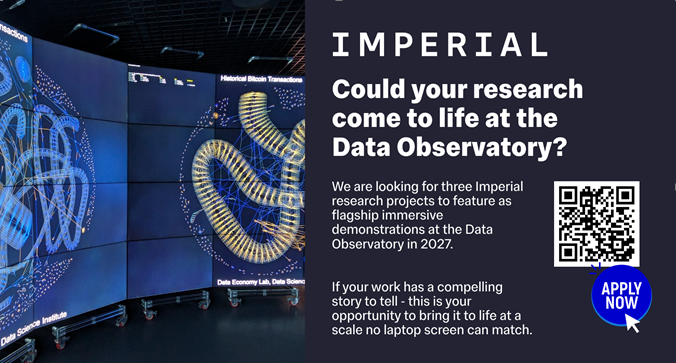 Could your research come to life at the Data Observatory?
We are looking for three Imperial research projects to feature as flagship immersive demonstrations at the Data Observatory in 2027.
If your work has a compelling story to tell- this is your opportunity to bring it to life at a scale no laptop screen can match.
What’s involved:
The submission portal is now open. Closing date: 27 November.
Submit your project idea here Observatory 2027- Flagship Project Call
To find out more, please contact the Kate Heyworth, Data Observatory Team Leader, k.heyworth@imperial.ac.uk.
We are delighted to share a fantastic opportunity for Early Career Researchers to get involved in the Imperial’s Inaugurals – a wonderful chance to develop your skills, raise your profile, and engage with the wider Imperial academic community!
Interested in moderating a Q&A? Please visit the link below to browse the upcoming Inaugural Lectures. To express your interest, simply email the event organiser from the Imperial Institutional Events Team — their contact details can be found on the left-hand sidebar of each event page under ‘For Further Details’
🔗 https://www.imperial.ac.uk/events/search/?tags=imperial-inaugurals
Please note that the schedule of the Inaugurals are updated to the website on a termly basis.
Thank you!
Calling all student performers!
We are looking for solo and group performers to compete in our Culture Evening for a chance to win £250.
We welcome all performances reflecting and honouring the cultural heritage, traditions, and creativity of the communities represented. So whether your performance is dance, music, fashion, and storytelling, we want to hear from you!
Submit your expressions of interest by Sunday 22 November 👇
https://forms.cloud.microsoft/e/M6fS1JgSma
Thinking about the social value of your science? Anxious that your work should make the world a better place? Keen to understand how your ideas, combined with a practical understanding of policy, might shape a future you’d look forward to? This Friday Forum reflects upon Imperial’s strapline ‘Science for Humanity’ and gives you an opportunity to put your research into a framework for the future.
For this Friday Forum the Good Science Project is delighted to collaborate with the Centre for Environmental Policy and the Imperial Policy Forum. Together we plan an afternoon of science imagination and robust future-shaping.
The Friday Forum consists of two parts. Part One is our customary panel discussion, running from 13:00-14:00. In Part Two, running from 14:15 – 16:00, we work in groups, exploring how we can use policy, and our own values, to bring about alternative futures. Expect to work with Imperial senior faculty, with peers and other experts, and with ideas drawn from your own research.
Lunch and coffee will be served from 12:15 onwards.
Panel discussion (13:00-14:00)
Afternoon Workshop (14:00-16:00)
Futures for discussion include:
1. Health and robotics
2. Science and AI
3. Climate change
4. Biofuels
For more information, including how to register, please click here.