Blog posts

Monthly Round-up | April 2026

The April listing of notices & updates for Network Members & Friends…


LATEST OPPORTUNITIES

Assistant/associate position at Uni of Birmingham/University of Birmingham School of Biosciences are hiring up to five assistant/associate professors and at least one is expected to be within mycology. The listing can be found here: Assistant or Associate Professor (Research and Education) – School of Biosciences – 107106 – Grade 8 or 9 – UoB Employee Careers
Closing date: 14 April 2026

Postdoc position on mycorrhizal ecology, based at the Royal Botanic Gardens, supported by the Leverhulme Centre for the Holobiont at Imperial. More info here: https://careers.kew.org/vacancy/postdoctoral-research-associate-ecology-of-the-mycorrhizal-holobiont-608669.html
Closing Date 03/05/2026


FUNDING OPPORTUNITIES

Pending updates.


EVENTS | Imperial Fungal Science Network

Thurs 14 May, 12noon:  Network Seminar Series – Keynote Speaker – Paul A. Rowley (The University of Idaho)

Sat 6 & Sun 7 June (12-6pm):  the Network is hosting a public engagement activity at The Great Exhibition Road Festival (free event); visit us at our ‘UNDERGROUND FUNGAL NETWORKS’ stand for the drawing wall activity; find our stand in the Underground Adventure Zone in Prince’s Gardens, London SW7


EVENTS | Other

Thurs 7 May:  F1AMR Network Scientific Meeting, University of Manchester, UK
Fungal One Health and Antimicrobial Resistance Network (F1AMR): a UKRI Network
live programme  Please be aware that registration for in-person attendance will close on April 21st or when capacity is reached; online registration will remain open.

9–10 November 2026:  FAILSAFE’s inaugural international scientific conference, Tackling the Global Threat of Fungal AMR, taking place in Bangkok, Thailand on 09–10 November 2026.  An invaluable opportunity to convene internationally recognised leaders in fungal AMR research, interdisciplinary researchers (clinical and non-clinical), early-career researchers, and FAILSAFE awardees.
Please register here: https://cmm-failsafe.com/fungalamrconference/
This inaugural conference will convene internationally recognised leaders in fungal AMR research, interdisciplinary (clinical and non-clinical) researchers, and early-career researchers (ECRs), alongside the global community of FAILSAFE awardees. The thematic focus includes: Cellular & molecular basis of fAMR; Drug discovery, modes of action & combination therapy; One Health, surveillance and environmental drivers; Clinical management.Confirmed speakers
If you have any questions, please contact FAILSAFE@exeter.ac.uk


MISCELLANEOUS

28 Mar – 2 May:  Delighted to share all the details about this new musical production… penicillin involved!  A group of Imperial PhD students, alumni, and a Professor will be performing in a new musical, Lifeline, which will run at Southwark Playhouse Elephant from 28 March to 2 May 2026. The production has transferred to London from off-Broadway.  More information about the production can be found here: https://www.lifelinemusical.com/
Lifeline tells a dual story: one strand explores the present-day challenge of antimicrobial resistance (AMR), while the other traces Sir Alexander Fleming’s 20th-century discovery of penicillin and its far-reaching impact. A unique aspect of the production is its rotating chorus, which is made up of scientists and healthcare professionals, placing scientific voices at the heart of both the narrative and the performance.  The musical offers an engaging and accessible way to introduce the public to the realities of AMR, while celebrating the role of scientists and healthcare professionals in addressing global health challenges.

Network Seminar Series | Visiting Speaker, Spring Term


Yen-Ping Hsueh (Max Planck Institute for Biology Tübingen, Germany)
‘Predatory Fungal–Nematode Interactions Across Scales’

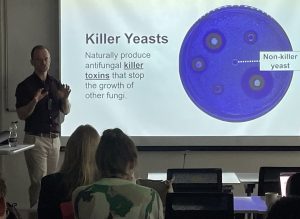
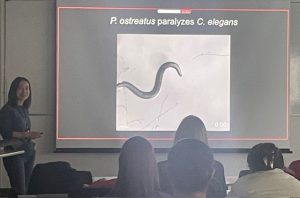
The Network welcomed Yen-Ping Hsueh (Max Planck Institute for Biology Tübingen) as Keynote Speaker on Thursday 26 March at the Flowers Building, South Kensington Campus.

Yen-Ping presented (together with superb visuals) Predatory Fungal–Nematode Interactions Across Scales.  Imagine a microscopic world where fungi set traps, lure prey with chemical bait, and even poison worms through their nerve endings.  It sounds like science fiction, but it’s happening in soil, everywhere in the world.  Yen-Ping Hsueh presented how her lab is unravelling the predatory playbook of carnivorous fungi using two fascinating model systems.  The first, Arthrobotrys oligospora, is a nematode-trapping fungus that eavesdrops on its prey’s chemical signals to spring sticky, lasso-like traps.  This fungus deploys a specialised arsenal of proteins for efficient capture, and even producing a chemical compound called (MMB) that lures the model nematode C. elegans to its doom.  The second, the oyster mushroom Pleurotus ostreatus, takes an even more sinister approach: it attacks from the nematode’s sensory cilia and triggers rapid neuronal cell death.  This strategy is aided by tiny lollipop-shaped structures on the hyphae called toxocysts, which are loaded with the volatile compound 3-octanone.  Together, these systems reveal that fungi have evolved strikingly diverse and sophisticated strategies to hunt their preys.

Network Seminar Series | ECR Talks, Spring Term


Lauren Dineen; Louis Cohen; Marco Balducci

The Network’s ECR Talks were held on Thursday 19 February at the Flowers Building on South Kensington Campus.  Thank you to our audience – it was great to host many of our members in-person and delighted that many were also able to join us online.  And thank you to the invited speaker guests, together with our ECR Reps (Eleonora MorattoMarco Balducci, Tom Williams) for a programme which explored each of the Network themes. 

Lauren Dineen is a post-doc in the Armstrong-James lab in the Department of Infectious Disease at Imperial College London. She presented Exploring tRNA biology of fungi: fundamental and pathogenesis perspectives. Lauren presented her research employing cutting edge direct tRNA sequencing and ML annotation methods to compare tRNA modification and modifying enzyme diversity across an entire fungal subphylum, the Saccharomycotina. She also presented her research focused on a functional analysis of a genome-wide tRNA knock out library in the human pathogen Aspergillus fumigatus, where she uncovered a unique tRNA involved in antifungal sensitivity. Together this research highlighted the underappreciated diversity of tRNA in fungi, and that tRNA are involved in stress adaptation in fungal pathogens. 

Louis Cohen is a PhD student in the Stanley lab in the Department of Bioengineering at Imperial College London. He presented “Mycorrhiza-on-a-chip” – developing microfluidic systems for studying root-fungal symbioses. Louis presented his innovative research, employing advanced microfluidic technology to design customized and simplified microenvironments tailored for the real-time monitoring of pre-symbiotic interactions between mycorrhizal fungi and plant roots. This approach provides a unique opportunity to investigate the underlying mechanisms driving symbiotic communication and crosstalk, offering valuable insights into the complexities of these critical ecological interactions.

Marco Balducci, ECR Rep for Ecology, Evolution and the Environment (Savolainen Lab, Department of Life Sciences, Silwood Park, Imperial College London), presented Can symbiosis underpin local adaptation? Marco explored how Howea palms and their arbuscular mycorrhizal fungal (AMF) communities vary across host species and soil environments. Using metabarcoding and meta-transcriptomics, he showed that both fungal community composition and function shift with habitat, revealing coordinated changes in stress tolerance and cross-kingdom gene expression. His work highlights how environmentally structured plant-microbiome interactions may contribute to local adaptation in natural systems.

We look forward to the next ECR programme in the Summer Term.