Exploring the Lethal Arsenal of Killer Yeasts for Biotechnology & Beyond
On Thursday 14 May, the network welcomed Paul Rowley, Associate Professor in the Department of Biological Sciences at University of Idaho, as keynote speaker at the Flowers Building on the South Kensington Campus. Paul’s research explores the hidden viral world inside yeasts and how these discoveries could open new directions in biotechnology and antifungal research.
When most people think about yeast, they think of baking and brewing. Baker’s yeast Saccharomyces cerevisiae has shaped industries for centuries, from bread and beer to the production of bioethanol. Yeasts have also become indispensable model organisms in basic science.
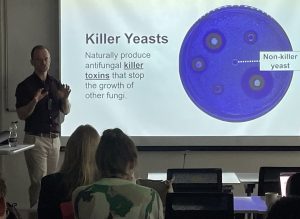
What is far less widely known, however, is that yeast themselves can become infected by RNA viruses that live parasitically within their cytosol. Some of these viruses carry small satellite RNAs that encode toxins, historically called yeast killer toxins, which are capable of killing competing yeast strains.
Rowley’s research focuses on understanding the prevalence and diversity of these viral systems across yeast species, as well as exploring how their toxins might be harnessed for biotechnology and medicine. One particularly exciting avenue is the potential use of these toxins against fungal pathogens such as Nakaseomyces glabratus, an emerging opportunistic pathogen that poses increasing challenges in clinical settings.
While the development of new antifungal therapeutics remains a long-term research and development effort, Rowley highlighted a more immediate industrial application: using killer yeast toxins to combat spoilage yeasts in brewing. Diastatic yeasts, notorious for contaminating beer production and altering flavour profiles, could potentially be controlled using these naturally evolved biological weapons. Encouragingly, several breweries have already expressed interest in testing the approach.
The talk also showcased the discovery of a new toxin identified by the Rowley lab. Structural predictions suggest that it resembles bacterial aerolysin toxins, pore-forming toxins associated with severe disease in animals, including haemorrhagic infections. The group is now investigating the mechanism of action of this yeast aerolysin-like toxin, its prevalence across yeast species, and whether it interacts with human cells. These studies may ultimately reveal whether the toxin could become a novel antifungal strategy or represent a previously unrecognised biological risk factor.