Category: Pathogenesis of fungal diseases

Network Seminar Series | ECR Talks, Summer Term

The Network’s ECR Rep team wrapped up our 25/26 Seminar Series with a programme of ECR Talks on Thursday 18th June at the South Kensington.  Thank you to everyone who attended in-person and guests who were able to join us online.
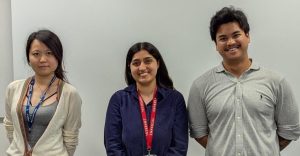
Network ECR Speakers – Xinxin Shou; Shirin Bamezai; Juan Miguel Bonnin

Shirin Bamezai is a PhD student at the Bezos Centre for Sustainable Protein and Microbial Food Hub within the Department of Bioengineering at Imperial College London. She presented her research on “Metabolic Engineering of Yarrowia lipolytica for the Bioproduction of Food-System Relevant Compounds.” In her presentation, Shirin discussed her efforts to engineer the metabolic capabilities of the yeast Yarrowia lipolytica for the biomanufacture of compounds that serve as biocontrol alternatives to synthetic agrochemicals. She outlined two approaches: the first involves expanding the yeast’s metabolic capabilities to produce a range of natural food colorants, and the second focuses on developing a co-culture system for the bioproduction of ginger essential oil.

Xinxin Shou in the Armstrong-James Lab, Department of Infectious Disease, Imperial College London presented Pathobiology of fungal histamine tolerance in allergic bronchopulmonary aspergillosis.

Miguel Bonnin is athird year PhD student in the Bell Lab, Department of Life Sciences, Silwood Park, Imperial College London and a researcher for CABI. He presented his research on “Culture collection coverage gaps in fungi — and what community cryopreservation can do about them.” Miguel showed that fungal biobanks, built mainly on pure axenic cultures, contain systematic gaps — particularly among symbiont-dependent and slow-growing taxa — that pure-culture methods cannot close. His evidence that complex microbial communities can be cryopreserved while retaining fungal viability suggests that community context may itself protect organisms that have so far resisted isolation.  
 

Network Seminar Series | VISITING SPEAKER, Spring Term


Yen-Ping Hsueh (Max Planck Institute for Biology Tübingen, Germany)
‘Predatory Fungal–Nematode Interactions Across Scales’

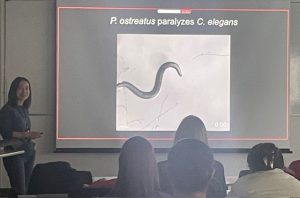
The Network welcomed Yen-Ping Hsueh (Max Planck Institute for Biology Tübingen) as Keynote Speaker on Thursday 26 March at the Flowers Building, South Kensington Campus.

Yen-Ping presented (together with superb visuals) Predatory Fungal–Nematode Interactions Across Scales.  Imagine a microscopic world where fungi set traps, lure prey with chemical bait, and even poison worms through their nerve endings.  It sounds like science fiction, but it’s happening in soil, everywhere in the world.  Yen-Ping Hsueh presented how her lab is unravelling the predatory playbook of carnivorous fungi using two fascinating model systems.  The first, Arthrobotrys oligospora, is a nematode-trapping fungus that eavesdrops on its prey’s chemical signals to spring sticky, lasso-like traps.  This fungus deploys a specialised arsenal of proteins for efficient capture, and even producing a chemical compound called (MMB) that lures the model nematode C. elegans to its doom.  The second, the oyster mushroom Pleurotus ostreatus, takes an even more sinister approach: it attacks from the nematode’s sensory cilia and triggers rapid neuronal cell death.  This strategy is aided by tiny lollipop-shaped structures on the hyphae called toxocysts, which are loaded with the volatile compound 3-octanone.  Together, these systems reveal that fungi have evolved strikingly diverse and sophisticated strategies to hunt their preys.

Network Seminar Series | ECR Talks, Spring Term


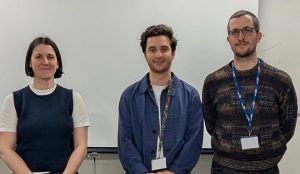
Lauren Dineen; Louis Cohen; Marco Balducci

The Network’s ECR Talks were held on Thursday 19 February at the Flowers Building on South Kensington Campus.  Thank you to our audience – it was great to host many of our members in-person and delighted that many were also able to join us online.  And thank you to the invited speaker guests, together with our ECR Reps (Eleonora MorattoMarco Balducci, Tom Williams) for a programme which explored each of the Network themes. 

Lauren Dineen is a post-doc in the Armstrong-James lab in the Department of Infectious Disease at Imperial College London. She presented Exploring tRNA biology of fungi: fundamental and pathogenesis perspectives. Lauren presented her research employing cutting edge direct tRNA sequencing and ML annotation methods to compare tRNA modification and modifying enzyme diversity across an entire fungal subphylum, the Saccharomycotina. She also presented her research focused on a functional analysis of a genome-wide tRNA knock out library in the human pathogen Aspergillus fumigatus, where she uncovered a unique tRNA involved in antifungal sensitivity. Together this research highlighted the underappreciated diversity of tRNA in fungi, and that tRNA are involved in stress adaptation in fungal pathogens. 

Louis Cohen is a PhD student in the Stanley lab in the Department of Bioengineering at Imperial College London. He presented “Mycorrhiza-on-a-chip” – developing microfluidic systems for studying root-fungal symbioses. Louis presented his innovative research, employing advanced microfluidic technology to design customized and simplified microenvironments tailored for the real-time monitoring of pre-symbiotic interactions between mycorrhizal fungi and plant roots. This approach provides a unique opportunity to investigate the underlying mechanisms driving symbiotic communication and crosstalk, offering valuable insights into the complexities of these critical ecological interactions.

Marco Balducci, ECR Rep for Ecology, Evolution and the Environment (Savolainen Lab, Department of Life Sciences, Silwood Park, Imperial College London), presented Can symbiosis underpin local adaptation? Marco explored how Howea palms and their arbuscular mycorrhizal fungal (AMF) communities vary across host species and soil environments. Using metabarcoding and meta-transcriptomics, he showed that both fungal community composition and function shift with habitat, revealing coordinated changes in stress tolerance and cross-kingdom gene expression. His work highlights how environmentally structured plant-microbiome interactions may contribute to local adaptation in natural systems.

We look forward to the next ECR programme in the Summer Term.