The Network’s ECR Rep team wrapped up our 25/26 Seminar Series with a programme of ECR Talks on Thursday 18th June at the South Kensington. Thank you to everyone who attended in-person and guests who were able to join us online.
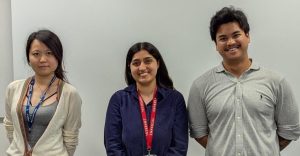
Shirin Bamezai is a PhD student at the Bezos Centre for Sustainable Protein and Microbial Food Hub within the Department of Bioengineering at Imperial College London. She presented her research on “Metabolic Engineering of Yarrowia lipolytica for the Bioproduction of Food-System Relevant Compounds.” In her presentation, Shirin discussed her efforts to engineer the metabolic capabilities of the yeast Yarrowia lipolytica for the biomanufacture of compounds that serve as biocontrol alternatives to synthetic agrochemicals. She outlined two approaches: the first involves expanding the yeast’s metabolic capabilities to produce a range of natural food colorants, and the second focuses on developing a co-culture system for the bioproduction of ginger essential oil.
Xinxin Shou is a PhD student in the Armstrong-James Lab within the Department of Infectious Disease at Imperial College London. She presented “Pathobiology of fungal histamine tolerance in allergic bronchopulmonary aspergillosis”. Xinxin showed that clinical isolates of Aspergillus fumigatus from ABPA patients exhibit enhanced growth in histamine-containing media compared with non-allergic isolates. Transcriptomic analyses revealed upregulation of copper amine oxidase genes in response to histamine, suggesting a mechanism for increased histamine tolerance. She also presented ongoing work investigating the molecular basis of histamine tolerance and its role in fungal survival within allergic immune environments.
Miguel Bonnin is a third year PhD student in the Bell Lab, Department of Life Sciences, Silwood Park, Imperial College London and a researcher for CABI. He presented his research on “Culture collection coverage gaps in fungi — and what community cryopreservation can do about them.” Miguel showed that fungal biobanks, built mainly on pure axenic cultures, contain systematic gaps — particularly among symbiont-dependent and slow-growing taxa — that pure-culture methods cannot close. His evidence that complex microbial communities can be cryopreserved while retaining fungal viability suggests that community context may itself protect organisms that have so far resisted isolation.