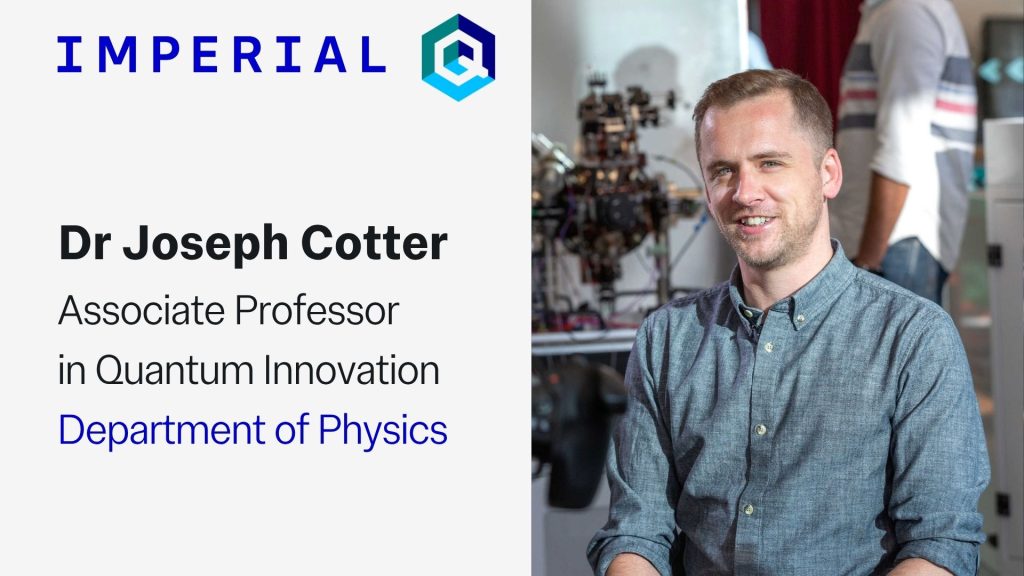
Associate Professor Joseph Cotter from the Department of Physics and Department of Materials at Imperial, and Co-Director of QuEST (the Centre for Quantum Engineering, Science and Technology at Imperial), works on quantum sensing and next-generation navigation technologies. His research focuses on atom interferometry and quantum-enhanced inertial sensors for navigation in environments where satellite signals are unavailable or unreliable. In this blog post, he shares more about his research, the motivation behind building alternatives to GPS, and the challenges of taking quantum sensors from the laboratory into real-world environments.
Can you tell us about your research area?
I develop quantum enhanced inertial sensors for future navigation systems that can be used for accurate positioning in satellite denied environments. These sensors rely on atom interferometry – a kind of matter wave interferometer – to very accurately measure the acceleration and rotation rates of vehicles, which we can use to calculate the vehicles change in position over time.
What led you to study this area?
I am fascinated by matter wave interferometry – that at small scales matter behaves like waves, that we can often control these matter waves really well, and that we can realise technologies built from those matter waves interfering – it still amazes me.
I’ve spent the last 15 years playing with matter wave interferometers of one kind or another – from measuring Earth’s gravity using interfering Bose-Einstein condensates on an atom chip, to testing the foundations of quantum mechanics through the interference of large complex molecules. The underpinning quantum principles that describe matter wave interference using Bose-Einstein condensates or complex molecules also apply to atom interferometry.
What are the main aims of your current research?
Signals from Global Positioning System (GPS) are vulnerable to jamming, spoofing and signal degradation. GPS also doesn’t work so well on submarines, aircraft, and in underground environments. I want to create a robust, reliable and resilient alternate to GPS.
How could this research potentially benefit society?
Global Navigation Satellite Systems (GNSS), like the US Global Positioning System (GPS), or the European Galileo system, provide extremely accurate position information almost anywhere on Earth. Our society relies on these systems, from navigation to banking, power grids to photo tagging, logistics to smartwatches. A full loss of GPS/GNSS would cost the UK economy over £1 billion per day.
What are the next steps in your research? Are there any challenges ahead?
In the lab we’ve shown that quantum enhanced inertial sensors can deliver amazingly accurate measurements of acceleration and rotation. We’ve also started taking these usually extremely delicate sensors outside of the lab, successfully deploying them on moving platforms including ships and trains. So far, the impact of environmental factors mean our sensors don’t perform as well on moving platforms in the “real world” as they do in the lab. There’s a huge challenge ahead to translate results from the lab into robust and reliable technologies that realise the full potential of these sensors.