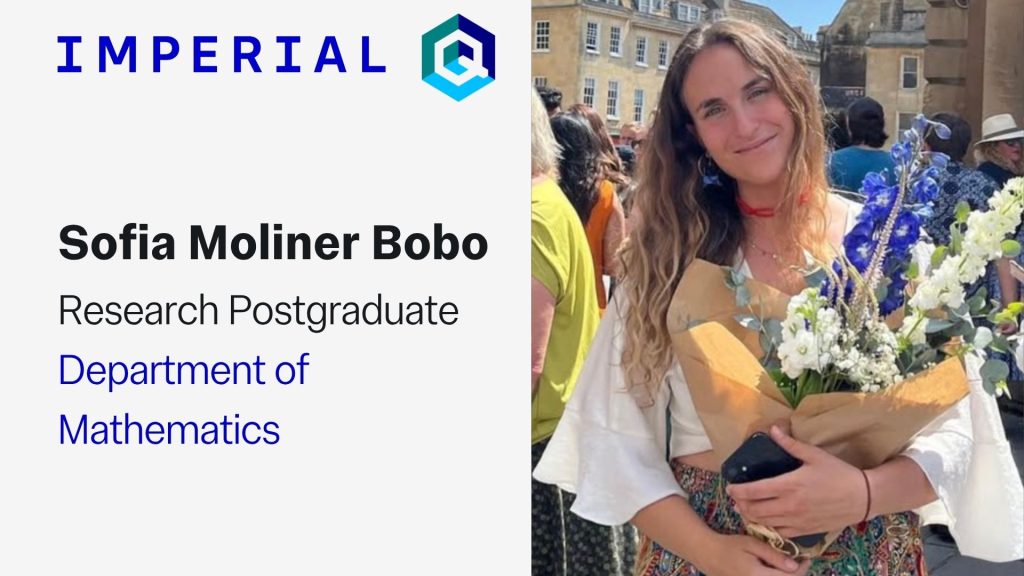
Sofia Moliner Bobo is a Research Postgraduate in the Department of Mathematics, working in the field of mathematical finance and quantum computing. Her research explores how quantum algorithms could be used to solve computationally intensive problems in finance, including derivative pricing, portfolio optimisation, risk analysis, and market simulation. In this blog post, she discusses her work on quantum algorithms for financial applications, the motivation behind combining quantum computing with mathematical finance, and the potential benefits for both efficiency and sustainability in the financial sector.
Can you tell us about your research area?
I am part of the Mathematical Finance department at Imperial working on Quantum Algorithms for financial applications. This field explores how quantum algorithms could accelerate computationally intensive problems in quantitative finance. It combines ideas from mathematical finance, machine learning, optimisation, and high-performance computing, with potential applications in derivative pricing, portfolio optimisation, risk analysis, and market simulation. Financial models are fundamentally probabilistic, often modelling asset prices, interest rates, or trading dynamics as stochastic processes evolving through time. This creates a natural connection with quantum systems, where probability and uncertainty are also fundamental features rather than imperfections of the model. My work aims to understand where quantum algorithms may provide realistic computational advantages over existing classical methods. This involves exploring both near-term and long-term quantum algorithms.
What led you to study this area?
I have always been interested in the intersection of mathematics, computation, and real-world applications. I grew up in a very finance-driven environment, which gave me early exposure to the industry and sparked my interest in financial markets from a young age. At the same time, during my undergraduate and MSc studies, I developed a strong passion for quantum computing, particularly in fault-tolerant quantum algorithms. What attracted me to this field was the opportunity to work between two very different communities. I always enjoyed the combination of theoretical research and practical applications, and I have a passion for communicating technical concepts to business- oriented audiences. Quantum computing in finance is still a developing area, which makes it an especially interesting space to help connect researchers, technologists, and industry practitioners. It allows me to work in a highly interdisciplinary environment and learn from my peers, while gaining exposure to both industry and academia in quantum computing. Additionally, the algorithms used in finance can be extrapolated to many fields. I experienced this personally when participating in the Quantum Innovation Challenge, where I applied a quantum algorithm commonly used in option pricing to calculate an optimal dose in PK/PD models.
What are the main aims of your current research?
I am currently investigating how a quantum walk-based algorithm called Quantum Fast Forwarding can be used to solve heat PDEs with complex boundary conditions, which are the foundational models describing the dynamics of option and interest rate prices. The aim is to provide a detailed complexity analysis to establish realistic conditions for quantum advantage over classical methods. This research could improve the efficiency of pricing complex financial products across large portfolios, where classical methods often become computationally expensive and difficult to scale. Ultimately, this project aims at applying this algorithm to compute portfolio-level risk sensitivities (also known as the “Greeks”), which are tools used by financial institutions to measure and manage financial risk.
How could this research potentially benefit society?
Financial institutions rely on extremely large-scale computational infrastructure for pricing, risk analysis, and market simulation, resulting in significant energy consumption. If quantum algorithms can accelerate some of these tasks in the future, they could help improve the efficiency and sustainability of financial systems. Beyond computational speed, I think an important aspect of this research is helping financial institutions understand and prepare for emerging quantum technologies. Quantum computing poses a long-term cybersecurity challenge, making it important for the financial sector to begin adapting its infrastructure and expertise early on. Doing so protects institutions from future threats and prevents them from becoming obsolete if the technology matures faster than they can adopt it. I believe there is significant value in building stronger connections between the quantum computing and finance communities so that institutions can better understand both the capabilities and the limitations of these technologies.
What are the next steps in your research? Are there any challenges ahead?
One of the next steps in my research is extending quantum walk-based algorithms to more complex derivatives where classical methods struggle to compute a solution within the required timeframe. These include options defined over many assets, exotic options, or options defined under more realistic models, such as local or stochastic volatility models, where the volatility of the asset is no longer constant. I am particularly interested inunderstanding how extensions of quantum walk-based algorithms (through Quantum Singular Value Transformation) could be applied to these scenarios, where the corresponding PDE parameters evolve in time. The next step is to investigate the extension of these methods to solve d-dimensional PDEs, where we believe that quantum computing could provide a significant advantage. One of the biggest challenges at the intersection of quantum computing and finance is that, although many quantum algorithms show strong theoretical promise, demonstrating a practical advantage for real financial problems remains difficult. The finance industry is fast- paced, highly practical, and application-driven, so it is crucial to demonstrate the potential of quantum technologies without feeding the quantum hype.