This blog was written by IGHI Teaching Fellow, Julien le Jeune d’Allegeershecque. It features reflections on wellbeing, belonging and flexibility in online learning from Julien and Dunya Al‑Hayali, a MSc Health Policy student.
More and more students are opting for online postgraduate taught (PGT) programmes. It allows people from diverse cultural, linguistic and professional backgrounds to balance study with work and caring commitments. Although flexible and convenient, the online environment doesn’t have in-person contact and it can present unfamiliar institutional norms. This can affect students’ confidence, engagement and academic outcomes.
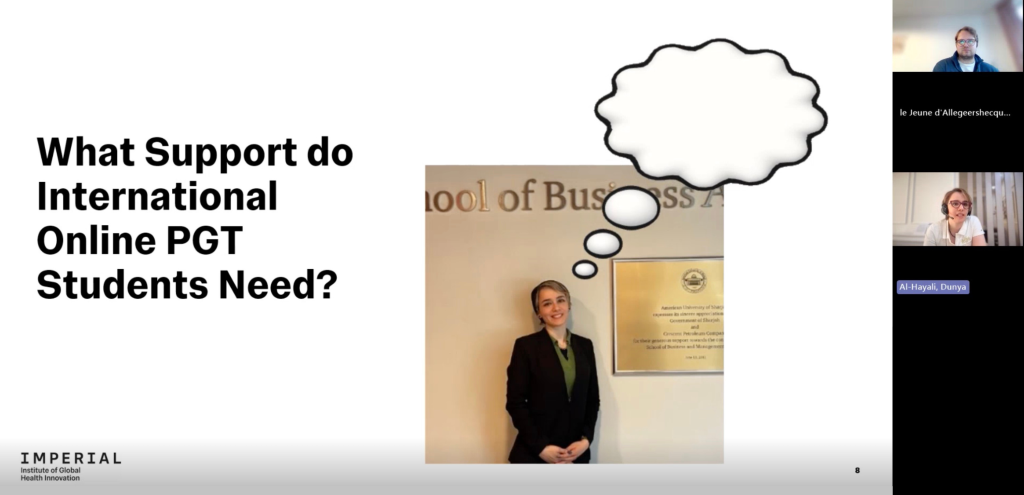
In a recent presentation for Imperial’s Students’ Voice initiative, chaired by Monica Tolocica from the Imperial Institute of Lifelong Learning, Dunya and I explored the challenges of online education. Dunya shared insights from her experience as a MSc Health Policy student. The online master’s programme is delivered by the Institute of Global Health Innovation.
Student Voice and Inclusive Design
During the presentation, Dunya emphasised how clear and timely communication helps students navigate the uncertainties of starting an online programme. Beyond conveying logistical information, the warmth and positivity of the ‘excitement emails’ she received before the start of the programme made her feel genuinely welcomed and eager to get started.
“What I witnessed and managed to get from Imperial is an amazing onboarding process. It was very detailed and continuous. […] I was mentally ready to start my course and already proud to be part of Imperial. From the first session, you feel like you made the right decision. The course is very engaging due to the careful session and delivery design.”
A key message from the session was that to ‘belong’ in online education, students need to feel seen, valued and able to make meaningful contributions. Dunya spoke enthusiastically about the value of group discussions during live sessions. She described them as a space to share her perspectives, to build connections with peers, and to engage with teaching staff.
These interactions do more than build individual confidence. They enrich the learning environment, as students bring a range of cultural, geographic and professional perspectives into the classroom. Course design plays a crucial role in enabling this: opportunities for genuine interaction, culturally sensitive materials, and responsive, ‘warm’ support from staff contribute to an environment where students feel connected (Baker et al., 2018).
The emphasis on warmth and responsiveness links to Monica Tolocica’s reflections on designing the ‘social architecture’ of online courses – structures that promote a sense of community between students. Practical strategies include creating inclusive, non-graded forums, clear thread titles, and optional notifications. These create accountable and relaxed spaces that foster trust and openness. This ensures that wellbeing is at the heart of the learning experience.
Alongside this, it is essential to maintain a balance of formal institutional support, peer networks and trusted staff guidance. Programme teams play an important role as ‘guides’. They have the knowledge, oversight, and relationships needed to support students effectively, whether through practical advice or clear, direct signposting.
As Monica highlighted, this ‘warm’ human support is appreciated by all online learners, not just international ones. This reinforces the importance of designing courses with teachers in mind, ensuring they have the structures and resources they need to provide relational, empathetic support to students. To achieve this, programme development should be co-produced by academics, teaching staff, digital learning design teams and students.
Intentionality and Flexibility in PGT Education
A key takeaway from the session was the need to be purposeful when embedding wellbeing into online learning. This means including reflective activities, having different types of assessments, localising examples, and being flexible.
Monica emphasised that students studying part-time online often experience what she called a ‘temporal tension’: a mismatch between the fixed demands of the course and the limited, often fragmented, time they have available (Romero and Barberà, 2011, cited by Sheail, 2018).
It’s essential to recognise the difference between ‘solid time’ – what students think they can commit to – and ‘quality time’ – what they can commit to. Designing courses around realistic, achievable milestones and building flexibility into engagement can help alleviate pressure without compromising academic rigour.
Flexibility also means acknowledging the realities of online learners: different time zones, varied working patterns, and changing personal circumstances. Offering self-paced options alongside live sessions, and tools to support time management can really help. Offering different ways to navigate a course is also important, so students dealing with life disruptions can continue their academic journey without framing it as a failure (Sheail, 2018).
From Day One: Consistency That Supports Wellbeing
Dunya also highlighted the importance of predictability. Clear structures, consistent communication, and a transparent rhythm of activity from the outset help students to settle in, manage their workload, and build the confidence they need to participate fully. This early stability reduces stress and anxiety. It also allows belonging and wellbeing to take root naturally and to develop throughout the programme.
Wellbeing, belonging and course design are interdependent. When they are aligned, online PGT environments are more inclusive, flexible, supportive, and conducive to student success. Getting this right at the start ensures they are integral to the learning experience, rather than an afterthought.
* * *
References
Baker, S., Ramsay, G., Irwin, E. and Miles, L., 2018. ‘Hot’, ‘cold’ and ‘warm’ supports: Towards theorising where refugee students go for assistance at university. Teaching in Higher Education, 23 (1), pp. 1–16.
Sheail, P., 2018. Temporal flexibility in the digital university: Full-time, part-time, flexitime. Distance Education, 39 (4), pp. 462–479.
* * *
About Students’ Voice series
Students’ Voice talks, designed and developed by Dr Argita Zalli, bring together Imperial College colleagues – including academics, digital education designers, technologists, disability advisors, library and ICT staff – who all share a commitment to inclusive practice and to improving students lived experiences of online education.
* * *
Inspired by Dunya’s learning journey? Explore our fully online MSc in Health Policy and see how you can shape the future of health systems. Learn more here.