Tag: Doctoral Students

Introducing dAIsy – Imperial’s New GenAI workspace

dAIsy is Imperial’s new Generative AI platform, designed to give you safe, easy access to multiple AI models (such as GPT, Claude, Deepseek, and others) through a single interface.

dAIsy is built to support teaching, learning, and research while ensuring data protection and institutional compliance.

Why use dAIsy?

  • Private and secure – your data stays protected. All your prompts and chat history are stored securely in Imperial’s cloud.
  • Build your own agents – You can define instructions or behaviours suited to your specific needs.
  • Advanced developer role available on request – if you want to go deeper.

Imperial offers licensed AI models to promote equitable access and, alongside Microsoft Copilot, dAIsy supports our commitment to harnessing AI’s transformative potential responsibly and effectively.

Further support

Join a new PhD Participatory Research Network!

A group of PhD students has set up a PhD Participatory Research Network (funded by LISS-DTP) to connect PhD students interested in participatory methods – approaches where people with lived experience are active partners in shaping all stages of the research process. Each month, we’ll meet to explore a different theme through interactive workshops, peer discussions, and guest speakers. Together, we’ll build a collective toolkit of resources and guidance by PhD students, for PhD students.

Our first session will be held at REACH Space, 3rd Floor, Surrey Street East Wing, Strand Campus, King’s College London, on Wednesday 5th November, 2pm-4pm. Our network is open to all PhD students from King’s College London, Queen Mary University of London, and Imperial College London. If you are based elsewhere but would like to join, please email Emma (e.hayashibara@qmul.ac.uk). As spaces are limited, please register your interest via Eventbrite to secure your place. If you can no longer attend, kindly cancel your registration so that someone else can take your spot.

For any questions about the network, feel free to contact Emma (e.hayashibara@qmul.ac.uk).

Help Us Build the Student Parent and Carers Network at Imperial!

Are you a parent, an expectant parent, or a carer navigating student life at Imperial?

We understand that balancing academic life with parenting or caregiving responsibilities can be both incredibly rewarding and uniquely challenging. That’s why we’re building a stronger, more supportive Student Parent and Carers Network, and we invite you to be part of it.

Our first crucial step is to find out more about the experiences and needs of Imperial student parents and carers. Please take a few minutes to complete the survey by clicking here: Imperial Student Parent and Carers survey

This network is designed to offer:

✅ Peer Support: Connect with fellow student parents and carers who understand your experience.

✅ Dedicated Events: Family-friendly, care-friendly and flexible networking opportunities, support sessions, and socials.

✅ Advocacy & Voice: Help shape how Imperial supports students like you.

✅ Resources & Guidance: Clear, accessible information on everything from parental or emergency leave, advice on childcare, wellbeing, and flexible study options.

Whether you’re currently parenting, expecting a child, supporting a partner who is, or caring for a family member or friend, you are welcome here.

How to Join:

Simply complete the survey above and join at the end, or reply to this email with your details and we will add you to the Network.

If you have any questions or queries, please don’t hesitate to contact us at, studentparentsandcarers@imperial.ac.uk

Imperial CREST Academy – Mentor Year 12 Students

The Imperial CREST Academy helps to match academic mentors to teams of Year 12 students who are undertaking a CREST Gold Project (or an Extended Project Qualification), which can be thought of as a scientific Duke of Edinburgh award, run by the British Science Association. The projects help the students go beyond school curriculum and get a small taste of scientific research. It is also hugely helpful for the students when applying to university as it helps with their personal statements and also gives them more breadth of knowledge and understanding should they be interviewed for a place at University.

The CREST Academy is run by Prof Cecilia Johansson (National Heart and Lung Institute) and myself, Simon Foster (FoNS & Imperial Space Lab). The Academy has been running for 13 years and has helped hundreds (possibly now thousands) of students undertake a CREST project and have gained a vital glimpse into the world of scientific research and academia.

The role of the mentor is to guide the project, initially helping to shape the project into something that can be conducted by the students in 70 hours (the rough allotted time for the project) and to give general scientific guidance. This is usually quite light touch and involves 2-3 meetings (in person or virtually) along with occasional emails. You will not be required to ensure the students are working on the projects or ‘push’ them, along, as this is the responsibility of their teacher. I have mentored a number of projects over the years and always found them immensely satisfying and they have had a huge impact upon the students. Based up my experiences, the time commitment is approximately 3-5 hours over the academic year (20 – 30 mins per online meeting and reading and responding to occasional emails).

If this might be of interest we will be holding an introduction an online Teams meeting on Friday 24th October at 11am top take you through the scheme: This link will take you to the meeting  Join the meeting now and if you email me, I can add you to the meeting invite. A recording of a previous intro meeting can be found here:  CREST chat-20221104_113001-Meeting Recording.mp4

You can also look at the projects interested and submit your interest in mentoring a project here https://imperial.eu.qualtrics.com/jfe/form/SV_0cz4YjDGrPemOlo

Climate Literacy Training (Oct 2025 to July 2026 dates available)

Climate change is one of the biggest problems our society is facing today. Sustainable Imperial is on a mission to help staff and students understand climate change: why it’s happening, it’s impacts on our planet and what we can all do about it.

The Climate Literacy Training sessions and Climate Fresk workshops are scheduled throughout the year and are now open for registration for staff and postgraduate students. You can also register your interest in organising a bespoke session for your team.

Climate Literacy Training

Climate Literacy Training is a half-day, action-packed course comprised of lecture, discussions and group quiz sections – teams can even win prizes!

Climate Fresk

Climate Fresk workshops are interactive, hands-on workshops where participants puzzle together the pieces of climate change’s causes and effects.

Register here!

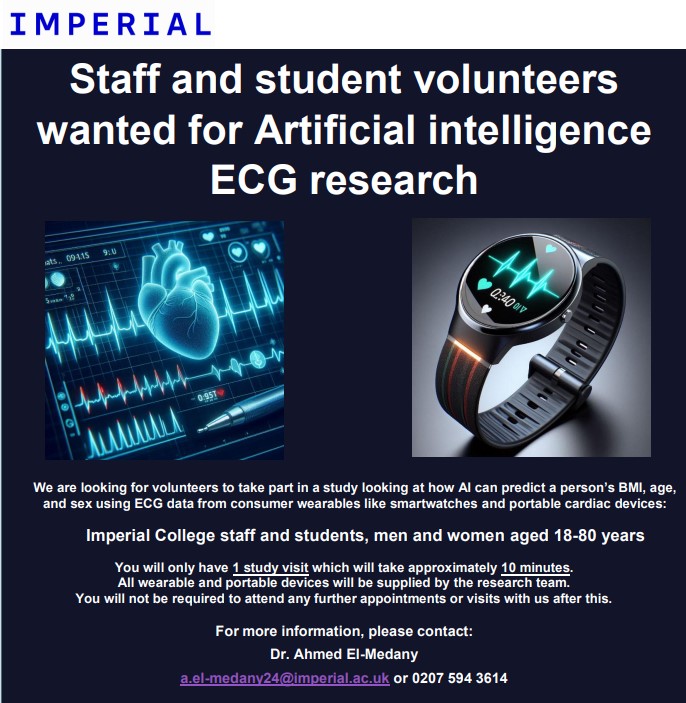
Staff and student volunteers wanted for Artificial intelligence ECG research!

Staff and student volunteers wanted for Artificial intelligence ECG research!

We are looking for volunteers to take part in a study looking at how AI can predict a
person’s BMI, age, and sex using ECG data from consumer wearables like
smartwatches and portable cardiac devices.

Who can take part?

  • Imperial College staff and students, men and women aged 18-80 years

Taking part involves 1 single study visit, lasting approximately 10 minutes:

  • A short health questionnaire
  • Having your height and weight measured
  • Having ECG recordings taken using Apple Watch, KardiaMobile, and Ekodigital stethoscope

For further information regarding our study, please visit:

https://cardiacep.ai/infosheet

If you are interested in taking part, we are currently taking appointments for study visits at the Imperial Centre for Translational and Experimental Medicine (ICTEM) via the following link:

https://cardiacepai.setmore.com/cardiacepai 

Please note, currently appointments are being taken up to 2 weeks in advance to avoid overbooking. New appointment slots will be available every week.

Many thanks for taking the time to read this email!

Dr. Ahmed El-Medany a.el-medany24@imperial.ac.uk

The Cardiac Electrophysiology & AI Research Group

Imperial College London

Imperial after:hours – day and evening classes for Imperial students and staff

Imperial after:hours is a programme of day and evening classes open to Imperial students and staff, and members of the public. Organised by the Centre for Languages, Culture and Communication, we have classes in various languages, ranging from Arabic, French and German. to BSL, Hindi and Spanish, as well as a huge range of arts and humanities courses.

Maybe you have always wanted to learn to play acoustic guitar or understand the meaning of art, or perhaps you want to make art yourself, on one our painting, printmaking and craft courses. We have day schools as well, including day trips this autumn to the medieval sites of Canterbury, Faversham and London, and day classes in topics including Christopher Wren’s architecture and art therapy.

No previous experience is needed for any course, there are no assessments or exams, and you’ll find our tutors are knowledgeable, friendly and welcoming.

Full details on all courses is available at www.imperial.ac.uk/afterhours. Classes are enrolling now.

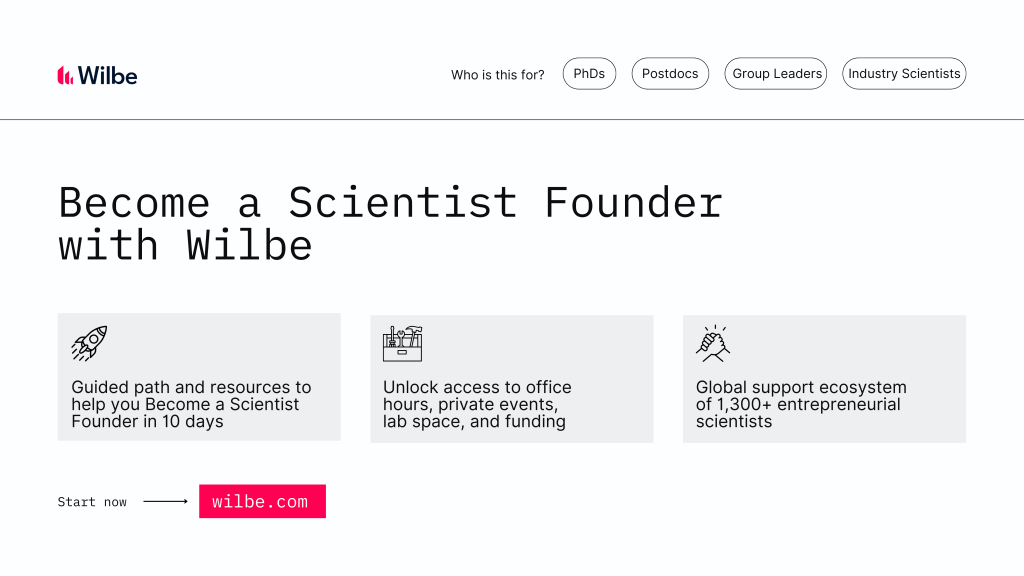
Become a Scientist Founder with Wilbe (BSF) – Now Live!

Become a Scientist Founder by Wilbe is live!

A free, open-access platform to help scientists and engineers move from research to enduring real-world impact with speed and precision.
Inside you’ll find:

  • A guided path to explore entrepreneurship, lay foundations, or build a company in 10 days.
  • A private community + weekly office hourswith the Wilbe team.
  • Access to curated events, lab space, and the wider Wilbe ecosystem.

Start now: wilbe.com

X
Become a Scientist Founder by @wilbe_science is live!

A free, open-access platform helping scientists + engineers turn research into real-world impact with speed and precision.

  • 10-day guided path
  • Community + office hours
  • Events, labs, ecosystem

wilbe.com

GTA Opportunity – Paid LaTeX development opportunity

The Research Computing and Data Science team are in the process of commissioning and collating a series of exemplar programming projects known as ReCoDE. These projects are designed to demonstrate good programming practice in research to help other students learn by example and include extensive annotation to explain their function and the design choices made.

We generally welcome any submission, but we are looking to commission a particular submission in the form of a LaTeX template for an Imperial doctoral thesis. This template should match all of Imperial’s thesis requirements and should not be overly complicated, such that a relatively inexperienced LaTeX user would have the background to understand it. The basic skeleton of the thesis and the formatting required to meet Imperial’s requirements should be the focus, but other useful pieces of LaTeX may also be demonstrated.  This template does not need extensive research content, but could include some if it helps to demonstrate the formatting tools used.

If you are interested in working on this exemplar, more information on contributing can be found here. Click on the “Pitch an exemplar here” button at the bottom of that page to submit a proposal. The next round of exemplars will be selected in the autumn, and we will review all proposals before reaching out to selected applicants to complete the exemplar over three months in the autumn term.

Authors of exemplar are paid as GTAs (or Casual Workers) for 45 hours of work at a rate of £35.78/hour, including holiday pay.

Opportunities for PhDs/Postdocs (Quant research roles)

Options Group is hiring in for an important hedge fund client who manage >$10bn in aum.  The client is looking to speak with entry level PhDs or Postdocs focusing on Machine Learning/AI, Math, Stats, Physics, Computer Science for various quant research roles based in London.  Additionally, about the client’s search:

They are looking for exceptional generalists—either applied researchers or theorists with some coding experience. Historically, statisticians have been the most common hires, but last year they hired more pure math candidates than any other background. They’ve also brought on people with publications in machine learning journals and active GitHub profiles. Their hires include computer scientists, including those focused on theoretical CS. One of their Partners in London, for example, comes from a theoretical physics background..

Interested parties can contact Keith Macksoud (Options Group, Executive Director) immediately with a CV.