Month: January 2026

#WNBiPonWednesdays: Charlotte Cao

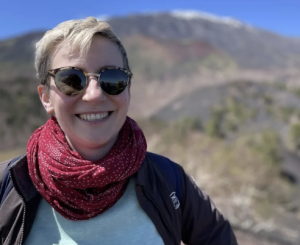
We are back for Week 3 of #WNBiPonWednesdays ! This week we spoke to Charlotte, a 3rd year undergraduate who is currently running the IPRL research branch in Space Society. Thank you for talking with us Charlotte! ⭐️

What is your favourite area in Physics?

I say something different every time someone asks, but I think maybe something fundamental, I really enjoy seeing beyond standard model physics. The data analysis and seeing it in experiments, there are so many phenomena beyond what the standard model predicts, for example charged particle asymmetry and its really cool to see it in experiments and try to fill in the gaps, I think that’s really interesting.
(more…)

#WNBiPonWednesdays: Dr Linda Cremonesi

We are back with another #WNBiPonWednesdays! This week we interviewed Linda Cremonesi, a UKRI Future Leaders Fellow and Associate Professor in Particle Physics. Thank you for taking the time to talk with us Linda 😁

Can you explain your area of expertise?

My area of research is particle physics, especially neutrinos. Neutrinos are somewhat like the smallest bit of matter that human brains could think of, because we don’t know how small their mass is. At most it’s 1eV, but it could be a million times smaller than that, or even more. My specialty is looking at neutrino oscillations– neutrinos come in three flavours (as far as we know), and when a neutrino is produced in a specific flavour, after it travels from a place to another this flavour can change. But what we don’t know yet is whether neutrinos and anti-neutrinos behave in the same way. The experiments that I work on are trying to understand the differences between neutrino and anti-neutrino oscillations. This is because we want to understand the differences in behaviour between matter and anti-matter and then link it to the origin of the universe.

(more…)

#WNBiPonWednesdays: Fatiha Tabassum

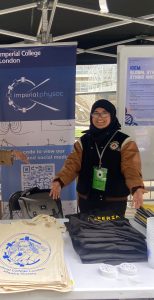
We’re excited to announce the return of #WNBiPonWednesdays this year, where we interview women and non-binary individuals in the Department of Physics, from undergraduates to professors! For our first interview, we’re delighted to feature our amazing PhySoc President, Fatiha, who is also a fourth-year MSci Physics student. Thank you so much for taking the time to speak with us!

Can you tell us about the topic of your MSci project?
My MSci project focuses on using machine learning to better understand gravitational waves, supervised by Professor Carlo Contaldi.
The work is mostly computational, like building the machine learning architecture and changing different parameters. We did a literature review on the theory from general relativity and Einstein’s work to how gravitational waves are detected today including machine learning techniques used by LIGO.

What kind of models are you currently working on?
Currently, we’re training a very simple model – using a sine wave as a signal and building a classifier to see if there’s a signal or not, and adding different types of noise. We are also using two different inputs, similar to LIGO which has two different detectors, by using the same signal but phase-shifted and with different noise profiles to reflect environmental changes.

(more…)