Blog posts

#WNBiPonWednesdays: Prof Marina Galand

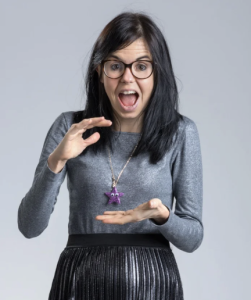
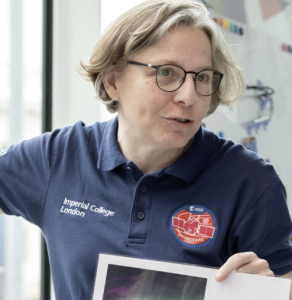
This week on #WNBiPonWednesdays, we are featuring Prof Marina Galand, a professor in planetary sciences! Thank you for your time!
What is your area of expertise?

My research focuses on plasma around planets, moons, and comets in the Solar System. More specifically, I am interested in the deposition and redistribution of solar and auroral energy in atmospheres. The deposited energy ionises the atmospheric neutrals; the induced plasma layer plays a critical role in the interaction of the body with its environment. The energy deposition can also be probed remotely, through, for example, the spectacular auroral emissions (or northern/southern lights at Earth). I have been developing and adapting kinetic and fluid models and have applied multi-instrument analysis, to interpret observations from space missions, including Cassini (Saturn and Titan) and Rosetta (comet 67P), and in preparation to JUICE (Jupiter and Ganymede) and Comet Interceptor. My research has evolved from pure modelling to data analysis and processing, and to instrumentation. I am currently leading the magnetometer on probe B2, as part of Comet Interceptor, the next space mission to a yet-to-be-discovered comet!
(more…)

#WNBiPonWednesdays: Dr Isabel Rabey

For this week’s #WNBiPonWednesdays, we’ve interviewed Dr Isabel Rabey, a senior teaching fellow in the Physics Education Group! Thank you for your time Izzie!.

What do you do on a day-to-day basis?

I’m a Teaching Fellow, which means I don’t do physics research anymore, but I’m focused on the education and the undergraduate curriculum. This year, I’ve been made Head of Year 1 Labs and Projects. So a lot of my time is spent learning what this role involves, so a lot of organizing, students, demonstrators, making sure everything runs smoothly, all the equipment and helping with the technicians, talking to them, all the assessments and the feedback – so a lot of new things that I’ve never done before.

(more…)

#WNBiPonWednesdays: Dr Serena Giardino

This week on #WNBiPonWednesdays we’ve interviewed Dr Serena Giardino, who joined Imperial last year as a postdoctoral researcher in theoretical physics. Thank you so much for speaking with us!

As an introduction, what is your area of expertise?

I study the force of gravity as a fundamental interaction, and its applications to cosmology. Gravity shapes the evolution of the universe and is the force that matters the most at these very large scales. These two things are very closely connected, which is why I think that they’re the coolest things to study!

In my research, we try to go beyond Einstein’s theory of general relativity. If you use general relativity for describing the universe, you have to postulate dark matter and energy. Our understanding of these components is only as good as our understanding of gravity. If we don’t understand gravity well enough, we could claim to have found dark energy, when we might just be misunderstanding gravity. I find this area extremely interesting because it addresses deep, fundamental questions, like what happened at the beginning of the universe. It’s always something that even children or teenagers find it interesting, because it relates to very fundamental questions.

(more…)

#WNBiPonWednesdays: Dr Jess Wade

We are back with another week of #WNBiPonWednesdays! This week we had the amazing opportunity to interview to Dr Jess Wade, an associate professor in functional materials! Thanks for taking the time to talk to us Jess. ⚛️🥼

As an introduction, what is your area of expertise?

I work in new materials for future technologies- optoelectronic, electronic, spintronic and quantum technologies. We are particularly interested in how we can use these molecules to tell us information about their environments. If we can make them really sensitive, they could be used for new types of magnetic imaging systems for brain scanning. My interest in molecules started from the physics department at Imperial, thinking about how we can use molecular (“organic”) semiconductors for solar panels. These molecules have very attractive properties for quantum technologies as well. Molecules have accessible quantum states (e.g. electronic or spin levels), that can be manipulated to create superpositions using optical or electrical pulses. They are also inherently reproducible, scalable and operate at room temperature, which is good for engineering quantum technologies ready for the real world. Imperial has great strengths in molecular semiconductors for optoelectronics, and the development of quantum sensors, so we’re in a great place to explore molecular quantum.

(more…)

#WNBiPonWednesdays: Ilinca Butu

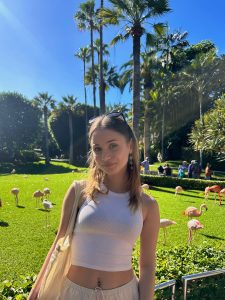
This week on #WNBiPonWednesdays we’ve interviewed Ilinca, a postgraduate student studying MSc Physics with Quantum Dynamics, and previously a researcher at Extreme Light Infrastructure. Thank you for speaking with us Ilinca!

As an introduction, can you talk about your path into physics?

Growing up in Romania with parents who studied physics, I thought I would go into something completely different like the creative arts. I knew I wanted to study abroad, but I was uncertain about what subject to choose. When the day came to submit UCAS choices, I clicked “physics” because it was the subject I had been good at in school. Today, I still have no idea what went on through my head!

I then studied MSci Physics at the University of Birmingham with a year abroad at the Hong Kong University of Science and Technology (HKUST) in my final year. After graduating, I spent almost two years working at the Extreme Light Infrastructure (ELI). This eventually led me to Imperial College London, where I am now studying for an MSc in Quantum Dynamics.

(more…)

#WNBiPonWednesdays: Idil Igde

We’re back with #WNBiPonWednesdays! For this post, we interviewed Idil, a second year physics undergraduate who won the 2025 Imperial FoNS-MAD innovation competition, securing £7,000 in funding and founding D-View. Thank you for speaking with us Idil!

Can you talk about your experience participating in FoNS-MAD competition, and founding D-View?

It was a very unique experience – I would definitely recommend it! The competition team was very supportive from the moment that we’ve applied and there are lots of opportunities, like getting a lab space, funding, and an advisor.

What we’re trying to have at the end is a micro seismic event detector that’s based on AI, so that it can be deployed in earthquake search and rescue. The motivation is from the 2023 Turkey-Syria earthquake. We’re both Turkish students, so it’s a very personal idea that’s close to our hearts, and receiving such support as two Turkish students in our first year at the university meant a lot for us. And after winning, thanks to the publicity we got from different social platforms, we were contacted by venture capitals and different investors about our product!

(more…)

#WNBiPonWednesdays: Charlotte Cao

We are back for Week 3 of #WNBiPonWednesdays ! This week we spoke to Charlotte, a 3rd year undergraduate who is currently running the IPRL research branch in Space Society. Thank you for talking with us Charlotte! ⭐️

What is your favourite area in Physics?

I say something different every time someone asks, but I think maybe something fundamental, I really enjoy seeing beyond standard model physics. The data analysis and seeing it in experiments, there are so many phenomena beyond what the standard model predicts, for example charged particle asymmetry and its really cool to see it in experiments and try to fill in the gaps, I think that’s really interesting.

(more…)

#WNBiPonWednesdays: Dr Linda Cremonesi

We are back with another #WNBiPonWednesdays! This week we interviewed Linda Cremonesi, a UKRI Future Leaders Fellow and Associate Professor in Particle Physics. Thank you for taking the time to talk with us Linda 😁

Can you explain your area of expertise?

My area of research is particle physics, especially neutrinos. Neutrinos are somewhat like the smallest bit of matter that human brains could think of, because we don’t know how small their mass is. At most it’s 1eV, but it could be a million times smaller than that, or even more. My specialty is looking at neutrino oscillations– neutrinos come in three flavours (as far as we know), and when a neutrino is produced in a specific flavour, after it travels from a place to another this flavour can change. But what we don’t know yet is whether neutrinos and anti-neutrinos behave in the same way. The experiments that I work on are trying to understand the differences between neutrino and anti-neutrino oscillations. This is because we want to understand the differences in behaviour between matter and anti-matter and then link it to the origin of the universe.

(more…)

#WNBiPonWednesdays: Fatiha Tabassum

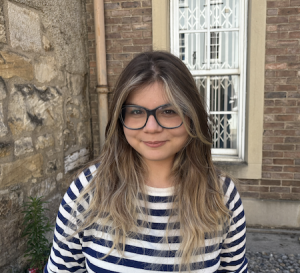
We’re excited to announce the return of #WNBiPonWednesdays this year, where we interview women and non-binary individuals in the Department of Physics, from undergraduates to professors! For our first interview, we’re delighted to feature our amazing PhySoc President, Fatiha, who is also a fourth-year MSci Physics student. Thank you so much for taking the time to speak with us!

Can you tell us about the topic of your MSci project?
My MSci project focuses on using machine learning to better understand gravitational waves, supervised by Professor Carlo Contaldi.
The work is mostly computational, like building the machine learning architecture and changing different parameters. We did a literature review on the theory from general relativity and Einstein’s work to how gravitational waves are detected today including machine learning techniques used by LIGO.

What kind of models are you currently working on?
Currently, we’re training a very simple model – using a sine wave as a signal and building a classifier to see if there’s a signal or not, and adding different types of noise. We are also using two different inputs, similar to LIGO which has two different detectors, by using the same signal but phase-shifted and with different noise profiles to reflect environmental changes.

(more…)

#WNBiPonWednesdays Anubha Bal

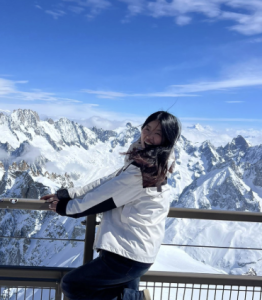
Welcome back to #WNBiPonWednesdays! For our latest interview, we spoke to Master’s student, Anubha, who is currently studying on the QFFF (Quantum Fields and Fundamental Forces) course. Thank you for your time Anubha!

As an introduction, describe your path into physics, what kickstarted it?

I had actually wanted to be a lawyer for a long time. I was quite headstrong and vocal about my opinions (not much has changed!), and my strongest subjects had always been the humanities in school so it felt like the appropriate career path. I didn’t pay much attention to science or maths as I felt I wasn’t “naturally” good at them. When I studied (Scottish) Higher Physics (Year 12 equivalent), we had a brief introduction to Special Relativity, and I started enjoying it much more after that. I still felt that physics didn’t seem to come “naturally” to me, but I was lucky to have very supportive teachers who suggested that I could be a scientist if I wanted to. I started dedicating more time to trying to really understand maths and science rather than just studying for the exams, and the more I did, the more I enjoyed them and the easier it became to do well. My decision to study physics over law was quite an impulsive one after that, and it’s the best decision I ever made!

(more…)