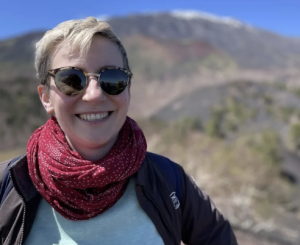
We are back with another #WNBiPonWednesdays! This week we interviewed Linda Cremonesi, a UKRI Future Leaders Fellow and Associate Professor in Particle Physics. Thank you for taking the time to talk with us Linda 😁
Can you explain your area of expertise?
My area of research is particle physics, especially neutrinos. Neutrinos are somewhat like the smallest bit of matter that human brains could think of, because we don’t know how small their mass is. At most it’s 1eV, but it could be a million times smaller than that, or even more. My specialty is looking at neutrino oscillations– neutrinos come in three flavours (as far as we know), and when a neutrino is produced in a specific flavour, after it travels from a place to another this flavour can change. But what we don’t know yet is whether neutrinos and anti-neutrinos behave in the same way. The experiments that I work on are trying to understand the differences between neutrino and anti-neutrino oscillations. This is because we want to understand the differences in behaviour between matter and anti-matter and then link it to the origin of the universe.
Can you describe the work you are currently doing?
Currently I work on two experiments. They’re called Long Baseline Neutrino Experiments, one of them is called NOVA, and the other one is called DUNE. NOVA is the currently running experiment. We produce muon neutrinos at Fermilab, and then we throw them to northern Minnesota, 810 kilometres away. Then we check which neutrinos get there. Many of these neutrinos change into the tau flavour, which you cannot see, and a few of them change into the electron flavour, which we can see. We look at these changes, and then we repeat the exact same experiment with anti-neutrinos. NOVA is currently taking data checking these changes. The second experiment I work on is called the DUNE, and it’s under construction, the idea is pretty much the same, but it’s going to be bigger and better in some sort of ways, so we’ll be able to produce more neutrinos, so have higher statistics, and the technology that we use to understand neutrino interactions is going to be higher quality, so we’ll have a better resolution and understanding what’s happening at the neutrino interaction level.
How do you detect the neutrinos?
Neutrinos are electrically neutral, so they don’t interact with the electromagnetic force, they’re leptons, so they don’t interact with the strong force, and they have a very small mass, although they can feel a little bit of the gravitational force, it’s tiny, tiny, tiny. The only way to see neutrinos is when they interact with the matter through the weak force and then produce other particles. We can never see a trace of a neutrino itself. The neutrino must have hit something, and this something is usually a nucleus. In the case of NOVA, the nucleus is either carbon or oxygen. We have a charge current interaction, in which a charged boson a W boson is exchanged. So, the neutrino is not a neutrino anymore, and it becomes a muon or an electron. Basically, what you see in our event display is nothing, nothing, nothing… and then a muon being produced in a boosted sort of direction from where you know the neutrino is coming from. Usually, other particles have been produced as well, sometimes protons or pions, depending on the neutrino energy. So that’s how we sort of see the neutrino, when most of the time when the neutrino is not a neutrino anymore and it became the charged lepton.
Can you describe your path into physics?
I grew up in the countryside of northern Italy. I did my bachelor’s at University of Milan in physics, and as a third year, I was able to be part of the Erasmus exchange programme at Queen Mary University of London. I almost got into neutrinos randomly, because all the other students chose their project three months before. By the time I got there a lot of the projects had already been taken. One of the leftover projects was a project about neutrinos. I didn’t know very much about them, but I ended up really liking it. I did a master’s at UCL, went back to Queen Mary to do a PhD, went back to UCL to do a postdoc, then went back to Queen Mary as an academic and fellow. A couple of months ago, I came to Imperial, moved my fellowship. In terms of research, it’s always been on neutrino oscillation experiments. During my undergrad and PhD, I was working on Japanese experiments that work in a similar way to DUNE and NOVA. During my postdoc at UCL, I worked on the Anita experiment, which still deals with neutrinos, but they’re ultra-high energy neutrinos that travel very long distances from outside the galaxy.
The idea of the experiment was there were a bunch of antennas attached to a giant helium balloon. Then every summer in Antarctica, there is a polar vortex which blows anti clockwise in a semi constant manner. So, when you sort of throw the balloon up in the air it travels anti clockwise for about a month. Then the radio antennas look down at the ice because when the high energy neutrinos interact with the ice, it produces a shower of particles, and this shower of particles also produces a thing called cascade radiation which is a small impulse in the radio frequencies, so very similar to the one that a piezoelectric will do, that is very deep in the ice so I was down in Antarctica in 2016 for that.
Why is public engagement important?
I’ve done a lot of public engagement and science outreach in general. I think it helps me connect with my research, my day-to-day job is sitting at a computer developing code or meetings and things like that. One of the things I like is sort of reconnecting to the reasons why I am doing this job. The second reason is pretty much visibility. A lot of people influenced me; I had a lot of role models and people that inspired me. I think if we can get more diversity into physics and more diverse thinking it would be a really good idea, public engagement and science outreach is a reason to get that. And a third reason is because, in the end, we are paid with public funds, so I think it’s important to be held accountable to the public on what we do.
Do you have any advice to other people that want to get into Physics?
When I started my journey in physics, there wasn’t necessarily someone like me. I’m an out gay woman, and at the time, I don’t think there were a lot of out gay people. The first people I met that were part of the LGBT community, were gay men. And so, I had to, in some sort of way, be my own role model, create a space for myself. So the advice to give to people is just don’t be afraid to be the first person like yourself, to be your own role model and create a space. If you don’t see someone like you in physics, it means we need someone like you in physics.