This week on #WNBiPonWednesdays we’ve interviewed Ilinca, a postgraduate student studying MSc Physics with Quantum Dynamics, and previously a researcher at Extreme Light Infrastructure. Thank you for speaking with us Ilinca!
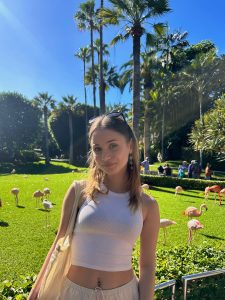
As an introduction, can you talk about your path into physics?
Growing up in Romania with parents who studied physics, I thought I would go into something completely different like the creative arts. I knew I wanted to study abroad, but I was uncertain about what subject to choose. When the day came to submit UCAS choices, I clicked “physics” because it was the subject I had been good at in school. Today, I still have no idea what went on through my head!
I then studied MSci Physics at the University of Birmingham with a year abroad at the Hong Kong University of Science and Technology (HKUST) in my final year. After graduating, I spent almost two years working at the Extreme Light Infrastructure (ELI). This eventually led me to Imperial College London, where I am now studying for an MSc in Quantum Dynamics.
How did your MSci and year abroad shape and shift your interests?
At Birmingham, I naturally gravitated toward particle physics through the modules I chose, and for a while I fully expected to pursue a PhD in that area. However, my experience was heavily shaped by COVID – my second year was largely online which limited my ability to engage with labs, staff, and research culture in person.
My year abroad at the Hong Kong University of Science and Technology (HKUST) became a major turning point. I took a Quantum Information course that introduced me to concepts like qubits and quantum algorithms, which opened my eyes to quantum technologies. I got to meet exchange students from diverse backgrounds outside of physics, which helped me realise that my career path didn’t have to be fixed.
What did your two years at the Extreme Light Infrastructure involve?
I worked on fundamental tests of physics which require quantum technologies. My group was interested in the birefringent properties of a vacuum which required developing highly sensitive detection schemes. Much of my work was computational, analysing how different interferometer configurations affected phase sensitivity. Contrary to cases usually considered in literature, the interferometer does not always need to be perfectly balanced, depending on the input state. I presented our work on this topic at conferences and wrote a paper that has since been accepted. My interactions with the research community helped me feel like a peer rather than just a student.
This experience also clarified my preferences: while I enjoyed the theory and simulations, I realised I did not want a purely computational PhD and I needed more hands-on, experimental work.
What has been your experience as a woman in physics?
Overall, my experience as a woman in physics has been quite positive. Within my own peer groups I’ve often had more women friends. I do notice that the gender imbalance is more visible among senior academics and professors, which reflects historical trends, but it hasn’t defined my experience – I’ve found physics to be an inclusive environment.
There have been a few moments where I was the only woman in a room or felt that a senior academic avoided making eye contact with me or directed their attention mainly toward the men. However, I interpret that more as a reflection of that individual rather than of physics as a whole. I’ve already experienced people sometimes perceiving me differently as I was born with a disability, so I tend to view that as revealing more about the person than about the field itself.
What is your favourite part of the MSc course and what are you working on at the moment?
On the Quantum Dynamics stream of the MSc, there is no project work in the first term, with self-study in the second term and the main research project in the summer. Until recently, most of my engagement with staff was through my role as course rep. My self-study focuses on molecular ions as quantum resources. Initially, I worried that it would need to align perfectly with my summer project, but I’ve come to realise that this isn’t necessary – especially since project choices are limited and not fully in students’ control.
What I’m enjoying most about the course is gaining formal, foundational understanding. In my previous research, I was using many advanced concepts, but often without fully appreciating where they came from. Now, they are clicking into place in a much deeper way, which has been extremely satisfying.
What advice would you give to your younger self?
Looking back, I would tell my younger self that you don’t actually need to know everything before starting a PhD. Although I was fortunate to have the option to take time out, I now wish I hadn’t let concerns about not having a “strong enough” recommendation letter or feeling underprepared hold me back.
A PhD is fundamentally a learning process – it isn’t something you’re supposed to enter already fully expert in. I realise now that expecting myself to be overqualified before even beginning was unrealistic, much like the tendency many women have to feel they must exceed every requirement before applying for something. With the research experience I now have, I feel I could begin a PhD tomorrow. What matters most is curiosity, commitment, and the ability to learn.
What do you do in your free time, apart from physics?
Because I’m only in London for one year, I’m trying to make the most of the city, although balancing that with the MSc has been challenging. I aim to explore new areas or parks each week, but I find London different to navigate compared to places like Bucharest or Hong Kong!
I used to do fencing in Birmingham, but nowadays I tend to stay local or focus on creative, hands-on hobbies. I knit, crochet, paint, and do other crafts – partly because I enjoy making things, but also because I like having something tangible to work on with my hands.