This week on #WNBiPonWednesdays we’ve interviewed Dr Serena Giardino, who joined Imperial last year as a postdoctoral researcher in theoretical physics. Thank you so much for speaking with us!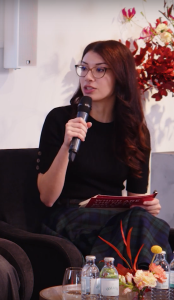
As an introduction, what is your area of expertise?
I study the force of gravity as a fundamental interaction, and its applications to cosmology. Gravity shapes the evolution of the universe and is the force that matters the most at these very large scales. These two things are very closely connected, which is why I think that they’re the coolest things to study!
In my research, we try to go beyond Einstein’s theory of general relativity. If you use general relativity for describing the universe, you have to postulate dark matter and energy. Our understanding of these components is only as good as our understanding of gravity. If we don’t understand gravity well enough, we could claim to have found dark energy, when we might just be misunderstanding gravity. I find this area extremely interesting because it addresses deep, fundamental questions, like what happened at the beginning of the universe. It’s always something that even children or teenagers find it interesting, because it relates to very fundamental questions.
What are you currently working on, and what do you do on a day-to-day basis?
I work on modified gravity theories and their cosmological implications. It’s what I did my PhD on, but now I’m coming at it from another angle in my postdoctoral research.
I collaborate with people in my group as well as back in Germany, where I did my PhD. Our meetings involve calculations with pen and paper, and more recently also computational stuff. For example, we use Mathematica or similar things like Python to model different modified gravity theories and try to understand how to test them. For example, there are many theories for gravitational waves that one can come up with, but we need to test them with observational data. This is really important to me – I actually care about nature and the data that we get from telescopes and experiments.
I go to a lot of seminars and events organised in our department with people coming from other institutions too. I really like the collaborative aspect of physics, exchanging ideas with people and not sitting in my room all day
Can you tell us about your path into physics?
I’m originally from Italy, so I studied in Bologna, which is a very nice university town, and completed my Bachelor’s degree in Astronomy. I was always fascinated about the universe and the big questions, but I then began to really enjoy the rigorous, foundational work of theoretical physics. I then did my Master’s in Theoretical Physics, (still in Bologna), but I also spent a semester abroad in Munich.
During my time there, I really fell in love with Germany and realised I wanted to do my PhD there. So I moved to Potsdam, which is a city near Berlin, to do my PhD, and stayed for an additional year as a postdoctoral researcher at the Max Planck Institute for Gravitational Physics (also known as the Albert Einstein Institute). After several years in Germany, I obtained a postdoctoral position at Imperial College London, where I now work with Prof. Claudia de Rham.
Do you have any advice for your younger self?
One important lesson I learnt is to not attach your entire identity to being a researcher, or being the best physics student. When I was younger, I grew up wanting to be the best in class and wanting to learn everything, I carried this with me deeply. In a way, it was good because it made me very ambitious and want to do well, but it eventually led me to burnout when I started my PhD.
My PhD itself was quite a rocky journey. With little in-person contact due to COVID, it was a tough and isolating period. I also began with a supervisor who left after one year, but luckily found another supervisor who took me on and has since become a role model for me. It taught me that I didn’t have to attach my whole identity to being a physicist. I had to find other things in life that were also a strong part of my identity, so I decided to spend more time doing hobbies and being with other people and caring more about relationships. I think this type of support system is really needed since it gives you a sort of stability when, when things go wrong in one area or another.
Something else I would suggest is to find a mentor. This has been really important to me, because there are not a lot of women in physics, so seeing someone like Claudia de Rham who is not only an absolute powerhouse of research, but also a great person on personal level, is really inspiring to see.
I also learned that there are different definitions of success. In theoretical physics, a lot of girls don’t feel confident in pursuing it because they feel like they need to be a genius. That is not true, and otherwise I would not be here. What matters is the hard work that that you put in and the curiosity with which you approach things. In some areas like astronomy, the culture feels more collaborative – thousands of people operate telescopes and interpret the results together. There are more women in astronomy than in theoretical physics – I think this is partly because the stereotype of the lone “genius” isn’t as strong; people feel they can contribute their part simply out of interest. That stereotype in theoretical physics is really unhelpful, and I wish it didn’t shape the field so strongly.
Can you tell us about your outreach work and why it is meaningful to you?
Outreach is one of the most meaningful things for me. I do something that is very theoretical abstract – there are no humans in what I’m researching, apart from the people I collaborate with. I really like teaching and mentoring younger students, and I think the public deserves to know the fruits of the research that we have conducted. It’s a way of giving back to society for allowing us to do this work, and it’s extremely satisfying to see the genuine curiosity that kids and some adults have about how the universe works.
Opening up a new horizon for someone is one of the most satisfying things ever. Working in a very abstract field can sometimes feel disconnected from society, even though it advances human knowledge. There are lots of problems with misinformation and not knowing how to distinguish what is reliable, so I do think that it’s really important to share what we know and how to analyse and learn things about the world. I think these are basic skills that we need to pass on. It’s really important in the world that we’re living in and spread the fascination with the universe is just extremely rewarding.
What has your experience been like as a woman in theoretical physics?
The most important positive has been having a career that is intellectually stimulating and never boring. The work itself is extremely interesting, and I can’t get enough of that. I’ve also met and collaborated with some amazing people who are not only smart and motivated but also genuinely great on a personal level. Traveling to conferences and experiencing different cultures has been rewarding too.
Early on, I struggled with self-doubt and insecurities, especially as a woman in a male-dominated field. Completing my PhD greatly strengthened my confidence. I was fortunate not to face active undermining, so the main obstacles were my own beliefs about myself. There is also intense pressure to excel, which can lead to burnout – something I experienced and observed in others. I’ve learned that mental and physical health must come first. Another challenge is balancing a research career with family life. The system rewards single-minded dedication, which makes it hard for people – especially women – who want both a career and family. Constantly uprooting life is rewarding in some ways but can be difficult in the long term.
What do you do outside of physics?
I love reading books, both fiction and non fiction. I’m a big fan of classic literature especially from Russia or Germany, 19th century novels and the worlds that they create. I’ve been really into neuroscience lately, too and am part of some book clubs where we read non-fiction books and come together and discuss them.
I also love exercising. It’s something that I didn’t do much when I was younger, but the benefits and fun that I have with it now is incredible. I love long distance running and I’m currently training for a half marathon, and I also try to be out in nature through hiking.
Something else I like is music! Piano used to be a big part of my life, so I love going to the theatre to listen to classical music concerts or opera, which is the love of my life. Especially in London, there’s so much going on in theatres, museums and plays.