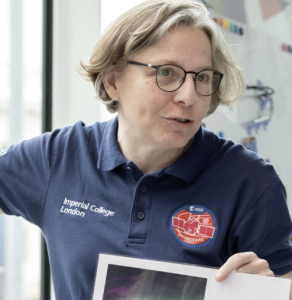
This week on #WNBiPonWednesdays, we are featuring Prof Marina Galand, a professor in planetary sciences! Thank you for your time!
What is your area of expertise?
My research focuses on plasma around planets, moons, and comets in the Solar System. More specifically, I am interested in the deposition and redistribution of solar and auroral energy in atmospheres. The deposited energy ionises the atmospheric neutrals; the induced plasma layer plays a critical role in the interaction of the body with its environment. The energy deposition can also be probed remotely, through, for example, the spectacular auroral emissions (or northern/southern lights at Earth). I have been developing and adapting kinetic and fluid models and have applied multi-instrument analysis, to interpret observations from space missions, including Cassini (Saturn and Titan) and Rosetta (comet 67P), and in preparation to JUICE (Jupiter and Ganymede) and Comet Interceptor. My research has evolved from pure modelling to data analysis and processing, and to instrumentation. I am currently leading the magnetometer on probe B2, as part of Comet Interceptor, the next space mission to a yet-to-be-discovered comet!
Can you describe the path you took to get here?
I did my undergraduate studies in France, obtaining a BSc in Math, a Master in Physics and an Engineering degree. After a PhD on the modelling of proton-induced aurora, in Grenoble, France, I headed to the US where I worked first at two space research centres in Boulder, Colorado, and then at Boston University. I next joined Imperial as a Lecturer. This path may seem smooth, but every few years I would question myself about the direction, the type of work I would like to do, the country where to live. Once the decision taken, I would embrace it fully for a few years without questioning it. I found it to be the best way to stay productive while enjoying it.
What have your experiences been like as a woman in Physics? (the good and the bad)
For a long time I thought of myself as a scientist, not as a woman scientist. While the experience has been mostly positive, at times I had to build a shield against misogynistic attitudes and to prove more than my male counterparts. When becoming a mother, I found it difficult first to reach the right balance between family and work, and not to feel guilty at home or at work. I am trying to be fully present at each moment of life, embracing the role I have at that time.
Do you have any advice for Women in Physics who hope to continue into research?
- Find and follow your passion. It will be easier to invest time and energy, and persevere.
- Believe in you, in what you can achieve. There is nothing which you cannot do because you are a woman.
- Identify the questions to tackle, have a plan to address them, but remain open minded on the outcome of your research.
- It is essential to be honest and critical. Be aware of what you know and what you do not.
- Do not hesitate to reach out to those who can help you and provide the expertise which you are missing. Collaboration is an essential part of research. At the same time, transmit, share, and inspire others.
- It may be tough at times, but it is worth the journey!
What are your interests outside of Physics?
Being a mother is the most inspiring, fulfilling, yet challenging journey in life. Besides this life adventure, I love hiking, playing piano, and sharing time with family and friends. I am curious of the world around us and enjoy exploring it.