We’re excited to announce the return of #WNBiPonWednesdays this year, where we interview women and non-binary individuals in the Department of Physics, from undergraduates to professors! For our first interview, we’re delighted to feature our amazing PhySoc President, Fatiha, who is also a fourth-year MSci Physics student. Thank you so much for taking the time to speak with us!
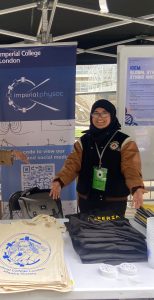
Can you tell us about the topic of your MSci project?
My MSci project focuses on using machine learning to better understand gravitational waves, supervised by Professor Carlo Contaldi.
The work is mostly computational, like building the machine learning architecture and changing different parameters. We did a literature review on the theory from general relativity and Einstein’s work to how gravitational waves are detected today including machine learning techniques used by LIGO.
What kind of models are you currently working on?
Currently, we’re training a very simple model – using a sine wave as a signal and building a classifier to see if there’s a signal or not, and adding different types of noise. We are also using two different inputs, similar to LIGO which has two different detectors, by using the same signal but phase-shifted and with different noise profiles to reflect environmental changes.
Where did you go for your IROP last year, what was the project about?
I completed my IROP at the Technical University of Munich, with a nanomagnetism group within the electrical engineering department. My work involved understanding how spin waves induced by magnetic fields can be used to propagate and store information. Information can be encoded in the amplitude, phase, and frequency of the wave, so they can be more efficient than classical transistors. I mainly worked on electrical characterisation of the spin waves using Vector Network Analyser measurements and MATLAB, producing frequency spectra across a range of magnetic field strengths.
When did you first become interested in physics?
I became interested in physics around Year 12, but my interest in mathematical and physical sciences started in around Year 11. I took part in a 10-week engineering outreach programme for girls, which ran over several weekends. Before that, I wanted to do something medicine related, but afterwards I was really interested in mathematical modelling and how maths can be used to build stuff like cars.
What is your favourite part of being President of the Physics Society?
My favourite part is being able to make things happen within the department! I also really enjoy connecting with students across different year groups.
This year, we expanded the Christmas Dinner to accommodate more students than previous years. We are also expanding QUIRK, the London undergraduate physics conference. This year, it will include universities beyond London such as Oxford, Cambridge, and will run over two days across multiple locations!
I also love working with my team and I’m really lucky to have very active committee members!
What advice would you give to younger physics students?
In Year 1, literally just enjoy your life! But also keep up to date since it also sets the momentum for later years. But if you do badly, it’s not the end of the world – just means you have to do better in second year. I think I would tell myself to tone down on extracurricular activities, too – really important to create a balance. That said, first year is the time to explore societies and meet people. You will meet the right people eventually, so there is no need to force connections, but being open and talking to people helps.
What do you do outside of physics?
Outside of physics, I work as a Recruitment and Outreach Student Ambassador. I enjoy going to the gym, playing badminton, and generally staying active too! I also practice taekwondo and earned my yellow belt last year. I competed in university taekwondo competitions and won a bronze medal in my second year.