Author: Sally Doong

#WNBiPonWednesdays: Dr Serena Giardino

This week on #WNBiPonWednesdays we’ve interviewed Dr Serena Giardino, who joined Imperial last year as a postdoctoral researcher in theoretical physics. Thank you so much for speaking with us!
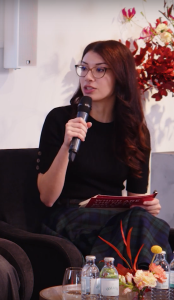
As an introduction, what is your area of expertise?

I study the force of gravity as a fundamental interaction, and its applications to cosmology. Gravity shapes the evolution of the universe and is the force that matters the most at these very large scales. These two things are very closely connected, which is why I think that they’re the coolest things to study!

In my research, we try to go beyond Einstein’s theory of general relativity. If you use general relativity for describing the universe, you have to postulate dark matter and energy. Our understanding of these components is only as good as our understanding of gravity. If we don’t understand gravity well enough, we could claim to have found dark energy, when we might just be misunderstanding gravity. I find this area extremely interesting because it addresses deep, fundamental questions, like what happened at the beginning of the universe. It’s always something that even children or teenagers find it interesting, because it relates to very fundamental questions.
(more…)

#WNBiPonWednesdays: Ilinca Butu

This week on #WNBiPonWednesdays we’ve interviewed Ilinca, a postgraduate student studying MSc Physics with Quantum Dynamics, and previously a researcher at Extreme Light Infrastructure. Thank you for speaking with us Ilinca!

As an introduction, can you talk about your path into physics?

Growing up in Romania with parents who studied physics, I thought I would go into something completely different like the creative arts. I knew I wanted to study abroad, but I was uncertain about what subject to choose. When the day came to submit UCAS choices, I clicked “physics” because it was the subject I had been good at in school. Today, I still have no idea what went on through my head!

I then studied MSci Physics at the University of Birmingham with a year abroad at the Hong Kong University of Science and Technology (HKUST) in my final year. After graduating, I spent almost two years working at the Extreme Light Infrastructure (ELI). This eventually led me to Imperial College London, where I am now studying for an MSc in Quantum Dynamics.

(more…)

#WNBiPonWednesdays: Idil Igde

We’re back with #WNBiPonWednesdays! For this post, we interviewed Idil, a second year physics undergraduate who won the 2025 Imperial FoNS-MAD innovation competition, securing £7,000 in funding and founding D-View. Thank you for speaking with us Idil!

Can you talk about your experience participating in FoNS-MAD competition, and founding D-View?

It was a very unique experience – I would definitely recommend it! The competition team was very supportive from the moment that we’ve applied and there are lots of opportunities, like getting a lab space, funding, and an advisor.

What we’re trying to have at the end is a micro seismic event detector that’s based on AI, so that it can be deployed in earthquake search and rescue. The motivation is from the 2023 Turkey-Syria earthquake. We’re both Turkish students, so it’s a very personal idea that’s close to our hearts, and receiving such support as two Turkish students in our first year at the university meant a lot for us. And after winning, thanks to the publicity we got from different social platforms, we were contacted by venture capitals and different investors about our product!

(more…)

#WNBiPonWednesdays: Fatiha Tabassum

We’re excited to announce the return of #WNBiPonWednesdays this year, where we interview women and non-binary individuals in the Department of Physics, from undergraduates to professors! For our first interview, we’re delighted to feature our amazing PhySoc President, Fatiha, who is also a fourth-year MSci Physics student. Thank you so much for taking the time to speak with us!

Can you tell us about the topic of your MSci project?
My MSci project focuses on using machine learning to better understand gravitational waves, supervised by Professor Carlo Contaldi.
The work is mostly computational, like building the machine learning architecture and changing different parameters. We did a literature review on the theory from general relativity and Einstein’s work to how gravitational waves are detected today including machine learning techniques used by LIGO.

What kind of models are you currently working on?
Currently, we’re training a very simple model – using a sine wave as a signal and building a classifier to see if there’s a signal or not, and adding different types of noise. We are also using two different inputs, similar to LIGO which has two different detectors, by using the same signal but phase-shifted and with different noise profiles to reflect environmental changes.

(more…)