
Taking a medicine every day might seem straightforward, but for many people it is anything but. In this blog, Javiera Rosenberg shares how her PhD research explored why patients stop taking statins and how those insights led her to develop a tailored text messaging intervention to support adherence.
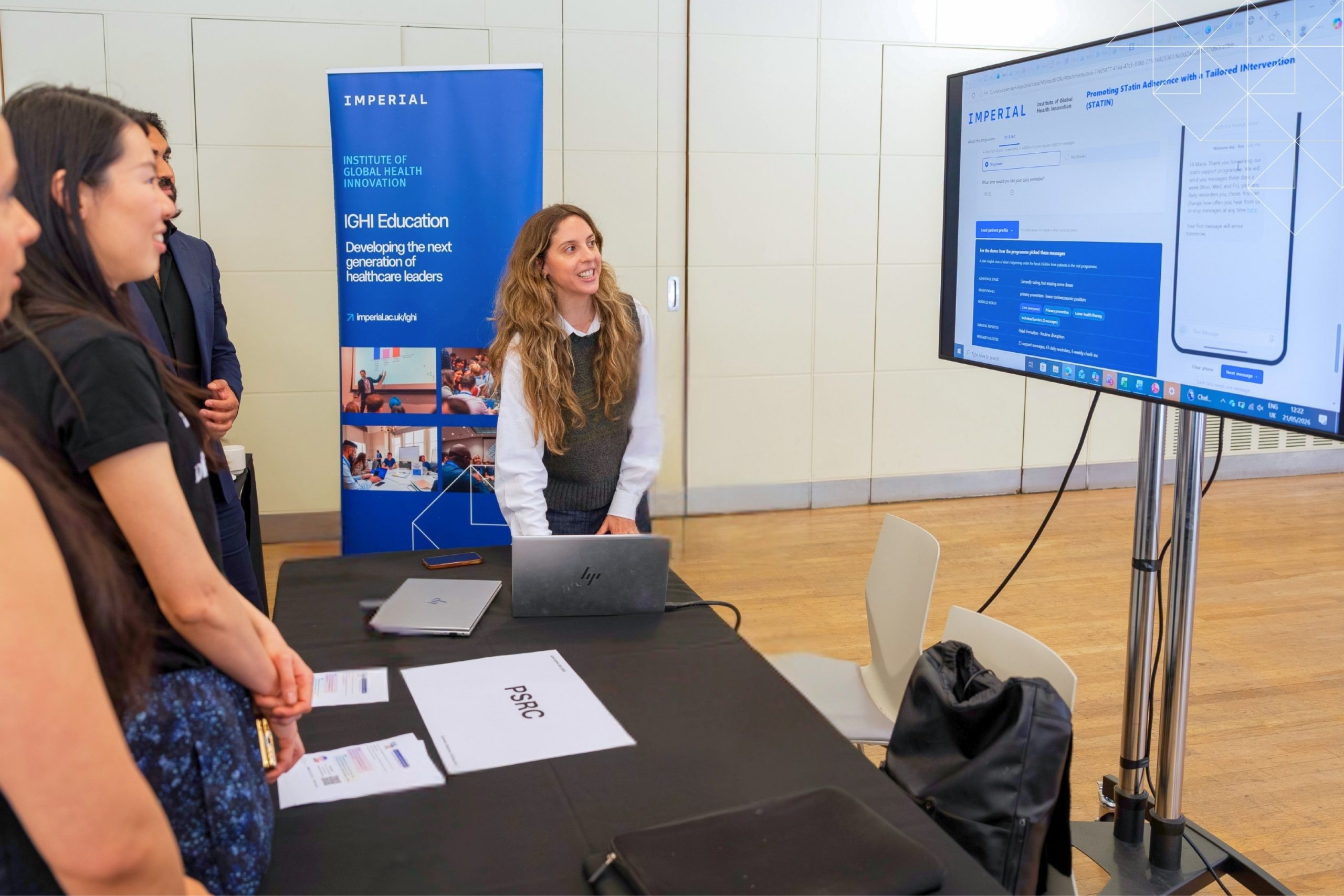
Javiera Rosenberg is a PhD researcher at the NIHR Patient Safety Research Collaboration: North West London, based at the Institute of Global Health Innovation. In her own words, she reflects on the behavioural science, patient co-design and digital innovation behind the intervention.
A GP is running an NHS Health Check. They calculate a QRISK score, which estimates the patient’s risk of a heart attack or stroke over the next 10 years. The score comes back high, so statins are offered: a daily tablet that lowers cholesterol and, with it, the risk. The patient is surprised, as their cholesterol is normal and has never been a problem. The GP recommends the tablets and the patient accepts, but there is little time to explain the details.
At home, the patient searches for statins online. Within minutes, they find alarming stories about side effects, from muscle pain to dementia. A few weeks later, a new ache appears. Could it be the tablets? If their cholesterol is normal, is the tablet even needed, and is it worth the risk? Quietly, the patient stops taking them.
A life-saving medicine, often left untaken
Our patient is far from alone. Around eight million people in the UK are prescribed statins, yet many do not take them as prescribed: around one in four never start, nearly half miss doses regularly, and three in 10 stop within the first year. Researchers call this “statin nonadherence”, and it is costly precisely because statins work. By lowering the cholesterol that builds up in the arteries, they prevent heart attacks and strokes and save thousands of lives each year, even in people whose cholesterol seems normal. In one study, people who frequently missed doses or did not take their statin during the year after a heart attack were around 70 per cent more likely to die in the following year than those who took it as prescribed.
Like many other public health issues, statin nonadherence is not spread evenly. The groups at highest risk of heart disease, including people from minority ethnic and socioeconomically disadvantaged communities, are the least likely to take statins as prescribed, but also the least represented in adherence research.
Understanding why people do not take statins as prescribed
Statin nonadherence, and what to do about it, has been the focus of my PhD at the NIHR Patient Safety Research Collaboration: North West London, supervised by Dr Gaby Judah, Professor David Wingfield and Dr Sara Garfield (UCL School of Pharmacy). What first drew me to this problem is that statins’ benefits depend on something often taken for granted: whether people actually take them. The prescription is issued, and the rest is assumed to follow. But taking a medicine every day is a behaviour, and like any behaviour it is shaped by many things: what people believe, how their days are organised, what they read and hear about their medicines. This is where behavioural science comes in: it offers ways to work out what gets in the way, and to design support that addresses it.
Our patient’s story shows how this plays out, but it captures only some of the reasons behind nonadherence. To map the full picture, I conducted a systematic review of 70 studies worldwide and interviews with 17 patients from diverse backgrounds, and I combined what these showed with an earlier survey of 233 primary care patients carried out by our team.
The reasons for statin nonadherence, or “barriers” as behavioural scientists call them, turned out to be remarkably varied. Across the three studies, we identified 46 barriers that an intervention could address. Some were common to almost everyone, such as not fully understanding what statins do or why they had been prescribed. Others were specific to particular patient groups. Patients from minority ethnic backgrounds questioned whether statins had been tested on “people who look like me.” Those taking several medicines described the burden of managing them all, with statins often the first to slip. And people prescribed statins before a stroke or heart attack doubted whether they needed them at all; they still saw themselves as healthy. Still others varied from one person to the next: experiencing side effects, forgetting doses, or lacking practical and emotional support at home.
“I was quite against taking statins because I always felt that I had a very good lifestyle.”
— Patient interview participant
A trade-off between personal support and wide reach
This variety of barriers is the heart of the challenge. Support that works has to address each person’s personal barriers and reach millions of patients within an overstretched NHS. Existing approaches meet one requirement but not the other. One-to-one support, such as counselling, is effective because it is personalised; but a professional helping one patient at a time is expensive at scale. Digital interventions can reach millions at very low cost, but most send the same content to everyone, leaving individual barriers unaddressed, which may partly explain their inconsistent success. So, the question is: how can we do both?
Messages tailored to each patient
Our answer brought together three ingredients: behavioural science to help people change what they do; working with patients and healthcare professionals to create relevant and acceptable messages; and the right technology to deliver them at scale. Behavioural science came first.
Using established frameworks, I matched each barrier to the techniques most likely to address it. This produced the intervention’s raw material: for every technique, I specified what it needed to do and who it was for: everyone, a patient group, or an individual.
But techniques are not messages. To turn one into the other, my team and I ran eight workshops with 48 patients from a range of backgrounds and 22 primary care healthcare professionals. Three public partners worked with us throughout, shaping the recruitment, the activities and the messages. The workshops changed the intervention in ways we could not have predicted. For instance, a message noting that taking statins benefits the NHS was rejected by some patients, yet motivated others, so it moved from the set everyone receives into a tailored one. Message by message, the content was tested, discussed and rewritten, and checked by healthcare professionals to make sure they were clinically safe and accurate. They also made sure it could run in a GP practice without extra workload. Patients differed over when and how texts should arrive, so these choices were left to them.
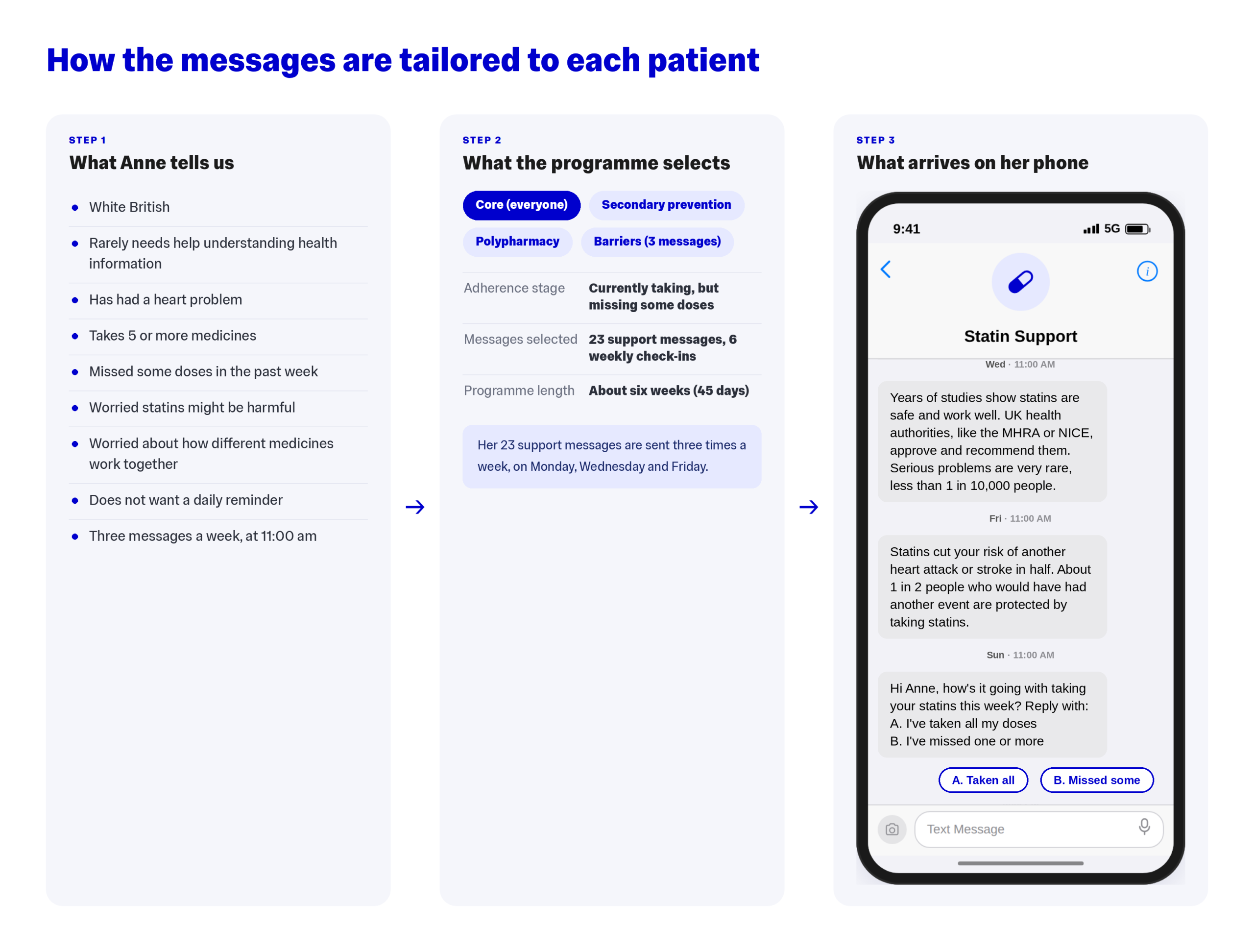
Out of this work came a tailoring questionnaire: questions for each patient about their barriers, preferences for receiving messages and reminders, and details about their health and background. Thanks to their responses, we could personalise the messages to their individual or group needs.
Technology was the third ingredient that brought it all together. We chose text messages over an app or automated calls because, in our survey, 84 per cent preferred SMS. Texts work without internet or complex digital skills. This is particularly important because the patients we most want to reach often face those challenges. As one patient put it:
“I’d like text messages because I’m not very good with technology.”
— Patient interview participant
Then I wrote the code that runs the programme. It turns each patient’s answers into their personal message schedule: which texts they receive, whether reminders are included, and when and how often each one arrives. From there, everything runs automatically.
How does it work for the patients?
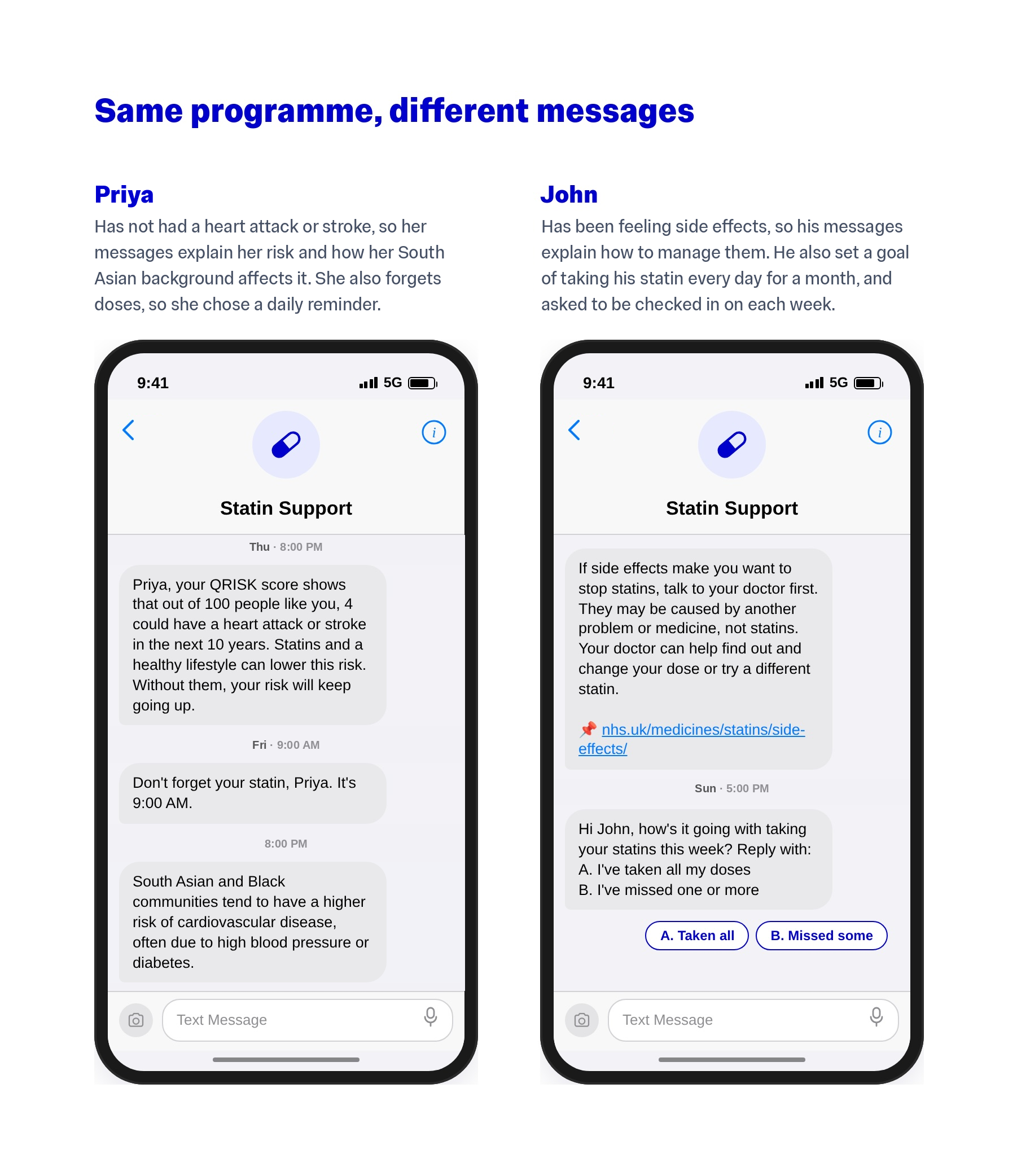
What the patient experiences is simple. It starts with a text from their GP surgery, inviting them to receive support with their statins. A link in that message takes them to key information, consent and the tailoring questionnaire described earlier. Then the texts begin. Someone who reports side effects gets advice on managing them and reassurance that these usually settle within a few days. Someone juggling five medicines gets practical advice on ways to organise them. Someone with lower health literacy gets more of the basics, starting with what cholesterol is. Everyone receives the essentials: why statins matter and how to take them. Patients can text back to say how they are getting on, to flag a new problem, or to add daily reminders. The programme lasts around three months, long enough for new habits to take hold.
What patients told us
A group of patients from a North West London GP surgery were recently invited to try the messages for a month, and 11 of them shared their experiences through a survey and focus groups. Patients described the messages as clear, easy to read and kind, and said taking part took little effort, exactly what we had hoped for. They said the texts felt personal and made them feel supported. Many reported that they felt more confident and reassured about taking statins, understood better why they were taking them, and remembered to take them on time. Almost everyone said they would recommend them to others. The cost of delivery was about £5 per patient, an early sign that we can deliver personalised support in a simple, scalable way. Patients told us what could be better, and their suggestions are shaping the next version of the messages.
“I heard a lot of bad publicity about statins until I started getting those texts… Even just reading them quickly made me feel more reassured that these tablets are all right.”
— User testing participant
Looking ahead
This is the first statin adherence intervention to be fully automated, tailored and co-designed. The next step is to work out how we can evaluate whether it improves adherence. We are preparing a funding application for a feasibility study, which will examine how best to reach and recruit patients, whether they stay engaged over time, and how adherence can be measured reliably, laying the groundwork for a full trial. If that trial one day shows the intervention works, even modest gains in adherence could prevent heart attacks and strokes and save lives. It could also reduce pressure on the NHS and help narrow health inequalities. As for me, I am completing my PhD on this work and hoping to carry the intervention into its next phase.
Click here to explore the project page
This project is funded by the National Institute for Health and Care Research (NIHR) under its Research for Patient Benefit (RfPB) Programme (Grant Reference Number NIHR205407). Infrastructure support for this study was provided by the NIHR Patient Safety Research Collaboration: North West London (NIHR PSRC: NWL, Ref. NIHR204292). The views expressed are those of the author(s) and not necessarily those of the NIHR or the Department of Health and Social Care.