The road from PhD research to global policy can seem long and winding, but for early-career researchers from Imperial’s Centre for Environmental Policy (CEP), it often leads straight to some of the world’s most high-stakes negotiation rooms.
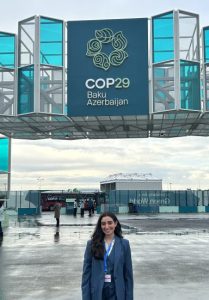
From the fluorescent-lit halls of COP29 to the side-event stages at the UN ECOSOC Forum, CEP students are not only observing, but actively feeding scientific expertise into policymaking conversations. It’s a part of academic life that few – even researchers – ever see. Here are three stories of young voices helping to shape global policy.
At the table
When Elsy Milan stepped into the Blue Zone at COP29, she wasn’t there to spectate. Representing Lebanon as part of the Arab Group, she was thrust into one of the thorniest tracks of the climate negotiations: Article 6, the rules surrounding carbon markets.
For a PhD student, it was an unusually frontline role. “They gave me the draft text and said, ‘This is your block. Sit in the front. Listen, don’t speak – yet,’” she said, “Everything was on the fly.”
Elsy had earned the Lebanese delegation’s trust over several years through her earlier involvement in the World Bank’s Youth for Climate programme, her observer role at COP28 with Imperial’s Grantham Institute, and the fact that her doctoral research aligned exactly with what Lebanon lacked: expertise in market-based climate policies.
Her days at COP were relentless. “There’s no fixed schedule. You check this internal system they call the ‘CCTV’ at 6am and suddenly you’re running to a session at 8,” she said. Negotiations often stretched late into the night. She remembers trudging through Azerbaijan’s Olympic Stadium at 01.00, long after public transport had stopped. Her boots, she admits, weren’t made for this. Her advice? “Never wear heels to COP,” she said.
As a first-time negotiator, she said that her role is to cement Lebanon’s commitment to the process: “You’re part of a group, and that group’s visibility matters. Sometimes just showing up is a kind of pressure.”
What Elsy found most valuable, however, was the two-way street between her research and the negotiations. “You see how countries respond to ideas like CBAM [Carbon Border Adjustment Mechanism] and how technical mechanisms clash with political priorities,” she said. “And you come back to your desk with new focus. Before COP, I’d search for ‘carbon markets’. After COP, I was searching for ‘CBAM impacts in Algeria’.”
She’s now preparing for the upcoming SB meetings in Bonn and, she hopes, a return to COP30. For Elsy, this is not a one-off. “This is part of my research life now. These spaces need researchers.
In the room
As a CEP PhD researcher, Marta Koch is focused on technological innovation in climate-vulnerable regions like the Arctic. She has taken a different path into the science-policy interface: part researcher, part consultant.
“I’ve been to COPs, but also smaller UN meetings, like the Technology Executive Committee in Denmark and the ECOSOC Forum in New York,” she said. “In those settings, you can really make your research visible.”
That visibility comes in the form of interventions: tightly timed statements (two to three minutes long) submitted in response to agenda items. The goal is to summarise your research, show why it’s relevant, and get it included in the official UN reports that inform future decision-making.
“It’s essentially science communication under pressure,” Marta said.
This approach has opened doors: from follow-up requests for publications to building connections with policymakers for future collaborations, and even shaping her PhD. “Just preparing for these interventions made me reframe my work. I had to think: ‘What are my findings, and how do I make them usable?’,” she said.
At the ECOSOC Forum, she chaired a side event exploring links between digitalisation, gender, and sustainable development, featuring speakers from UN offices and fellow PhD researchers from Imperial. “Side events are powerful because they’re where conversations happen across boundaries: academia, policy, civil society,” she said.
Still, Marta said that the work does not yield immediate results, despite the urgency of the problem. She said, “Policymaking is slow. But if your research isn’t even in the room, it can’t shape anything.”
Watching the gaps
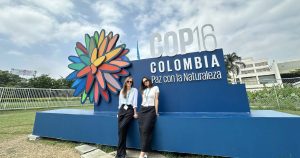
At COP16 – the biodiversity COP held in Cali, Colombia – Chen Ly spent much of her time listening. A second-year PhD student studying gender equity in environmental governance, she attended as an observer through the Grantham Institute, alongside a handful of other Imperial researchers.
Unlike the climate COPs, the biodiversity COP is smaller and less covered by media, but no less significant. It was also Chen’s first time in an international policy space. “I had no idea what to expect,” she admits. “There was a schedule online, and I just tried to plan my days around side events that matched my research.”
She gravitated toward women’s forums and Indigenous-led panels, often taking place outside the official negotiation rooms. What struck her was the lack of crossover. “These events were full of activists and researchers, but often not negotiators. And that felt like a disconnect,” she said.
The disparity became a key insight for her evolving research. “We talk about impact, but if marginalised groups are only talking to each other, how does that translate to policy?” she said. “It made me think: what if we studied who’s actually in the room at these conferences and whether that shapes the outcomes?”
Chen also noted how few UK-based academics were visibly active, despite the presence of research institutions. “I think Imperial – and academia more broadly – could do more to be proactive in these spaces.”
Though she didn’t present research this time, Chen is determined to return. She’s already planning for the next biodiversity COP in Armenia, where she hopes to not only observe but study the very dynamics she’s been reflecting on: “Now that I’ve seen how the system works, I want to be part of it and contribute something meaningful.”
This article first appeared in the FoNS Magazine 2025