For Women at Imperial week, we spoke to Sofia Moliner, a PhD student looking at quantum algorithms in Financial applications. She answered questions on her academic career so far, her role models and what barriers to progression she thinks women in academia still face today. 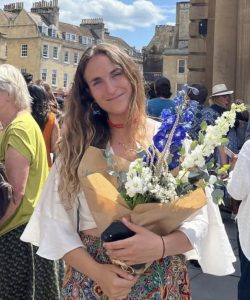
Please introduce yourself and what you are currently working on
My name is Sofia Moliner, and I am a second year PhD student in the Department of Mathematical Finance working on Quantum Computing for finance. I am additionally involved in initiatives to investigate the barriers of underrepresented groups in quantum computing, trying to assess what could be done to support women in quantum at many stages of seniority in academia.
What has been your proudest achievement in your academic career so far?
I am in the very early stages of my academic career, but I feel very proud (and lucky) to have entered this field so early on. Completing the MSc in Quantum Dynamics at Imperial with distinction and beginning my PhD has been the most demanding challenge I have faced so far. I went from pursuing a Maths and Physics BSc with a focus on industry to learning how to contribute to a research community in a vibrant and growing field.
If someone had told me a few years ago — or even when I was younger — that I would be pursuing a PhD in Mathematics at Imperial College, I would not have believed them. I am also very proud to have had the opportunity to give tutorials at Imperial. Teaching subjects and delivering lectures that I would have attended a few months earlier pushed the limits of what I thought I could do.
What barriers to progression do you think women in academia still face today?
I come from an all-girls school where science was the most popular subject. Growing up, I never felt that ‘science was for men’, which helped me develop my confidence from a young age. However, studying the same subject at university in a male-dominated environment sometimes made me feel smaller and more intimidated. This made me realise that women often doubt their abilities more than men and are more prone to impostor syndrome, which can sometimes lead them to shy away from careers in STEM.
“Women often doubt their abilities more than men and are more prone to impostor syndrome”
As a side note, I believe that women in male-dominated environments may at times encounter uncomfortable situations or microaggressions, often without harmful intent. It is therefore important to foster environments where women feel comfortable speaking out against them.
At the same time, I believe that it is a great time to be a woman in STEM, as there are many initiatives dedicated to bringing this community together and encouraging its growth.
Is there anyone you’d consider a role model?
I have many role models. However, they have not necessarily been the most influential people I have encountered, but those who had the greatest passion for their field and for the people in it.
The first person that comes to mind is my BSc Project supervisor, Dr James Foadi. For the three months we worked together, every meeting I had with him filled me with energy and motivation for learning. He encouraged me in every meeting to continue my academic journey and helped me in every step of the way. I would not be doing a PhD if it was not for him, which shows that one person can change the entire course of your career.
On the other hand, I really admire Carmen Palacios-Berraquero, CEO of Nu Quantum, a quantum computing start-up. I am a huge fan of her determination, her work, her leadership, and her accomplishments at such a young age. We also have a very similar background, and I really appreciate her return to Spain to help build the Quantum Ecosystem, which is something that I would love to do in the future.
What role can Imperial play in better supporting women’s academic and career progression?
It is likely that science will remain an imbalanced field for some time. At Imperial, however, there are many initiatives aimed at supporting women at different career stages and encouraging younger generations to become involved in science.
One aspect that could be improved is encouraging more people to participate in these initiatives. I sometimes found it difficult to take part in outreach or “Women in STEM” events, as doing so could feel like stepping away from research or falling behind on other priorities. These efforts can make an important difference in the long run, not only for women in STEM but also for other underrepresented groups. Recognising these contributions as part of a student’s work at Imperial College could help encourage greater involvement.
These efforts create a positive cycle: the more women enter the field, the more confident and supported each of them can feel. Men and women also have much to learn from one another, and a more balanced community allows the different perspectives and strengths each person brings to contribute more effectively.
What is one piece of advice you wish you had received earlier in your academic journey?
To just go for what interests you with excitement and confidence. Sometimes the biggest barriers and discriminations are the ones we place on ourselves. Everyone can do science; we just need to have the courage to ask questions and seek answers.
“The beginning of your academic journey is the most important part of it all”
I would also say that the beginning of your academic journey is the most important part of it all: focus on choosing your supervisors or groups based on their desire to help you grow as a researcher and contribute to the community, rather than their prestige or number of publications. At the end of the day, the topic is important, but the set of skills and passion for academia is what will make you stay.
Finally, do not take matters too personally. A PhD is also hard because your work seems to define you. We are all doing our best with the tools we have, and for each of us, our toolkit is different. This is probably what I struggle most with, but it makes no sense to compare yourself to your peers. Finally, it is important to keep reminding ourselves of why we chose this route, and to take it as an exciting challenge and a personal investment in our future and that of the field.