Blog posts

Inside Imperial’s fourth-year Deep Learning course

Prof Bernhard Kainz and Dr Yingzhen LiProfessor Bernhard Kainz outlines how Imperial’s fourth-year Deep Learning course combines theory with hands-on experimentation at scale. With more than 600 students taking part this year, the course explores both the foundations of deep learning and emerging approaches in generative and multimodal AI.


Deep learning continues to evolve at pace, but a strong understanding of its foundations remains essential. In the Department of Computing, students on the fourth-year Deep Learning course engage with both the theoretical foundations and modern frontiers of the field, combining rigorous analysis with hands-on experimentation at scale.

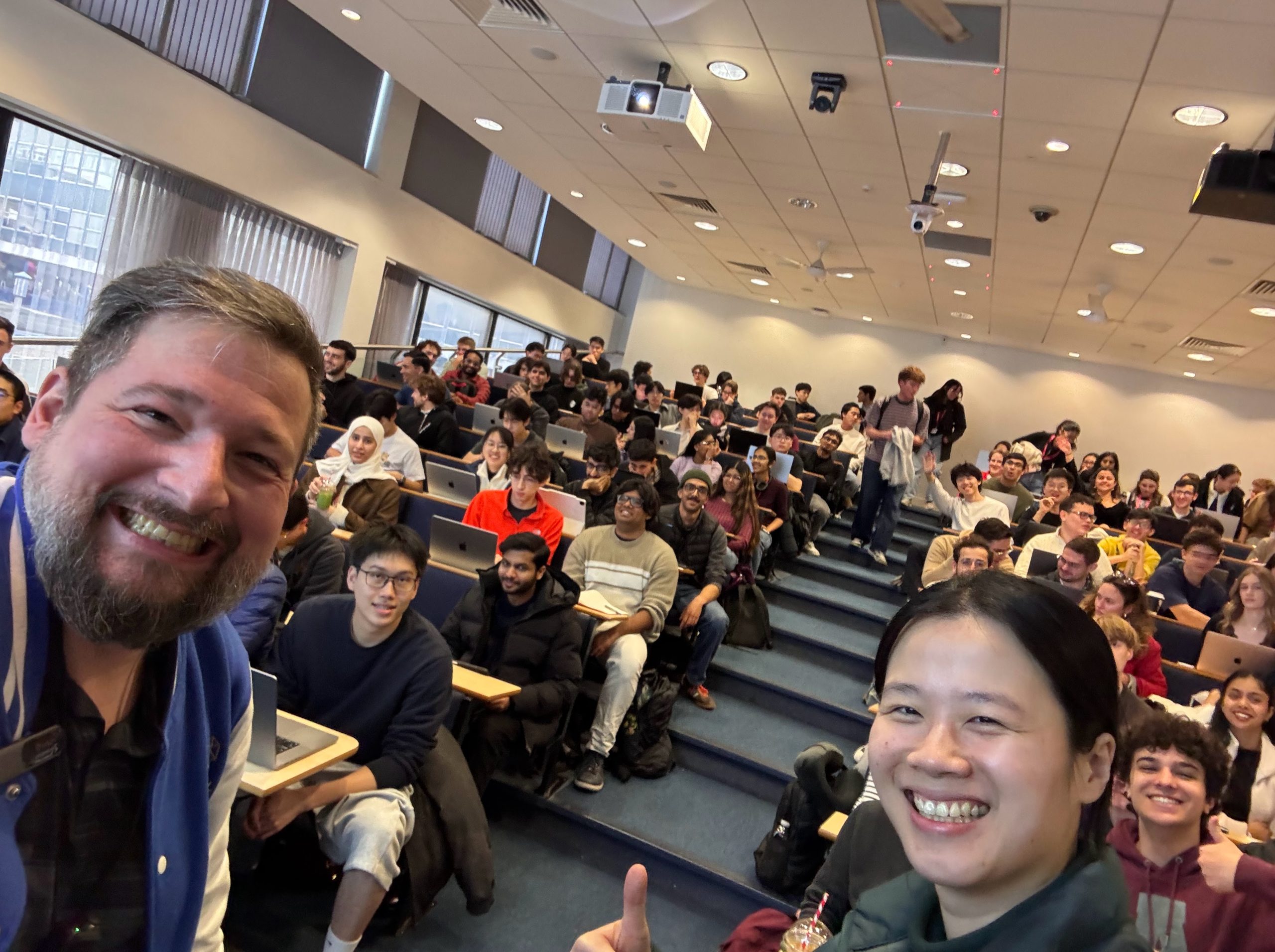
This year, more than 600 students took part under the joint leadership of Professor Bernhard Kainz and Dr Yingzhen Li, with support from Dr Harry Coppock from the UK AI Security Institute (ASI). The course explores core principles of representation learning, modern architectures and optimisation strategies, and integrates classical deep learning with emerging paradigms in generative and multimodal AI.

A central component of the course is the well-established “hot dog, not hot dog” project, inspired by the television series Silicon Valley. Students begin by developing robust classifiers to distinguish between hot dog and non-hot dog images, addressing challenges such as dataset bias, distribution shift and generalisation.

Building on this work, students then extend their models to generate entirely new images, transitioning from discriminative to generative modelling. Through this process, they are introduced to advanced concepts including diffusion-based generative models, data-centric AI and the limitations of synthetic data.

Although playful in appearance, the project is designed to operate under realistic computational constraints. Students typically work in single-GPU environments, encouraging efficient model design and careful experimentation rather than brute-force scaling. This setup supports practical engagement with how models learn, fail and generalise.

This year’s submissions included strong examples of resource-efficient diffusion models capable of synthesising high-quality images from noise. These approaches reflect techniques that are now widely accessible through large language model interfaces provided by organisations such as OpenAI, Google and Anthropic.

Given the size of the cohort, separate winners were selected for each course stream following a vote conducted by the 25 graduate teaching assistants supporting the course.

Project winners
COMP60034: Tom Shtasel

COMP60034: Tom Shtasel

COMP70010: Harvey Densem

COMP70010: Harvey Densem

The project was led by Hanna Tolle and Carles Balsells Rodas, whose coordination supported the delivery of the course at scale.

The winners were awarded API credits for the large language model of their choice, supporting continued exploration of modern AI systems beyond the course.

Celebrating student work from Imperial’s Computer Graphics course

Bernhard Kainz

Professor Bernhard Kainz highlights student work from the Department of Computing’s Computer Graphics course, where students develop rendering algorithms and visual effects using Imperial’s browser-based teaching framework. Outstanding work is recognised through awards for technical complexity and scene composition.

Computer Graphics combines algorithmic thinking, physical modelling and visual design. In the Department of Computing, the Computer Graphics course gives students the opportunity to apply these principles by building rendering systems and generating photorealistic images.

Students on the course work using ShaderLab Web, the department’s browser-based Computer Graphics teaching framework. The environment supports the development and testing of rendering algorithms directly in the browser.

As part of the course, students develop their own Computer Graphics rendering effects and implement a ray tracer using the web-based programming environment. Ray tracing is a physically grounded rendering technique that enables the creation of realistic images through the simulation of light transport within a scene.

For the final project, students are free to implement their own visual effects and scene designs. This typically results in a wide range of creative and technically sophisticated outcomes, reflecting different approaches to rendering and scene construction.

Outstanding work is recognised through two award categories. The Technical Complexity award highlights advanced rendering features such as physically correct refraction, volumetric effects and global illumination. The Scene Composition award recognises visually compelling and creative scene design.

Technical Complexity Award

The winning submissions demonstrated physically accurate refraction and reflection, advanced material modelling and carefully constructed lighting setups, resulting in highly realistic renderings.

Forest Li (fl1123) Bernhard Kainz

Runner-ups:

Baekhyeon Sung (bs1723)

Max Ryan (mtr23)

Scene Composition Award

The winning submissions combined complex geometry with strong artistic direction, producing visually distinctive scenes with coherent lighting and material design.

Cheng Tan (ct1022)

Runner-up

Noam Tal (nt1825)

Award recipients receive API credits to support further experimentation with modern Computer Graphics and AI systems.

More than a meal: The Department of Computing’s first community Iftar

IftarTo mark Ramadan, students in the Department of Computing hosted their first-ever community Iftar, welcoming more than 100 guests to share a meal, learn about fasting, and reflect together. Entirely student-led, the event celebrated openness, curiosity and community while creating space for faith, conversation and cultural understanding.


You may have recently seen or heard about our first-ever Department of Computing community Iftar. Perhaps you even attended in person. For many in our department, particularly my fellow Muslim students, it was a time we are unlikely to forget, and one that demonstrates the strength of our community overall.

Iftar is the meal eaten to break the fast during Ramadan, eaten at sunset and usually shared with family members or the wider community.

There is no shortage of tasks to complete at Imperial; coursework, applications or society roles, student life here is notoriously fast-paced, and Iftar provides a welcome window for reflection. We decided to invite our peers and colleagues to share this occasion with us and learn more about Ramadan.

The event itself was entirely student-led, an immense task given the logistics of sourcing food, organising a room and delivering talks on the day. A big shout out to the team at the Imperial Islamic Society for their assistance with food and volunteers for the Iftar. Openness and accessibility are woven into Iftar traditions across the world; it is not uncommon for mosques to provide a meal for their attendees, and we decided to mirror this practice by eliminating entry fees and sign-ups. Much of the vital planning and coordination on the day was undertaken by Aahil Jouher and Mohammed Tayyab, with support from Dr Jackie Bell (Principal Teaching Fellow for Equality, Diversity, Outreach and Public Engagement), the DoC Equality and Diversity team, and lastly the team of wonderful volunteers from the department.

(more…)

Data Visualization at Imperial’s Data Observatory: Unveiling Insights Beyond the Surface

Hi, I’m Sharia, a third-year MEng Computing student at Imperial. I was raised in Tehran, Iran, and I’ve always had a passion for music. I enjoy playing Flamenco guitar and the traditional Persian instrument, the Tar. In my free time, I like to stay active by playing basketball, and I also enjoy CTF challenges.


In a recent visit to Imperial’s Data Observatory, I embarked on a journey through the realms of data visualization that left me profoundly enlightened. Nestled within the heart of the Department of Computing, the observatory is a beacon of innovation where data transcends mere numbers to reveal intricate patterns and unseen insights.

The Data Observatory is the largest of its kind in Europe, it features an enveloping circular wall of 64 monitors powered by 32 computers facilitating 313 degrees of surround vision. Over 130 million pixels make up the total screen resolution, allowing participants to experience big data like never before.

(more…)

High Speed Rail (Data): Querying Train Prices with C++

Hi, I’m Hamish; I’m from Watford, UK, and I’m in the second year of Computing. In my free time I enjoy studying foreign languages, playing water polo and doing Competitive Programming. This year I’m behind Imperial CyberSoc and CTF Team. Let’s connect on LinkedIn!Hamish photo


A few months ago, I took the train to Oxford with a school-friend. Rolling through the picturesque Chilterns, the sun streaming through the window, and as the fans of GBRJ that we are, we proposed visiting more UK cities by train. Yet, existing booking sites wouldn’t let us sort destinations by price. Fine, we thought: a bit of programming will solve this. It also happened to explain a long-running enigma why UK train prices seem so random: 

(more…)

Second-Year Projects – WACC and PintOS

Hi, I’m Hamish; I’m from Watford, UK, and I’m in the second year of Computing. In my free time I enjoy studying foreign languages, playing water polo and doing Competitive Programming. This year I’m behind Imperial CyberSoc and CTF Team. Let’s connect on LinkedIn!Hamish photo


Amongst computing students there is a definite consensus that the second-year projects of WACC (writing a compiler from scratch) and PintOS (adding features to a barebones OS in C) are among the most formative experiences of the degree, though we haven’t had a blog post on them, so I want to give an overview of this term and last, and what I’ve learned (incredibly hard to sum up in only a few hundred words!) 

(more…)

Internships for First Years!

Hi, I’m Hamish; I’m from Watford, UK, and I’m in the second year of Computing. In my free time I enjoy studying foreign languages, playing water polo and doing Competitive Programming. This year I’m behind Imperial CyberSoc and CTF Team. Let’s connect on LinkedIn!Hamish photo


It’s no secret that internships are the most common method of tech graduate recruitment, with nearly all Imperial students undertaking one before graduating. Nonetheless, the success rate in acquiring a first-year placement is lower, as firms often prefer students closer to graduation.

(more…)

Perk-ademy Awards 2022-23

Hi, I’m Hamish; I’m from Watford, UK, and I’m a first-year student in Computing at Imperial. I like programming, Linear Algebra and modern foreign languages. I play water polo for IC 2s and hope to represent Imperial in Competitive Programming next year. Let’s connect on LinkedIn!Photo of Hamish


In a previous post on reasons to be happy I mentioned the perpetually puzzling fact that people actually want to hire us (!), but not the important ramifications of this.

(more…)

Min-Maxing your Groceries and other Computing Problems

Hi, I’m Hamish; I’m from Watford, UK, and I’m a first-year student in Computing at Imperial. I like programming, Linear Algebra and modern foreign languages. I play water polo for IC 2s and hope to represent Imperial in Competitive Programming next year. Let’s connect on LinkedIn!Photo of Hamish


Often while wandering around doing whatever students do, I discover a relationship to what I’ve learnt in Algorithms or Competitive Programming, so I wanted to share some cases I’ve thought about recently where computing is Here To Help with student life.

(more…)

n Reasons to be Happy in Imperial Computing

Hi, I’m Hamish; I’m from Watford, UK, and I’m a first-year student in Computing at Imperial. I like programming, Linear Algebra and modern foreign languages. I play water polo for IC 2s and hope to represent Imperial in Competitive Programming next year. Let’s connect on LinkedIn!


As is to be expected at this time of year, the Imperial exam season is well underway, which could be a source of worry for many students, whether fretting about achieving top marks or just hoping to pass onto next year. Therefore, I think now is a great time to take a break from revision and share my top n reasons to be happy in DoC. Writing this in my room in Imperial’s Kemp Porter Buildings I feel genuinely overcome with positivity, so why is that? Let’s dive in:

(more…)