Tag: Research Staff

REF 2029: What you need to know

REF 2029: what you need to know 

Code of Practice 

Imperial’s REF 2029 Code of Practice has been submitted to Research England and is now available for staff to view. The Code of Practice is our REF governance framework which ensures that decisions are being made fairly and transparently and that our submission reflects the breadth and excellence of our research.

Training and resources

Training and resources are available to all staff to support REF preparations, including:

All staff should also make sure their Imperial Essentials are up to date.

Volume measure and REF independence

The volume measure is a calculation of staff contracts which determines the size of Imperial’s submission to REF 2029. You can find more detail about the volume measure, how it’s calculated, and which contracts are included in our FAQs.

We are required to have a process for determining whether contracts in the Research job family at grades Research Associate, Research Fellow and Advanced Research Fellow, meet the REF criteria for ‘research independence’. Staff who hold a contract at these grades will receive an email notifying them about whether their contract will be included in the volume measure.

Decisions on whether a contract is included in the volume measure are for REF purposes only and have no relation to an individual’s career progression at Imperial.

Sexual Harassment Awareness e-training

Sexual harassment awareness e-training

As part of our commitment to ensuring a respectful and safe environment for work and study, an online sexual harassment awareness training course was introduced last summer for all staff, from all job families.

All new starters must complete this training within six months of joining Imperial.

As part of our commitment to preventing incidents of harassment and sexual misconduct, and to meet regulatory requirements from the Office for Students, we have created a webpage with resources which include:

  • Information about what harassment and sexual misconduct is
  • How to make a report and what happens when a report is made
  • Sexual misconduct policy for staff
  • Disciplinary procedures for staff and students
  • Resources for advice and support

Please familiarise yourself with the webpage on preventing harassment and sexual misconduct and share with staff as necessary, particularly those working with students.

Funding Opportunity: Wellcome Accelerator Awards

Wellcome Accelerator Awards

Application deadline: 25 August 2026, 15:00 BST

The third round of our annual Wellcome Accelerator Awards is now open. The awards support researchers of Black, Bangladeshi and Pakistani heritage in the UK to undertake activities that put them in a stronger position to reach their next career stage within academia. The funding can be used for research or research-adjacent activities, such as training, secondments, and networking.

Accelerator Awards | Grant funding | Wellcome

UKRI Policy Fellowships 2026

UKRI Policy Fellowships 2026

Applications are now invited to the UKRI Policy Fellowships scheme, which will offer 50 fellowships that span the breadth of the UKRI remit. Fellowship opportunities will be based with a host in 1 of 27 different UK government departments, devolved governments and What Works Centres.

The UKRI Policy Fellowships are designed to improve the exchange of specialist knowledge between academic institutions and policy, facilitating deeper, more enduring connections between researchers and policy makers. These exciting opportunities will allow fellows to undertake cutting edge research and inform decision-making on the most pressing policy problems of our time. The fellowships aim to support career development and enhance fellows understanding of applying research in government contexts. All fellows will become part of a cohort of academic researchers and receive training, mentoring and networking opportunities with likeminded individuals.

The fellowship cohort will be organised around the key policy priority areas including, where applicable, the UK Modern Industrial Strategy sectors (IS-8) and government missions.

Three types of fellowship are offered:

Core Policy Fellows

Core policy fellows are open to early and mid-career researchers and will be based within UK or devolved government, or an arm’s length body focusing on key public policy priority areas. For Whitehall departments and arm’s length body hosts, fellowships will align with one of the IS-8 sectors supporting objectives to drive productivity, innovation and long‑term economic growth, or one of the government’s core missions.

Modern Industrial Strategy (IS-8) sectors:

  • advanced manufacturing
  • clean energy Industries
  • creative industries
  • defence
  • digital and technologies
  • financial services
  • life sciences
  • professional and business Services

Government missions:

  • economic growth
  • NHS fit for the future
  • safer streets
  • break down barriers to opportunity
  • clean energy

Gambling policy fellowships are also offered within the core policy fellowships, focusing on delivery of the government’s statutory levy on gambling operators. The fellowships will enable early and mid-career researchers to work closely with levy commissioners on key public policy areas for the prevention and treatment of gambling related harms.


Natural Hazards and Resilience Policy Fellows

Natural Hazards and Resilience policy fellowships are open to early and mid-career researchers and will be based within UK or devolved government, or an arm’s length body. The Natural Hazards and Resilience policy fellowships will enable early and mid-career researchers to work closely with policy makers to focus on natural hazards and pandemic preparedness to help solve critical national and global challenges and work to guarantee the UK’s future resilience to situations that could cause or threaten serious harm to human welfare or the environment. This would include a spectrum of potential natural hazards with a clear focus on human impact such as:

  • health risks (including infectious disease)
  • flooding
  • loss of essential services like power, food, water, and telecoms

These fellowships are funded by the Department for Culture, Media and Sport as part of the COVID-19 Commemoration programme.


What Works Innovation Fellowships

What Works Innovation fellowships are open to researchers at all career stages and fellows will be based within the What Works Network to increase the supply of and demand for evidence to address priorities in the hosts’ policy areas of:

  • homelessness
  • policing
  • place


Key Dates

9 June 2026 9:00am: Opening date
25 June 2026: Webinar
10 September 2026 4:00pm : Closing date
October/November 2026: Shortlisting
December 2026: Invitations to interview
January 2027: Interviews
February 2027: Decisions communicated
1 May 2027: Start date

Further Details

All fellowship opportunities are 18 months in duration and open to applications from researchers based at an organisation eligible for UKRI funding. Full details and links to apply can be found at this link UKRI Funding Finder.

UKRI will be holding a webinar for this call on 25 June and you can register here.

Gave a talk? Get a DOI – Cassyni

Upload your conference or seminar recording to Cassyni and publish it as a citable video seminar — free for Imperial ECRs. Papers with a linked Cassyni seminar see more downloads and more citations.
https://www.imperial.ac.uk/early-career-researcher-institute/networks-events-and-funds/events/cassyni-research-seminars/

Publish your talk: https://cassyni.com/publish/imperial-ecri?utm_source=imperial-ecri&utm_medium=email&utm_campaign=ecri-noticeboard

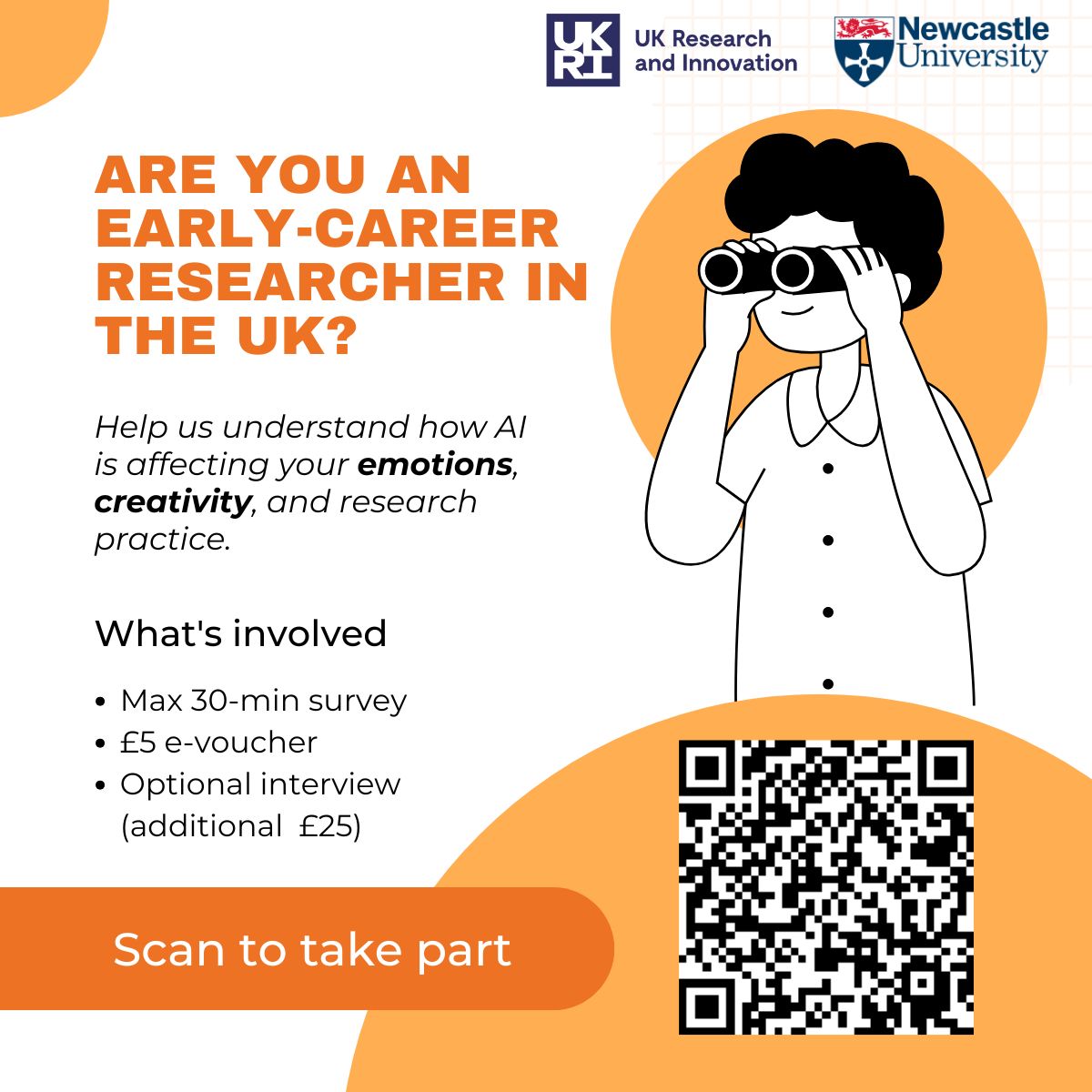
Survey on how ECRs use generative AI

The Early Career Researcher Institute (ECRI) is carrying out a survey to find out how Early Career Researchers (ranging from doctoral students to early career lecturers) use generative AI as part of their research process.

Our goal is to understand what practices are currently common in the community with a view to disseminating best practice, informing the teaching provision we provide to the community, and advocating on the behalf of ECRs in the Imperial community at large.

The link can be found here, and should take around 10 minutes to complete

2 Year AI in Science Fellowships, supported by Schmidt Sciences

About the role:

Applications are invited for prestigious Eric and Wendy Schmidt AI in Science Fellowships, a program of Schmidt Sciences, commencing 1 September 2027.

  • Up to six 2-year independent Eric and Wendy Schmidt fellowships dedicated to AI in Science in a program supported by Schmidt Sciences. Further details here (Research Associate level) & here (Research Fellow level)
  • Up to two 2-year independent Chapman-Schmidt fellowships dedicated to AI in Science in a program supported by Schmidt Sciences. Further details here

What you would be doing:

The Eric and Wendy Schmidt Ai in Science Fellows will produce independent and original research, using AI to advance science within their host department and the I-X Centre for AI in Science. These fellowships have the aim of identifying excellent researchers and accelerating them in using AI to advance and disrupt Science or Engineering. Here ‘AI’ is interpreted very broadly, e.g.: topics in Bayesian Inference and Robotics; ‘Science’ covers any typical topic in Natural Science and Engineering (Epidemiology, Biology and basic science in biomedicine are included but clinical medical themes are not covered, including conventional medical imaging). Examples include Bayesian optimization for molecular or materials design; machine learning for single cell data; physics-based ML for turbine design and astrostatistics. These posts are not suitable for generic AI research with general application: candidates must be aiming to substantially advance a particular area of science. Applicants could view themselves as AI researchers tackling particular pieces of science or science researchers using AI to transform their area. Extensive AI knowledge is not required, and AI training is offered.

What we are looking for:

Candidates will:

  • Hold, or be near completion of, a PhD (or equivalent) in an appropriate discipline.
  • Have the potential for leadership qualities in the subject, as illustrated, for example, through showing initiative on research projects.
  • Have an outstanding research record commensurate with their level of experience as demonstrated, for example, through an outstanding thesis, publications, conference presentations, code etc.
  • Have a proposal which is within the AI in Science research remit and skills which fit the cohort of AI in Science fellows.
  • For the RF positions candidates will be expected to have several years of experience post-PhD (in research or AI-based industry) and experience supervising team members


What we can offer you:

Fellows will join the Eric and Wendy Schmidt Network of researchers and will join a unique co-located cohort of top scholars based in the I-X Centre for AI in Science with tailored training and one-on-one career development. The fellowships are flexible and independent, allowing recipients to freely explore while drawing on expert faculty mentors of their choice.

We have a programme of additional support for women in AI in Science including a coaching circle for women in AI, additional funds for their career development and a community of I-X AI in Science women. The I-X Women in Artificial Intelligence (IXWAI) founded by two of our current Fellows aims to enhance representation of women in AI and foster an environment where they are valued, supported and inspired to achieve their full potential. We expect to appoint at least one candidate through this route.

Further Information

These are full time, fixed term position for 2 years. You will be based at White City Campus.

Candidates who have not yet been officially awarded their PhD will be appointed as a Research Assistant.

If you have any queries about these opportunities, please contact Eileen Boyce at e.boyce@imperial.ac.uk

Joint Fellowships

We have partnered with the Institute of Cancer Research (ICR) and the CNRS. If you are applying for one of these joint fellowships, we require that the principal mentor be in Imperial, but a secondary supervisor must be at ICR/CNRS. Please indicate if this is a joint fellowship by ticking the appropriate ICR/CNRS tick box in the online application form. Please note that these applications will require an institutional letter of support and ICR and CNRS will have their own internal process with a deadline ahead of the closing date below. The ICR deadline will be Monday 29th June at 9am. You must contact Becky Cook (rebecca.cook@icr.ac.uk) at ICR and Carl Iamov carl.ialamov@cnrs.fr and/or Louis Avigdor louis.avigdor@cnrs-dir.fr at CNRS to confirm these internal processes and deadlines

Cancer Research UK Postdoc Futures Conference (24 September)

Cancer Research UK are inviting all cancer non-clinical postdocs, regardless of funding source, to a one-day event on 24 September in Manchester, designed to empower you to take the next step in your career.

Explore career opportunities both within and beyond academia, learn about their training and funding programmes and pick up practical tools to help you build a fulfilling career in cancer research.

You’ll also connect with the wider cancer postdoc community, take part in roundtable discussions and join talks covering career progression, common challenges and potential solutions.

Register now: https://cruk.ink/4tS7Ai5

Human–AI Collaboration and Systems Design Contributor

We’re looking for an experienced contributor to join the Executive Education programme Transforming Business with AI, running from 13–17 July. This person would support a small number of afternoon sessions during the week, bringing practical insight into how AI systems are designed, adopted, and used in real organisational settings.

We’re looking for someone who brings together strong academic foundations with hands‑on experience working with businesses and executive audiences.

What we’re looking for:

  • PhD‑level training (or equivalent experience) in Information Systems, Human–AI Collaboration, or a related field
  • Practical experience designing and implementing AI solutions that address both technical and organisational challenges
  • Hands‑on work with SMEs on applied AI projects, including:
    • Retrieval‑Augmented Generation (RAG)
    • Data chunking and structuring
    • Tools such as LangChain, knowledge graphs, and related frameworks
    • Previous involvement in executive education, leadership programmes, or senior‑level workshops

For more information about the programme, please contact:
Mariana Gamba Fadul, Senior Learning Design Manager

For information about rates and logistics, please contact:
Toni McCloggan, Client Relationship Manager – Open and Custom Programmes

Quality Management Systems (QMS) for Medical Devices Online Course

The MedTechONE team is excited to announce launch of our new course, Quality Management Systems (QMS) for Medical Devices — designed to support professionals working across the medical device lifecycle. 

Developed by experts at Imperial College, this course provides a clear and practical introduction to the policies, processes, and procedures manufacturers implement to ensure medical devices are safe, effective, and fit for their intended use. Whether you’re new to QMS or looking to strengthen your understanding, the course offers a strong foundation. 

What to expect from the course:

·                Engaging video-based learning, narrated by an AI avatar 

·                Downloadable lecture notes to support deeper understanding and further reading 

·                Light assessments throughout to help reinforce key concepts as you progress 

The course is designed to be flexible and accessible, allowing you to learn at your own pace while building confidence in QMS principles relevant to the medical device sector. 

Watch our short introductory video to explore what the course covers. 

Enrol Here: Imperial College staff and students can self-enrol via Blackboard using their Imperial credentials only — no additional registration is required.