Professor Riccardo Sapienza started as the new Vice Dean (Research) of the Faculty of Natural Sciences in May 2026. Ahead of starting the position, he spoke about his motivations for taking on the role and the challenges he anticipates will come with it.
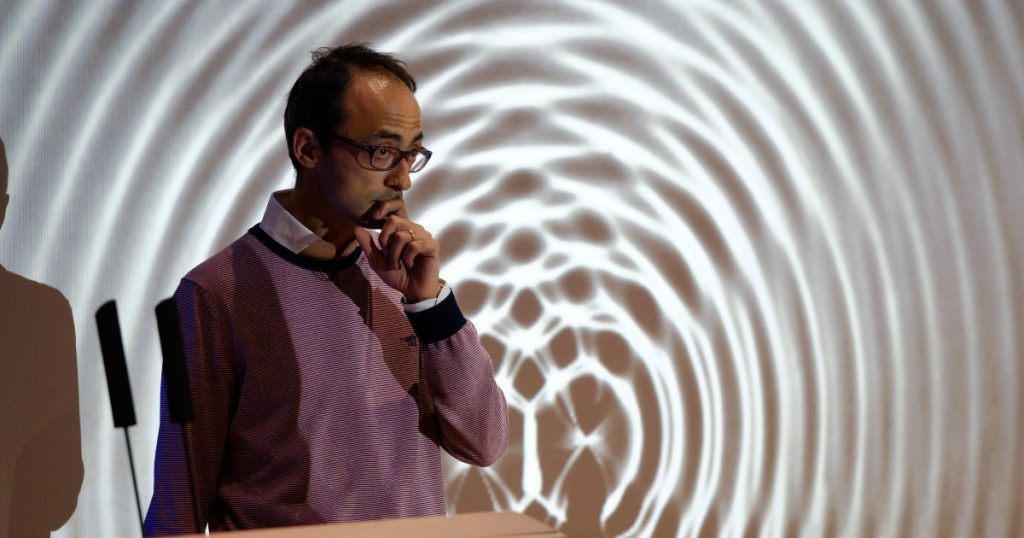
The most important part of the role of Vice Dean (Research) of the Faculty of Natural Sciences is being “the link between the individual, the department and the university”. Professor Riccardo Sapienza sees his new Vice Dean role as a joiner of two worlds – representing the needs of the Faculty and its departments to Imperial’s senior leadership team. Ensuring the Faculty is brought up in every conversation is a critical component of the job, he says.
“We can do a lot better together than the sum of all of us”
A professor of physics, Professor Sapienza works with light and matter, working in the fields of nanophotonics and metamaterials. He joined Imperial College London in 2017, having done a PhD split between Florence, Italy and Paris, France.
In May 2026, Professor Sapienza took the new role from his position as Deputy Head of Department (Research) in the Department of Physics, taking over from Professor Ramon Vilar, who moved on to become Head of Chemistry.
As well as holding the Vice Dean role, Professor Sapienza founded a start-up called Rayd Technologies where he holds the role of Chief Technology Officer. The startup is looking at developing “a new kind of hardware for machine learning, where a metamaterial laser performs the computation instead of the typical silicon transistor and electronics”.
Why this role?
Professor Sapienza says he was drawn to the role of Vice Dean (Research) because he has always been very curious about how to bring academics together through research. He said that within his Deputy Head of Physics role he began working in this area, led by the belief that “we can do a lot better together than the sum of all of us”.
He said: “I’m generally curious about how to bring a lot of independent and very creative and intelligent people together and try to do something more.”
At the same time, he said, he has always been very curious about the work done by his colleagues. He hopes that this is a role where he will be able to “explore many, many different research directions”. He adds that although it may be a “strange motivation”, he is led by an enjoyment of discussing areas of research he knows “nothing or very little about”.
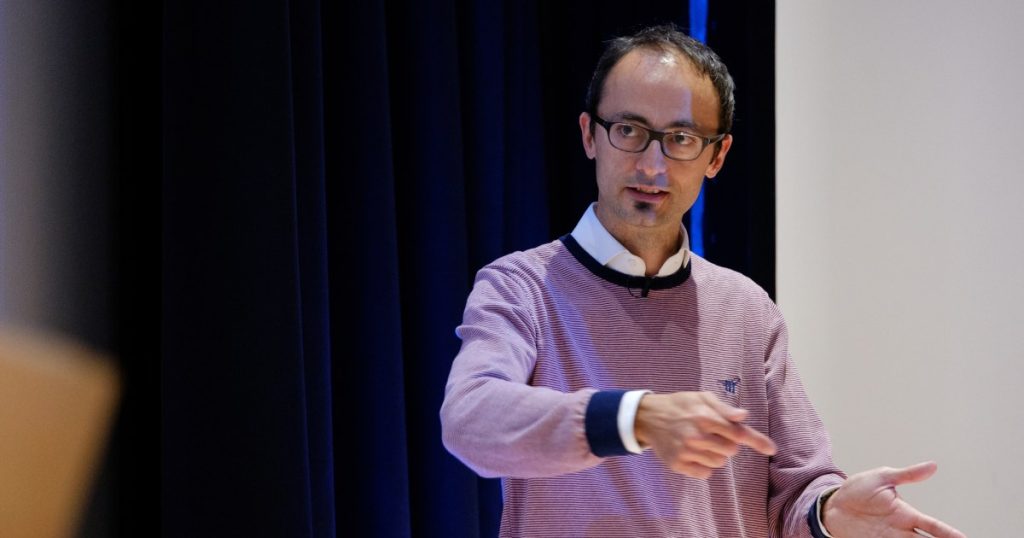
When asked about cross-departmental research that he has been part of, Professor Sapienza spoke about some ongoing work around trying to bring together from across the college “all the activity in metamaterials across different wave domains, including people working in optics, like us, or acoustic waves or mechanical waves”. He said the plan is to try to coordinate people working in this area in order to exchange ideas.
So far, he said, they have held a workshop called Imperial Waves, where they “bring together researchers that control waves with metamaterials”. He said he hopes this continues to grow.
‘Unicity of FoNS’
Professor Sapienza spoke about the “unicity of FoNS” stemming from having such different departments, especially when compared to other Faculties whose departments may seem more homogenous.
“The beauty of our Faculty is that we have different people tackling different problems.”
This is a challenge, he said “but it is also the beauty of our Faculty in that we have different people tackling different problems, from policy in the Centre for Environmental Policy, to working with malaria mosquitos in Life Sciences and synthetic cells in Chemistry, to the most abstract mathematics or physics.”
Professor Sapienza said this challenge involves “a lot of understanding and a lot of talking”, but that physics has a lot of similar hurdles, also being a “microcosm of very different researchers”.
“The big challenge is to translate or to understand what is done in different parts of the Faculty,” he said.
Adding: “I hope that by talking to people and understanding how they do it, we’ll be able to link together the different pieces. Of course, it’s always a resource because being so diverse means that we can tackle different problems in different ways. We have more to respond to any scientific problem. The price to pay is that we need to be able to talk to each other, which is not always easy.”
This challenge extends across the Faculty and it is important, in this role, to understand the “full breadth of research across the Faculty which is not only in different areas, but also done in different ways, from large teams to that which is very applied, very experimental, very theoretical”.
He continued: “We have people that need to have the full Silwood Park to run their experiment and others that do it on their computer”. He said his goal would be to “understand that and then bring people together.”
Adding: “I see the role of the Vice Dean as a kind of ambassador or a catalyst that tries to bring things together and tries to stimulate something new out of that. Making sure that we can do more than what we would have done individually.”
‘It is important to keep on protecting fundamental science’
Professor Sapienza will be implementing the recently launched FoNS Research Strategy – a task which he is more than up for.
On the new strategy, he said: “It is important to keep on protecting fundamental science, especially in a shifting environment, where more directed science is increasingly prioritised”.
He also spoke about the impact of artificial intelligence (AI). He said: “Another point that I am very passionate about is the transformation that is happening because of AI and automation. This is not just a little transformation. It’s a new thing, touching all aspects of science, from how we search the literature to how we apply for funding and how we run the labs. And there are more and more automatic labs that produce an enormous amount of data.
“This is something that will change the way we do science. We need to be prepared ahead of time for that.”
This article first appeared in the Faculty of Natural Sciences’ Faculty Magazine 2026.