This year, Bridges turns five. The programme, which was established in 2021 with the aim of supporting first-year undergraduate students from underrepresented backgrounds within the Faculty of Natural Sciences, has grown considerably in this time.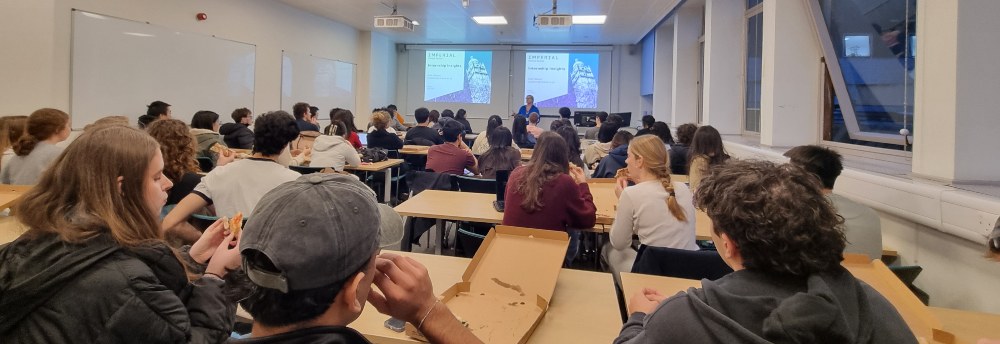
Covering events such as meet-ups and breakfast, as well as mentoring opportunities, careers workshops and “adulting” tips, the goal of Bridges is to ensure that all students feel a strong sense of belonging and have the resources they need to thrive both academically and socially during their time at Imperial.
In the past year, 275 students registered for the Bridges programme, with 85 individual peer guide appointments taking place for 14 individual students. The programme saw seven events across the year, with attendance of up to 65 undergraduate students. Most popular events included ‘speedfriending’ – a welcome event where new students met peers through guided conversations, playing bingo, and enjoying free pizza – and a Q&A on career internships.
“That level of support will be accessible to a larger pool of our underrepresented students.”
This fifth anniversary coincides with a decision to expand Bridges across Imperial’s faculties and to a wider student audience. Exact details of how this will work are yet to be confirmed, but the expansion shows that the programme is working and that there is a need for it across Imperial.
On this expansion, Emma Mattin, Education and EDI Coordinator within FoNS, who has been looking after the programme for the last three years, said: “We’re supporting other faculties to hopefully be able to launch their own bespoke flavours of the programme for their own students.
“Bridges is no longer going to be just FoNS. That level of support will be accessible to a larger pool, if not all, of our underrepresented students at Imperial.”
 Many of Bridges’ activities are already offered to those outside of FoNS, but this expansion is a recognition of its breadth and a formalisation of that offering.
Bridges started its life as the “Changing Face of Science Programme” in 2021, before changing its name to Bridges in 2024.
One of the programmes that has expanded in that time is the Peer Guide Scheme.
Throughout the year, students registered to Bridges can select a peer guide from a pool of upper-year students who have navigated similar challenges. The peer guides are available to share their experiences and insights to help students navigate various aspects of university life, such as maintaining a work/life balance, applying to internships, and acclimatising to our environment, ensuring that students feel welcomed and valued within Imperial’s community.
This includes through sustained 1:1 peer guide appointments, or at Bridges events where peer guides attend and facilitate. The programme has now been going on long enough that some students who were mentored are becoming mentors themselves.
“I decided to become a Peer Guide to ease this transition for first years.”
Moyin Olojede, a third-year student, became a Peer Guide herself after joining Imperial from an underrepresented background and finding the transition a difficult one. She said:
“Being from an underrepresented background starting at Imperial was a big jump, from living alone to understanding the working world and what opportunities were available to me during and post my degree.
“I decided to become a Peer Guide to ease this transition for first years. That’s why I believe it’s beneficial; it has students helping other students on what it’s like being at university, providing a real perspective for them.”
Beyond Bridges
EDI within FoNS is wider than the Bridges programme, with other activities such as FoNS Social Mobility Week, which involved five days of activities celebrating and exploring social mobility at Imperial and beyond, and FoNS Neurodiversity Week, a four-day series celebrating and exploring neurodiversity.
Other recent events within the wider faculty that have supported staff and students from minority groups include Black Voices in FoNS, a conference which took place in June, expanded from Black Voices in Maths, which originated within the Department of Mathematics.
Another new event was held by the Department of Life Sciences to help staff teach students who are deaf or hard of hearing.
This year also saw the appointment of a new Associate Dean for EDI. Professor Vincent Savolainen began the role in May of this year, following Professor Bernadette Byrne’s move to Associate Provost (Equality, Diversity and Inclusion) in January. He has already started work on a new EDI Strategy for FoNS.
Elsewhere, the Department of Chemistry was awarded its third consecutive Athena SWAN Gold award last year. In May of this year, the Department of Physics was re-awarded Athena SWAN Silver and the Department of Mathematics was awarded its first Athena SWAN Silver award – an increase from its previous Bronze award.
Emergency Period Care provision
A recent success within the faculty has been its Emergency Period Care provision, which ensures that a range of free menstrual products and essential clothing are available to anyone who needs them across all departments.
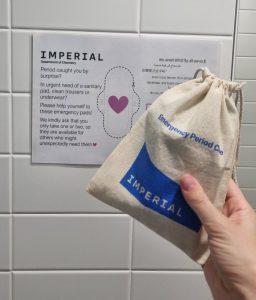 Products include tampons, sanitary towels in a range of sizes, and where possible, emergency clothing such as underwear, leggings, and joggers. Most products are available directly in toilets, including female and gender-neutral toilets, with additional items accessible via departmental offices.
The programme goes beyond Imperial’s standard offering and has been expanded across all three sites with FoNS presence – South Kensington, White City and Silwood Park. The team behind it won a Julia Higgins Award for this programme.
Emma credits one of its champions, Emma Pallett from the Department of Chemistry, who pioneered Emergency Period Care within her department.
One of the challenges of expanding this programme, Emma Mattin said, is working across departments and across campuses, which might have different needs and capacity levels. She said it was important to work out what would work for them first and foremost, especially when introducing a new initiative rather than one that is already established.
“We’re just a small cog in the wheel of progress.”
There are still a lot of challenges to overcome. Emma spoke of Imperial’s lack of diversity in some areas and said she is conscious this problem goes wider than one programme.
She said: “Bridges can’t fix on its own all of the EDI issues for our students that they might experience from being underrepresented or minoritised. We certainly hope that the programme contributes to reducing disparities in student experience and outcomes, but Bridges alone isn’t a fix-all.”
She added: “There are lots of other projects around EDI or student experience for underrepresented groups and we’re just a small cog in the wheel of progress.”
Register here to be a part of Bridges 2026/27
This article first appeared in the Faculty of Natural Sciences’ Faculty Magazine 2026.