Author: FoNS News

How to win Traitors (using game theory)

Following the dramatic series finale of Celebrity Traitors, we speak to Dr Dante Kalise from the Department of Mathematics at Imperial College, as he unpicks the treacherous tactics used in the game. He explains how the Traitors used game theory to betray their way to the top, and how the Faithfuls tried to unmask them using strategic deduction – a mathematical deep-dive into the art of betrayal.

Dante Kalise

Spoilers for the final of Celebrity Traitors below.

(more…)

Wandering searchers and supermarket queues: mathematically exploring how cells move resources

PhD student José Giral Barajas explains how he is using queueing theory to understand how cells move and accumulate materials.

Supermarket queue. Photo by John Cameron on Unsplash


Imagine you need to deliver a package to someone in a crowded place, but you have no idea where they are. No matter how determined you are to take a specific path, the constant collisions with all the people around you will force you to change direction most of the time. The path you take in your search for the recipient becomes effectively random. This simple picture is a helpful way to think about how cells move materials.

(more…)

The road to the stars: getting young people excited about space

Imperial is using its outreach programmes to get more young people excited about space. This blog post looks at the reach and impact of these initiatives. 

The road to the stars, it turns out, begins with a postcard. But instead of the Eiffel Tower or Big Ben, the postcards depict ‘flight surgeons’ and ‘space lawyers’, and instead of inspiring wanderlust, these postcards inspire young people to imagine their futures beyond the Earth’s boundaries.

Lunar Launch at ICL 2nd December 2022 © Brendan Foster Photography-463
Lunar Launch at ICL 2nd December 2022 © Brendan Foster Photography

(more…)

FoNS-MAD: the low cost technologies that can change lives

The final of the 2024/2025 Faculty of Natural Sciences Make-A-Difference competition takes place on Wednesday 22 October 2025. Ahead of this, we hear from the finalists about their projects.

“We knew it would happen again.” That was the certainty Arda Kancal and his teammates brought with them from Istanbul, Turkey. The 2023 earthquake that devastated their country was not the first, and, according to seismologists, almost certainly not the last. With a 60% chance of a similarly catastrophic quake hitting Istanbul by 2030, the team behind D-View entered Imperial College London’s Faculty of Natural Sciences Make-A-Difference (FoNS-MAD) competition determined to build something life-saving.

D-View
Team D-view: Earthquake rescue drones

Their project, an autonomous drone system that uses low-cost geophone sensors to locate trapped earthquake survivors, was born not only out of a sense of academic curiosity but also necessity. “We watched as people in our hometowns waited for rescue that never came,” Arda said. “We knew we had to do something. Something cheap enough for governments to actually use, something deployable, not just theoretical.”

(more…)

How measurement can shape reality

PhD student Harsh Rathee explores an experiment from Imperial’s Quantum Measurement Lab, which captures the peculiar nature of the quantum world.

Quantum physics is captivating yet perplexing, contrasting sharply with our everyday experiences. The allure and mystery surrounding the term “quantum” has unfortunately led to misconceptions in the general public. Hollywood has capitalised on this mystery, portraying quantum physics as the basis for instantaneous teleportation, time travel, and multiple dimensions.

While some of these explanations contain a kernel of truth, they often rely on a leap of faith to explain groundbreaking scientific advancements. However, it is important to note that the real-world progress in quantum technology is far from dull.

(more…)

Living with fire: adapting to changing wildfires risks in the Brazilian Amazon

Illustration of the diversity of land management and associated use of fires within the Brazilian Amazon (Illustration from Manini Bansal)

PhD student Michel Valette explain how multi-scalar and inter-disciplinary research could support adaptation to emerging wildfire risks and the development of integrated fire management policies.

In January 2025, the Los Angeles wildfires captured the media spotlight, partly due to the widespread destruction in urban areas, the risks to human life, and the astronomical costs associated with the wildfires. The Los Angeles wildfires add to a growing list of wildfires that have made headlines in recent years, such as the 2023 Canadian wildfires, the 2022 European wildfires, and the 2019–2020 Black Summer in Australia.

(more…)

Restoring the world beneath our feet

Alice Day is a PhD student at the Waring Lab and the Fisher Lab within the Department of Life Sciences. She researches the potential of fungal inoculations in restoring agricultural land. In this blog post, she discusses how modern agriculture has depleted our soils of the microbes that once made them thrive, and how we may one day re-introduce them.

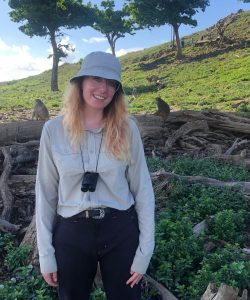
Miss Alice Day, doing fieldwork for her project investigating fungal inoculants.

(more…)