What do fire safety, women’s health, vaccine transportation and sustainable printing have in common? They are just some of the real-world challenges that students in the Faculty of Natural Sciences Make-A-Difference (FoNS MAD) competition are daring to solve.
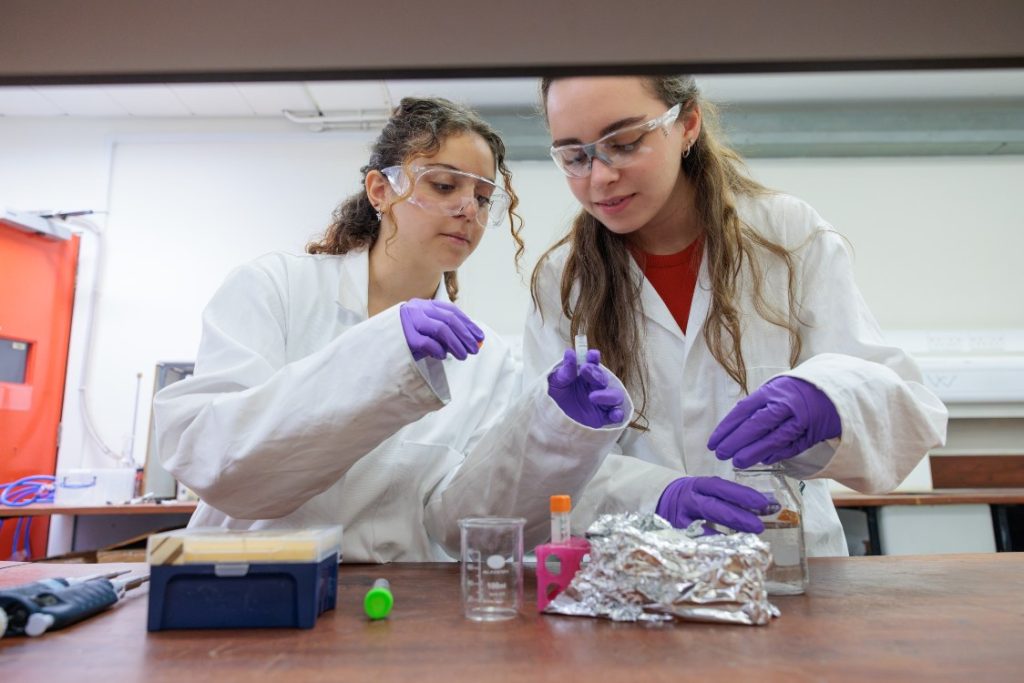
Now in its thirteenth year, Imperial’s flagship undergraduate innovation and entrepreneurship programme continues to make a meaningful difference in the world.
Through the competition, FoNS MAD challenges students to apply their scientific skills and knowledge to develop low-cost, high-impact solutions to real-world problems. It has continued to grow with 34 teams registered this year, with 32 of those going on to submit outline proposals. From these, the judging panel announced its six finalist teams in April.
Over eight weeks this summer, the teams will receive funding, lab space and mentorship to develop their proof-of-concepts. The winning team will be announced at the final in October, where they will be awarded up to £7,000 in prize money.
Previous winners have included 2025’s winner D-View, who came up with a device that is trained by AI to listen out for and detect the presence of humans in rubble following an earthquake, and Matoha, the 2017 winners who used infrared spectroscopy and AI to develop a tool that maximises recycling sorting. Matoha have now sold their products in over 50 countries, with their founders recognised in the Forbes 30 Under 30 (Europe) list.
Primus

One of this year’s teams, Primus, are also looking at a device to help in search and rescue efforts. They are developing a system that detects likely occupant locations during a fire and shares them with firefighters to speed up rescues.
The team is made up of second-year students: Rhys Wijeratne from the Department of Design Engineering, and Bochang Lu and Neil Pandit from the Department of Physics. The team said they came up with this idea after their research showed them how “firefighters tackling burning buildings have very little information about the number of people inside the building or even the location of the people inside”.
“Firefighters tackling burning buildings have very little information about the people inside.”
Bochang said this was especially true for non-residential buildings, such as hospitals, office buildings and other institutions. In their research, the team realised that there are many institutional problems within firefighting that could be solved with modern technology. They believe their technology could both save lives, and reduce costs – as firefighters could be less reliant on expensive thermal image cameras.
The team are looking to develop a radar that would detect whether someone was in a room or area, that would be able to be added to pre-existing systems, such as fire alarms, already in place. The radars, using an algorithm, would provide an image of the entire building, allowing users to track which rooms have people inside. The team said that this would mean that everyone has access to the same up-to-date information, as their research has shown that a flaw with the current search and rescue system is that information passes from one person to another, with a large reliance on individuals, meaning information can fall through the cracks.
They acknowledged that a challenge of their project would be working out how to efficiently and effectively integrate it within other systems.
Kalyb

Another team, Kalyb, are designing a low-cost, electricity-free device that records the number of freeze events experienced by vaccines during transport for their FoNS MAD project.
Made up of Flynn Li, Kaiqi Song and Yubo Gao from the Department of Life Sciences, alongside Bella Zheng from the Department of Physics – all first year students – the team said they wanted to focus on UN Development Goal Target 3.8, which is about Universal Health Coverage and access to safe, effective, quality and affordable essential medicines and vaccines for all.
Yubo said their device will monitor vaccines during transportation, addressing the issue of vaccines being ‘wasted due to poor cold chains throughout the world every year’. He said: “We believe that this is seriously hindering effective immunisation programmes, especially in parts of the world where they don’t have as many resources.”
“We believe this is seriously hindering effective immunisation programmes.”
The team want to create something that would be able to track the freeze events leading to their damage. It would work using a non-electric freeze stall detector, which can detect whenever the vaccine freezes by initiating a turn on a wheel. They would then determine how many times the vaccines have experienced freezing by looking at the number on an indicator, which would highlight any major issues that exist along a delivery chain.
The team predicts that one of the biggest challenges they will face in the project is learning about and using different techniques that they haven’t come across before, for example, 3D printing and modelling.
Kidnicheck
The team behind Kidnicheck are designing a lateral flow urine test that enables rapid, non-invasive early screening for kidney cancer.
Team members Alexander Holliger, Baba Zack, Mousavizadegan Arshia and Shu Liu are all first-year Biochemistry students in the Department of Life Sciences.
Mousavizadegan said that there are two problems with cancer diagnosis currently. The first is the price – with most techniques being expensive and not very cost efficient. The second is that cancer is diagnosed at a late stage. The team hopes their lateral flow test would address these problems, using biomarkers to diagnose cancer at a very early stage. The test wouldn’t require a hospital trip, making it a more accessible option.
Shu said that a lot of current approaches are reactive rather than preventative, with 50% of all cases of kidney cancers identified incidentally through imaging for other reasons, leading to late-stage diagnoses.
The team predicts that one of their challenges will be working in the lab independently, which is different from their lab experience up until now, where they have received a lot more support from teachers and instructors.
They also acknowledge that the biggest challenge will come when comparing their prototype to real life tests and seeing both how it compares, and if it is able to detect cancer at the early stage that they are aiming for.
Eviso
Also looking at urine screening is team Eviso, who are developing a low-cost toilet-mounted device that passively tracks women’s urinary biomarkers to deliver hormone and metabolic health insights.
Eviso are made up of Isla Binks from the Department of Mathematics and Eve Sharma from the Department of Physics, who are both third year students. They are joined by Buse Liv and Oyku Erciyes, both first year students from the Department of Life Sciences.
They hope their design could help make women’s health more accessible, supporting women going through the menopause by monitoring hormone levels, as well as showing women how their hormone levels are changing throughout their monthly cycle.
The device would work by having an electromagnetic sensor that sits in the toilet and monitors urine, collecting results via a sensor that is then sent to an app on a phone via Bluetooth. They hope to create a device that can also self-clean.
As well as working in an area that is quite new to the team, they see one of their biggest challenges being “consistency and cleanliness”, adding “no one really wants something dirty sat in their toilet that they use every day”.
EcoPrints
Team EcoPrints are looking at the theme of sustainability. Made up of Liam Nguyen from the Department of Life Sciences and Ansh Agarwal from the Department of Engineering, they are designing a biodegradable, more sustainable and easily recyclable 3D printing filament.
All first years, they are looking at using carnauba wax to create this filament. This is because it has a low melting point compared to PLA, which is the most popular material used in desktop 3D printing. This melting point would allow the filament to be recycled at home.
This would mean, Ansh said, that “if you print something and it doesn’t quite fit, or doesn’t quite work, you can easily melt it down and create a new spool of filament that can be reused the next day”. Whereas currently, much of this would not be recycled.
“It is an important problem that we could make a meaningful difference on.”
The team say their biggest challenge will be its feasibility, as they have yet to come across anyone doing anything similar.
OneGarm
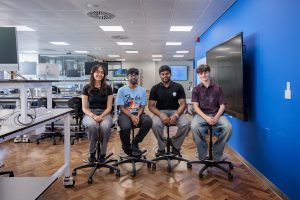
This year’s final team, OneGarm, are also looking to develop a device to monitor health. They are looking to develop a multifunctional vest, called the SHLOK Vest, which is paired with an app to support stroke survivors with a focus on visual neglect, monitoring of health data and muscle rehabilitation.
The team consists of first years Bihadu Jayaweera, Reilly Webster and Sharen Shivagumar, from the Department of Physics, as well as Pratyusha Singh, from the Department of Mathematics.
Reilly said that he wanted to create something that helped stroke survivors, following a stroke within his own family.
He said: “I wanted to do something to do with strokes because my dad had a stroke and it was a bit more personal. Discussing with my dad, as well as with one another, we identified this as quite an important problem that we could make a meaningful impact on.”
The idea is that the device would help stroke survivors monitor their health post stroke, helping to prevent secondary strokes, which are common, as well as monitoring the rehabilitation aspect of their recovery.
The device would consist of a vest which is able to measure different health metrics, including heart rhythm monitoring and blood pressure. They also hope the device could be used to help assist those with visual neglect – a neurological disorder where a patient fails to respond to stimuli on one side of their visual field, usually the left, following a right-hemisphere brain injury – by alerting the wearer to obstacles. The team plan to use this to measure the user’s reaction times. A partnered app would allow users to monitor these metrics.
One challenge that the team foresee is being able to keep the device lightweight, with what is needed to measure and track the individual wearing it. Although they acknowledge that the device they will be creating in the eight-week period will only be a prototype.
“They truly embody the spirit of FoNS MAD and will, without a doubt, make a real difference!”
‘Yet another exciting year’
Open to all Imperial undergraduate students, the FoNS MAD competition brings together interdisciplinary teams to turn ideas into practical technologies. Across a year-long programme, students take part in ideation workshops, team building activities, presentation and pitching skills training, as well as sessions on intellectual property and commercialisation, helping them to develop their innovation and entrepreneurship skills.
Dr Thibault Bertrand, FoNS MAD Committee Co-Chair and Associate Professor in Statistical Mechanics, said of this year’s competition:
“This is yet another exciting year for FoNS MAD, with a record number of outstanding applications making the selection process exceptionally competitive.
“This year’s six finalist teams are tackling pressing societal challenges: Low-cost cancer diagnostics, personalised women’s health monitoring, sustainable prototyping materials, smart rehabilitation technologies, life-saving fire emergency and vaccine-delivery innovations. They truly embody the spirit of FoNS MAD and will, without doubt, make a real difference!”
This article first appeared in the Faculty of Natural Sciences’ Faculty Magazine 2026.
Support the teams at this year’s final on Wednesday 28 October. Register your place.
Interested in taking part in the 2026/2027 Make A Difference competition? Register for the launch event on Wednesday 11 November.