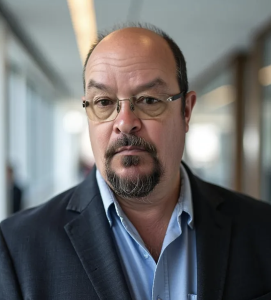
Professor Vincent Savolainen took up the role of Associate Dean (Equality, Diversity and Inclusion) within the Faculty of Natural Sciences in May of this year. Ahead of this, we spoke to him about his background, priorities and plans.
Could you explain your career/academic background?
I am an evolutionary biologist, so I run a genomic lab and tackle some of the big Darwinian questions that have not yet been resolved.
I spent nine years at Kew Gardens as a researcher and then joined Imperial College 18 years ago. I started by tackling questions like ‘how do plants evolve on very remote islands in isolated locations’. But I also wanted to work on animals. So I joined Silwood Park 18 years ago. And since then, I have been doing projects on sharks, and on lions. And now I work on same-sex relations in primates.
It is one of the reasons why I’m also interested in EDI because, for instance, homosexuality used to be seen as a big paradox – why would a trait that doesn’t lead to a baby have evolved in nature and not be eliminated, from all species, including humans? I’ve been working on this question for a long time.
What drew you to the role of Associate Dean (Equality, Diversity and Inclusion) within FoNS?
EDI for me is much more than just my research. I had formal training while working as Deputy Head of the Department of Life Sciences for four years, through Imperial’s Management and Leadership Development programme.
I have also been involved with organising conferences on, for example, LGBTQ+ issues and genetics. I was invited to give a keynote lecture by the University of Oxford to senior religious leadership about the issue of diversity from the point of view of what’s happening in nature.
In my own department as Deputy Head, I saw the low number of female academics. I was in charge of the Silwood Park campus, and it used to be a gentleman’s club, to be honest. One of the things we did was to put processes in place so we could encourage more women to apply. Every time we had a position open, I would write personally to awardees of fellowships in the UK to tell them about these opportunities. As a result, we increased the number of women appointed at Silwood Park.
I have also been involved in capacity building programmes in Ghana, Côte d’Ivoire and South Africa, including creating one of the largest DNA banks for biological samples in Cape Town. This was funded by the Royal Society and through that I met many incredible, talented young people, not all of whom had the opportunities we did. We were able to support these young people to go on to work in universities, with some of them going on to secure jobs as professors.
We all know that a diverse workforce is beneficial. You get more ideas, and that’s what science is about – creativity. That’s why we want a diverse bunch of people to do the best science at Imperial.
What would you like to be your first priority in this role?
I want to design an EDI strategy for FoNS. We have a basic strategy, but we have to look at it in a lot more detail. We need to look at what are priorities are and then allocate resources accordingly. But we need to not try to do too many things at once and instead just do a few things very well.
Why is EDI within Imperial so important?
The main reason why I think it’s important is because a diverse team is going to do better science. If you join Imperial, you want to be supported, and then you’re going to feel better, and then you’re going to do better. It really is to drive everything towards excellence.
At the same time, what is incredible is that there are still quite a lot of people, not at Imperial but elsewhere, who don’t support the idea of an EDI lead. They think we’re doing affirmative action.
We’ve seen what’s happening in the US with EDI and quite a lot of people are not on board yet. They see it as a waste of time and resources, and the wrong thing to do.
I think it’s important to change minds and help people realise the benefits of looking after the diversity of people. It’s only going to be for the greater good.
When it comes to students, it’s very clear that students at Imperial don’t reflect the demographics of London or even the UK. We know that lots of students from less advantaged schools are concerned about coming to Imperial because of the reputation that it is maybe too tough. There is a lot we need to do to attract the best talent, regardless of where they come from and their background.
What do you see as the biggest challenge in this role and how would you tackle it?
I think changing people’s minds. There is still a big diversity of views about EDI and how important and useful it is.
There is a lot of communication needed to change people’s minds, and for them to see how important and useful it is and to come on board.
I’m very clear to everybody, it’s not a tick box exercise. We’re not going to add workload for people. You may need to do things slightly differently, not more.
What would success within this role look like?
It would be better engagement from the whole of the Faculty at every level. I think FoNS is quite well placed. It’s a very friendly Faculty where most people get on very well and are open-minded. But we could have better engagement and we should be able to document that we’ve been attracting a higher proportion of talented people that would have hesitated to come to us before.
What is something that people would be surprised to learn about you?
I’ve been involved for a long time with cavalry horses and training people within the military to ride horses. I have owned cavalry horses for the last 15 years. As part of this, I’ve been involved with the military in the City of London and the livery companies and I was a riding master for five years with the Saddle Club of The Honourable Artillery Company. So that’s very different from what I do at Imperial.
This article first appeared in the Faculty of Natural Sciences’ Faculty Magazine 2026.