Dr Chloë Coxshall writes about her experiences being diagnosed with POTS (Postural Orthostatic Tachycardia Syndrome) during her first year of her PhD and the impact it had on her PhD journey. She went on to finish her PhD with a first author paper in leading Nature Ecology & Evolution journal and won the Napier Memorial Medal from the Primate Society of Great Britain (PSGB). PSGB instituted the Napier Memorial Medal in 1991, in memory of its founding President, Professor John Napier. The medal is offered every two years to a new primatologist to provide encouragement through the public recognition of their work.
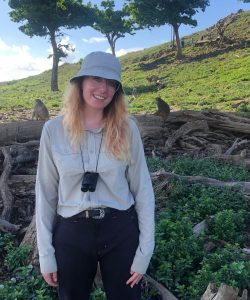
My name is Chloe, I recently completed my PhD at Imperial and have been awarded the Primate Society of Great Britain Napier Memorial Medal for an outstanding thesis in Primatology. However, my PhD journey did not go as I expected.
During my first year, I was diagnosed with POTS (Postural Orthostatic Tachycardia Syndrome), which is a form of dysautonomia. This essentially means that my body has trouble regulating anything related to the autonomic nervous system, including circulation, respiration, digestion, and temperature. The key characteristic of POTS is a dramatic increase in heart rate when standing, which can lead to fainting, often with very little warning.
I didn’t originally suspect I had POTS. I was being treated for Long COVID and expected my symptoms would get better with time and maybe taking some vitamins. I was invited for a TILT test where you are strapped to a bed and raised to an upright position, and your heart rate and blood pressure are monitored throughout. The test is meant to last 45 minutes, but I didn’t even last 5 minutes before fainting! This confirmed my diagnosis of POTS, and I was put on medication to manage my symptoms.
At first, I was in denial about the severity of POTS. I originally thought my symptoms would be resolved by taking some vitamins, so finding out I had a chronic illness that would affect me for the rest of my life was something I struggled coming to terms with. I often pushed through my symptoms, ending up in a boom-and-bust cycle which made my symptoms worse.
Good Days and Bad Days
POTS affects me every day, and I need to think about energy management and capacity whenever I do a task. I can appear fit and well and participate in various activities, however, this often comes with the cost of recovery over the following days, or sometimes weeks. 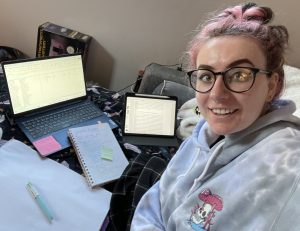
Bad days can be disheartening. I have recently experienced a flare due to the hot summer – in a flare, I faint more frequently, and struggle with everyday tasks which involve standing for extended periods, like showering or washing up. Although fainting sounds the most extreme of my symptoms, I find the fatigue and brain fog the most frustrating. On a bad fatigue day, I can struggle to sit upright without getting breathless and I have trouble holding conversations. My flares can be difficult to accept and leave me questioning my capability.
How does POTS affects my work?
I struggled to balance my health and workload when I was first diagnosed, as I did not ask for support until the second year of my PhD. I disclosed my POTS to Occupational Health when I was preparing for fieldwork who decided it was not safe for me to go, given the risk of fainting and tough fieldwork conditions. This was incredibly disappointing, as I absolutely loved fieldwork, but more than anything, I become very stressed about my PhD project plan, which revolved around data collection from the field.
The Department were very supportive during this time and suggested I take an Interruption of Studies to focus on my health. I was initially reluctant to accept this as I felt like I was giving up, but reflecting now, that interruption was the best decision as it gave me the space to better understand myself and how to manage my health, workload, and importantly my wellbeing. Returning from my Interruption, I adjusted my PhD plan and focused on a new chapter with a more computational approach. That chapter is now published in Nature Ecology & Evolution.
The main thing I have learnt through this journey, is that you must be your own priority. Research is tough for anyone and can take a huge toll on your health if you are not looking after yourself. Listening to your body and taking the time to rest when you need to are critical for pacing.
What Support Did I Access?
After returning from my Interruption, I worked with the Disability Support Service to ensure I had reasonable adjustments in place. Working from home was incredibly helpful, as it allowed me to manage my limited capacity and focus on my research. I also had adjustments in place for my viva, including the option to take breaks and have notes with me. As POTS affects the nervous system, symptoms can worsen in periods of high stress, which made me particularly nervous for my viva. Having adjustments in place made me feel more confident and supported, even if I was having a bad POTS day.
I think asking for support is the most valuable thing you can do, and accessing reasonable adjustments can have huge impacts on your ability and opportunity to succeed. Equally, I think we, as a society, have a responsibility to the disabled community to make disclosure less intimidating, by having more open conversations around disabilities, and recognising disabled experiences.
Reflecting on My Experiences 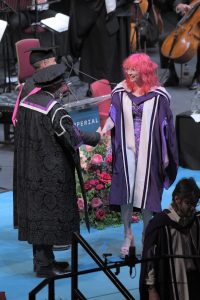
There were times when I felt like giving up on my PhD. On days where I struggle to stand without fainting or sit up without getting breathless, it is easy to feel like I am not capable. I feel empowered reflecting on my success over the last few years, including being awarded the Napier Memorial Medal. Not only am I grateful to be recognised for my work, but I feel proud to say “I did do this” after years of feeling like I couldn’t.
I believe it is important to share our experiences so that we can learn from each other and develop our understanding of diverse backgrounds. I am still learning to be kind to myself and accept that there will be ups and downs throughout my future. I am grateful to have a fantastic support system, my partner, family, friends, and the Department, who have been patient with my limitations, and support my ambitions.