When Does Prevention Become Medicine? Trust, legitimacy & the future of lifestyle medicine
At what point does something we do every day become medicine? Eating. Moving. Sleeping. Managing stress. Connecting with other people are among the most ordinary acts of human life. They happen largely beyond hospitals, clinics and consultation rooms. Yet they are also intimately connected with health.
And therein lies an intriguing tension: we readily accept that medicines prescribed for hypertension, diabetes or depression belong within healthcare. But what happens when the therapeutic proposition is not principally a tablet, procedure or device, but a different way of living? Who should deliver that intervention? What qualifications should they possess? Who do people trust? And perhaps most importantly: what makes an approach feel sufficiently legitimate to belong within medicine at all? These questions sit at the heart of our recently published study in BMJ Open, Legitimacy, trust and readiness for implementing lifestyle medicine in England.
The paradox of the unfamiliar familiar
One of the most striking findings was a paradox; most people were not particularly familiar with the term lifestyle medicine. Among 733 participants, only 26% of the overall sample had previously heard of it. Among healthcare professionals, awareness was considerably higher, at 62%. And yet, when we moved beyond the label, people largely recognised its substance. Nutrition. Physical activity. Sleep. Stress management. These were readily understood as legitimate components of health. In other words, lifestyle medicine appears to suffer from an unusual problem: its constituent ideas may be more familiar than the discipline that brings them together.
This matters, because public health frequently assumes that if an intervention is evidence-informed, useful and available, people will engage with it. But healthcare does not operate through evidence alone. It also operates through meaning, expectation, professional authority and trust. Before a person asks, “Does this work?”, another question may already be operating beneath the surface: “Is this really medicine?”
Legitimacy is not an abstract concept
Our findings suggest that this question has practical consequences. Perceived legitimacy was strongly associated with participants’ stated intention to use a lifestyle medicine service delivered through the NHS. Nearly half of participants said they would use such a service if it were available through the NHS, rising to around two-thirds of healthcare professionals. Because the study was cross-sectional, we cannot conclude that perceiving lifestyle medicine as legitimate causes people to use it. But the association raises an important implementation question. Perhaps prevention cannot simply be offered, but must instead also be socially and institutionally authorised.
That distinction is more important than it first appears. The same advice (eat differently, move more, sleep better, reduce harmful exposures, strengthen social connection) can be interpreted very differently depending on who gives it, where it is given and the institutional framework surrounding it.
Advice from a friend is advice. Advice from an influencer is content. Advice from a clinician may be interpreted as healthcare. The behaviour being discussed may be identical, but meaning attached to it is not.
Trust follows more than knowledge
Our findings make this particularly visible. Participants reported high levels of trust in lifestyle advice delivered by clinicians who had formal lifestyle medicine training: 73% expressed high trust. Trust was substantially lower for non-medical professionals, at 42%, even when those professionals possessed lifestyle medicine qualifications. This presents a difficult but important question for prevention.
What exactly are people trusting?
Is it knowledge? Credentials? Professional regulation? Clinical accountability? The symbolic authority of medicine? Or some combination of all four? There is no simple answer in our data. Nor should these findings be interpreted as evidence that one professional group necessarily provides better lifestyle support than another. But they reveal something that implementation science cannot afford to ignore: the credibility of an intervention and the credibility of its messenger may be inseparable in the minds of those being asked to act upon it.
For lifestyle medicine to scale, therefore, the challenge is not merely to identify effective interventions. It is to develop trusted systems through which those interventions can be delivered.
The prevention paradox inside healthcare
There was another tension in the findings in that healthcare professionals appeared interested in lifestyle medicine, yet the infrastructure surrounding them appeared much less mature.
Among the 58 healthcare professionals surveyed, 48% reported providing lifestyle-related advice to patients, while only 21% reported having received formal training in lifestyle medicine. Almost two-thirds wanted additional training or resources. The principal barriers they identified included patient readiness, limited time and insufficient training. Most strikingly, only 3% thought that the NHS currently supported lifestyle-based approaches “very well”. Because the healthcare professional subgroup was small, these estimates require appropriate caution, but they do generate questions that require further investigation.
We increasingly ask healthcare professionals to practise prevention while maintaining systems historically structured around the identification, treatment and management of established disease. We tell clinicians that lifestyle matters and encourage conversations about physical activity, food, sleep, stress and social connection. But if those conversations are to become a meaningful part of healthcare rather than an optional addition to it, clinicians also require time, competencies, referral pathways, professional standards and services to which patients can actually be directed. A health system cannot become preventive simply by asking its workforce to talk more about prevention. Prevention needs infrastructure.
Perhaps the question is larger than lifestyle medicine
This is where our study findings lead to a broader philosophical question. Modern medicine has become extraordinarily sophisticated at intervening once pathology is visible. We can image increasingly subtle abnormalities, quantify biological risk, stratify populations algorithmically and develop treatments targeted at increasingly specific molecular pathways. Yet many of the actions through which health is created or lost remain remarkably ordinary. They happen in supermarkets and kitchens, on pavements and playing fields, in workplaces and bedrooms, within families, friendships and communities. The future of prevention may therefore depend partly on whether healthcare can become more comfortable operating at the boundary between the clinical and the everyday.
Lifestyle medicine occupies precisely this boundary. Its proposition is not that ordinary life should become medicalised. Nor should structural determinants of health be reduced to individual responsibility. People do not make choices in a vacuum: income, housing, work, neighbourhoods, commercial environments, education and opportunity all constrain what is realistically possible. The more interesting proposition is that healthcare might take the conditions of everyday life more seriously without pretending that every determinant of health belongs inside the consultation room. That requires a different conception of prevention. Not prevention as instruction. Not prevention as telling people to “make better choices”.
But prevention as capability: that is, creating the knowledge, confidence, opportunities, professional support and environments that make healthier lives more achievable.
From lifestyle advice to prevention infrastructure
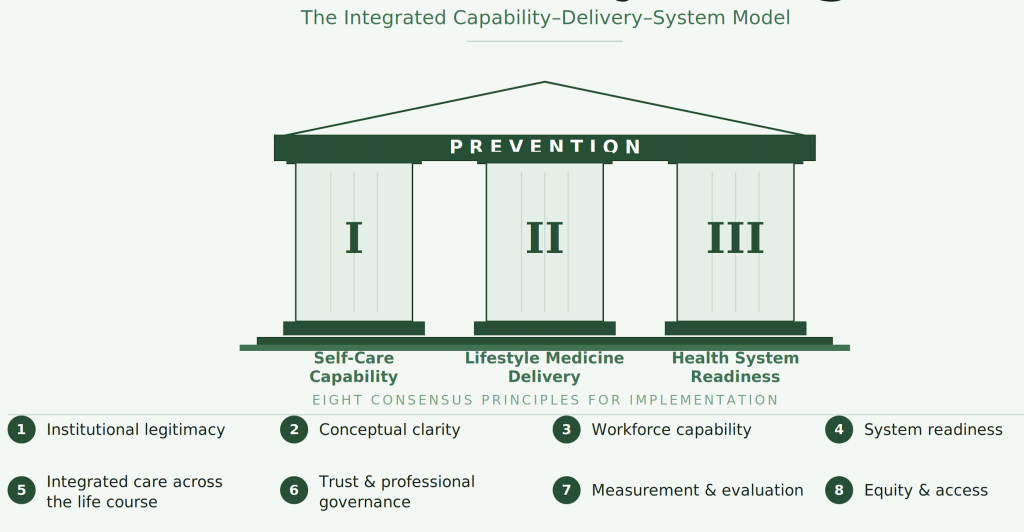
For that reason, the future of lifestyle medicine may depend less on defending the term and more on answering three practical questions: Can people trust it? Can professionals deliver it competently? Can health systems support it consistently and equitably?
Our findings suggest that these domains (legitimacy, capability and system readiness) are deeply interconnected. Awareness alone will not be enough. Enthusiasm alone will not be enough. Nor will simply adding another service to an already crowded healthcare landscape.
Training matters. Standards matter. Professional credibility matters. Institutional endorsement matters and implementation matters. There is also an important warning here for those of us interested in prevention and self-care. If lifestyle medicine becomes available primarily to people who already possess the resources, knowledge, confidence and time required to engage with it, it could reproduce rather than reduce existing inequalities. A credible model of lifestyle medicine must therefore be more than clinically plausible. It must also be accessible, trusted and equitable.
So when does prevention become medicine?
Perhaps there is no single moment… Perhaps prevention becomes medicine only when scientific evidence is translated into competent practice; when people trust the person delivering it; when health systems make room for it; and when individuals are given meaningful opportunities to participate in decisions about their own health.
The distinction between treatment and prevention may ultimately be less rigid than our institutions have made it appear.
After all, health is not produced only when we enter the healthcare system. It is being shaped long before we arrive. The challenge for the NHS and for health systems more broadly is therefore not simply to treat disease earlier. It is to decide how far upstream healthcare is prepared to travel. Lifestyle medicine offers one possible route.
Our study suggests that people may be more receptive to that journey than familiarity with the terminology alone would suggest. But for lifestyle medicine to move from an appealing idea to a credible component of prevention, it will have to earn something that cannot be manufactured through branding alone: trust.
And perhaps that is the larger lesson. The future of prevention will not be determined only by what we know can improve health. It will also depend on whether we can build institutions, professions and systems that people believe have the legitimacy to help them act on that knowledge.