Month: August 2026

PRE-ACT: From prediction to prevention & making risk intelligence actionable in primary care

Health systems are becoming increasingly good at predicting risk. Routinely collected health data, machine learning, clinical risk scores, remote monitoring and digital technologies can identify people who may be at increased risk of disease or adverse health outcomes – sometimes well before those outcomes occur.

But prediction is not prevention.

Knowing that someone is at increased risk only creates value if that information can be translated into an appropriate response: something understandable to the person, clinically meaningful to professionals, feasible within routine care, and capable of supporting action. This is the problem that the Prediction-Enabled Action for Self-care in Primary Care (PRE-ACT) consortium sets out to address.

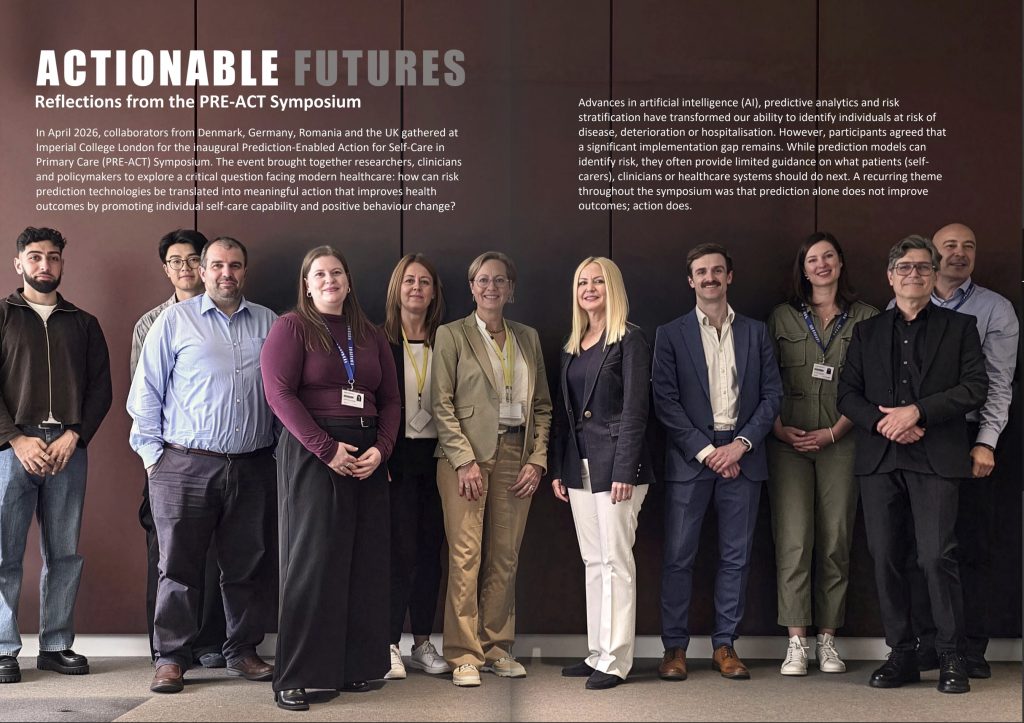
The PRE-ACT consortium is a collaboration between Imperial College London Self-Care Academic Research Unit (SCARU) and the Research Unit OPEN, University of Southern Denmark, bringing together researchers, clinicians and implementation partners with expertise spanning primary care, public health, risk prediction, digital health, behavioural science and self-care.
Closing the gap between risk and action

Much of the innovation in predictive healthcare has understandably concentrated on improving model performance: identifying the right variables, improving discrimination and calibration, and determining whether an algorithm can accurately classify risk. These are necessary questions. But they are not sufficient:

Between a risk estimate and an improved health outcome lies an important translational pathway. Risk must be interpreted. It must be communicated appropriately. Decisions need to follow. Patients may need support to act. Primary care teams need workable pathways through which to respond. And all of this must occur without widening existing inequalities.

PRE-ACT starts from the proposition that prediction should be viewed as the beginning of a preventive pathway, rather than its endpoint.

The initiative therefore brings together predictive analytics, decision support, primary care and self-care within a single translational framework. Its focus is not simply on whether we can identify risk, but on what should happen next.

Why self-care matters

This question is particularly important as healthcare moves towards earlier intervention and greater participation by patients in managing their own health.

The 2018 Declaration of Astana on Primary Health Care provides an important foundation. It renewed the global commitment to primary health care as a route to universal health coverage and emphasised, among other principles, the importance of prevention and health promotion, empowering individuals and communities, and enabling people to acquire the knowledge, skills and resources required to maintain their health.

PRE-ACT takes this principle into an increasingly data-driven healthcare environment. If predictive technologies can identify an opportunity to prevent deterioration, then we should also ask how individuals can be meaningfully supported to respond. That may involve self-monitoring, behavioural change, appropriate use of digital tools, supported self-management, or timely engagement with healthcare services.

Self-care in this context does not mean shifting responsibility from health systems to individuals. It means designing systems in which people are equipped and supported to participate in prevention, with appropriate professional oversight and clear routes into care.


Prediction-enabled prevention must also be responsible

There are important safeguards. A technically sophisticated predictive system may still have limited value if clinicians cannot interpret its output, patients do not understand what the result means, actionable services are unavailable, or those with lower digital access are systematically disadvantaged. PRE-ACT therefore places issues such as equity, human oversight, transparency, evidence, privacy, clinical governance and implementation readiness alongside predictive performance.

These considerations matter because the future of prevention will increasingly involve interactions between people, professionals, health systems and intelligent technologies. Success cannot be judged solely by the accuracy of an algorithm. We also need to ask whether an intervention is understandable, actionable, acceptable, equitable and capable of being integrated into real-world care.

From predicting risk to changing outcomes

One way of expressing the PRE-ACT pathway is: Prediction → Interpretation → Decision support → Activation → Self-care & clinical action → Outcomes

Each transition matters. A failure at any point can break the chain between recognising risk and preventing harm. Conversely, designing these elements together creates an opportunity to move predictive technologies away from passive risk stratification and towards genuinely preventive healthcare. This is the broader ambition of PRE-ACT: to help define what responsible, human-centred and actionable prediction should look like in primary care.

As predictive technologies become more powerful, the central question may therefore become less “How accurately can we predict what happens next?” and more: “What can we enable people and health systems to do differently because we know?” That is the point at which prediction becomes prevention.
From Measuring Loneliness to Preventing It

Loneliness is usually experienced as something intensely personal. Public health, however, has to ask a broader question: What if loneliness is shaped not only by individuals, but also by the places, relationships and systems surrounding them?

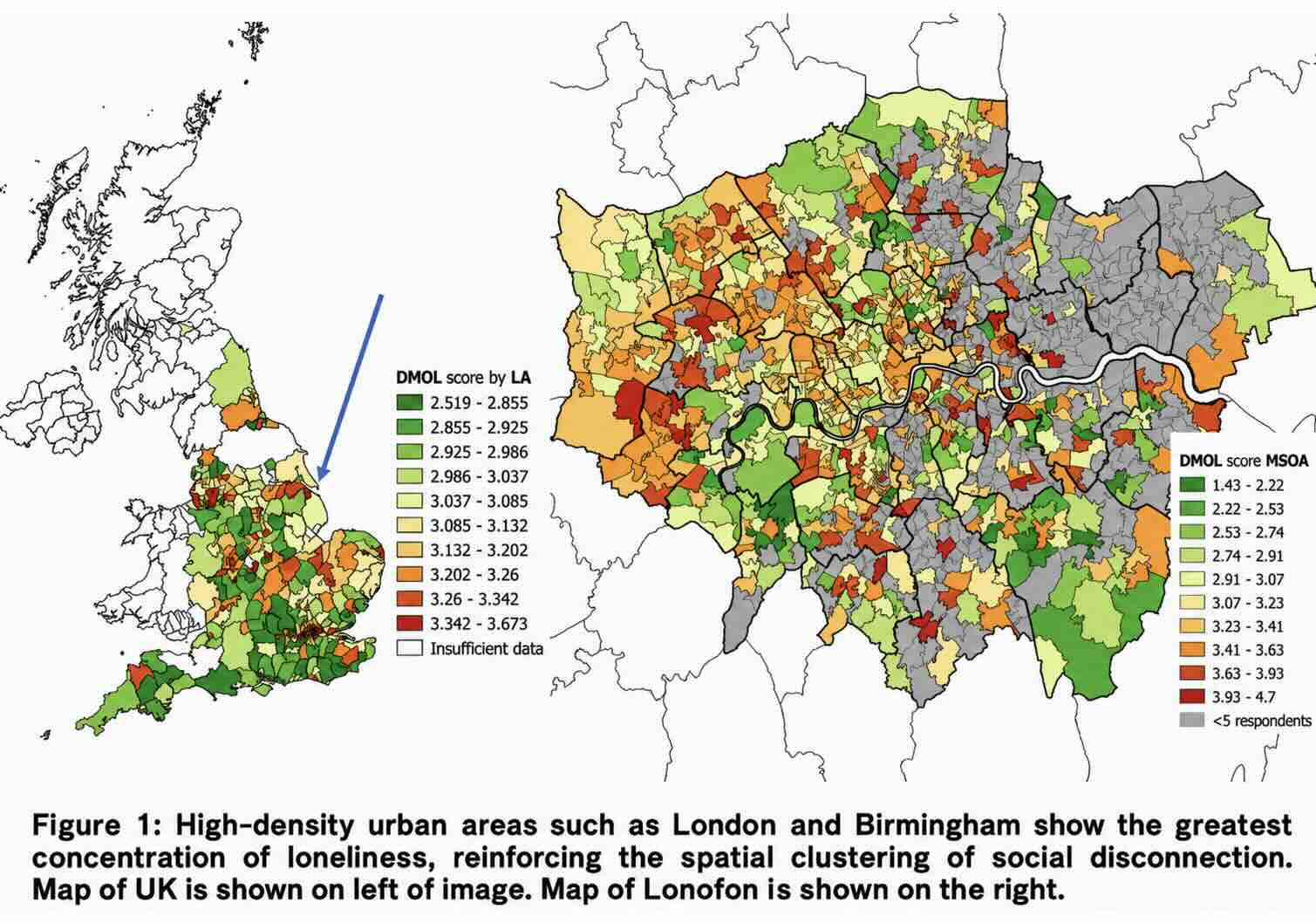
The first published paper in a series to report the findings of the Measuring Loneliness in England (INTERACT) Study, led by Imperial College London’s Self-Care Academic Research Unit (SCARU), provides an important starting point. More than 135,000 adults aged 16 and over participated. Among them, 16.5% reported feeling lonely “often or always”, while around one in five frequently reported lacking companionship, feeling left out or feeling isolated from others.

These findings are striking, but they require careful interpretation. INTERACT recruited a volunteer, non-probability sample, so the results describe the people who participated rather than providing a precise estimate of loneliness prevalence across England.

Its particular value lies elsewhere: in combining scale with geographical and social detail. INTERACT examines loneliness alongside social connection, neighbourhood trust, cohesion, health and socioeconomic circumstances. By linking responses anonymously to geographical areas, we can begin to move beyond asking simply: “How many people are lonely?” towards: “Where does loneliness appear to concentrate, among whom, and within what social and neighbourhood contexts?” For prevention, that distinction matters.

A map is not an intervention

Mapping loneliness can help identify patterns and generate hypotheses. But describing a problem is not the same as changing it. The real challenge is how evidence can inform decisions about where attention is needed, which community assets already exist, where gaps remain and which approaches should be tested. That is why SCARU has been working closely with the public-health teams serving Westminster and Kensington and Chelsea, alongside voluntary and community organisations, health partners and local networks. The aim is not simply to collect data about communities, but to develop research with the organisations and people who understand them.

Westminster’s Building a more connected Westminster Loneliness Action Plan creates an important opportunity to take this further. Rather than treating loneliness as the responsibility of a single service, the Action Plan seeks to bring together public services, communities and local organisations in a more coordinated response.

From INTERACT to LAP-IMPACT

This creates the next scientific question: Can a coordinated, place-based approach actually reduce loneliness and strengthen social connection? That is the thinking behind LAP-IMPACT, the research programme we are developing with our local partners. Subject to competitive funding, governance and the necessary approvals, the aim would be to move from mapping loneliness towards rigorously evaluating the response. The questions are practical and important. Who does a Loneliness Action Plan reach? Which components appear most promising? Are benefits distributed equitably? How does implementation vary between neighbourhoods and organisations? What role do community assets play? And what can other local authorities learn from the experience? These questions matter because an Action Plan should not be judged simply by whether activities happened. The more important question is whether the local system changed in ways that were meaningful for residents.

Prevention is not telling people to be less lonely

There is also a danger in framing loneliness only as an individual problem. Advice such as joining a group, volunteering or taking part in community activities may help some people. But it can obscure a more fundamental issue: Were meaningful opportunities for connection accessible in the first place?

A person cannot participate in an activity they cannot reach. Signposting has limited value if services have no capacity. Community assets cannot fulfil their potential if they remain disconnected from wider local systems.  This is why loneliness prevention must include the infrastructure of connection: the services, organisations, neighbourhood assets and relationships that make social participation possible. For SCARU, this also reflects a broader principle of self-care research. People exercise agency within environments that can either expand or constrain their options. Social wellbeing is no different.

From knowing where loneliness is to knowing what works

INTERACT has given us an unusually large window into loneliness and social connection in England. The next question is what we do with that knowledge.

Can local intelligence help communities organise prevention differently? Can services become better connected? Can existing community assets be strengthened? Can people be reached before loneliness becomes entrenched? And can we demonstrate which approaches work, for whom and under what conditions?

That is where loneliness research now needs to go. The INTERACT Study helps us understand the landscape. LAP-IMPACT is about understanding how that landscape might be changed. That is the Prevention Lab model in practice: moving from evidence, to action, to evaluation.

When Does Prevention Become Medicine? Trust, legitimacy & the future of lifestyle medicine

At what point does something we do every day become medicine? Eating. Moving. Sleeping. Managing stress. Connecting with other people are among the most ordinary acts of human life. They happen largely beyond hospitals, clinics and consultation rooms. Yet they are also intimately connected with health.

And therein lies an intriguing tension: we readily accept that medicines prescribed for hypertension, diabetes or depression belong within healthcare. But what happens when the therapeutic proposition is not principally a tablet, procedure or device, but a different way of living? Who should deliver that intervention? What qualifications should they possess? Who do people trust? And perhaps most importantly: what makes an approach feel sufficiently legitimate to belong within medicine at all? These questions sit at the heart of our recently published study in BMJ Open, Legitimacy, trust and readiness for implementing lifestyle medicine in England.

The paradox of the unfamiliar familiar

One of the most striking findings was a paradox; most people were not particularly familiar with the term lifestyle medicine. Among 733 participants, only 26% of the overall sample had previously heard of it. Among healthcare professionals, awareness was considerably higher, at 62%. And yet, when we moved beyond the label, people largely recognised its substance. Nutrition. Physical activity. Sleep. Stress management. These were readily understood as legitimate components of health. In other words, lifestyle medicine appears to suffer from an unusual problem: its constituent ideas may be more familiar than the discipline that brings them together.

This matters, because public health frequently assumes that if an intervention is evidence-informed, useful and available, people will engage with it. But healthcare does not operate through evidence alone. It also operates through meaning, expectation, professional authority and trust. Before a person asks, “Does this work?”, another question may already be operating beneath the surface: “Is this really medicine?”

Legitimacy is not an abstract concept

Our findings suggest that this question has practical consequences. Perceived legitimacy was strongly associated with participants’ stated intention to use a lifestyle medicine service delivered through the NHS. Nearly half of participants said they would use such a service if it were available through the NHS, rising to around two-thirds of healthcare professionals. Because the study was cross-sectional, we cannot conclude that perceiving lifestyle medicine as legitimate causes people to use it. But the association raises an important implementation question. Perhaps prevention cannot simply be offered, but must instead also be socially and institutionally authorised.

That distinction is more important than it first appears. The same advice (eat differently, move more, sleep better, reduce harmful exposures, strengthen social connection) can be interpreted very differently depending on who gives it, where it is given and the institutional framework surrounding it.

Advice from a friend is advice. Advice from an influencer is content. Advice from a clinician may be interpreted as healthcare. The behaviour being discussed may be identical, but meaning attached to it is not.

Trust follows more than knowledge

Our findings make this particularly visible. Participants reported high levels of trust in lifestyle advice delivered by clinicians who had formal lifestyle medicine training: 73% expressed high trust. Trust was substantially lower for non-medical professionals, at 42%, even when those professionals possessed lifestyle medicine qualifications. This presents a difficult but important question for prevention.

What exactly are people trusting?

Is it knowledge? Credentials? Professional regulation?  Clinical accountability? The symbolic authority of medicine? Or some combination of all four? There is no simple answer in our data. Nor should these findings be interpreted as evidence that one professional group necessarily provides better lifestyle support than another. But they reveal something that implementation science cannot afford to ignore: the credibility of an intervention and the credibility of its messenger may be inseparable in the minds of those being asked to act upon it.

For lifestyle medicine to scale, therefore, the challenge is not merely to identify effective interventions. It is to develop trusted systems through which those interventions can be delivered.

The prevention paradox inside healthcare

There was another tension in the findings in that healthcare professionals appeared interested in lifestyle medicine, yet the infrastructure surrounding them appeared much less mature.

Among the 58 healthcare professionals surveyed, 48% reported providing lifestyle-related advice to patients, while only 21% reported having received formal training in lifestyle medicine. Almost two-thirds wanted additional training or resources. The principal barriers they identified included patient readiness, limited time and insufficient training. Most strikingly, only 3% thought that the NHS currently supported lifestyle-based approaches “very well”. Because the healthcare professional subgroup was small, these estimates require appropriate caution, but they do generate questions that require further investigation.

We increasingly ask healthcare professionals to practise prevention while maintaining systems historically structured around the identification, treatment and management of established disease. We tell clinicians that lifestyle matters and encourage conversations about physical activity, food, sleep, stress and social connection. But if those conversations are to become a meaningful part of healthcare rather than an optional addition to it, clinicians also require time, competencies, referral pathways, professional standards and services to which patients can actually be directed. A health system cannot become preventive simply by asking its workforce to talk more about prevention. Prevention needs infrastructure.

Perhaps the question is larger than lifestyle medicine

This is where our study findings lead to a broader philosophical question. Modern medicine has become extraordinarily sophisticated at intervening once pathology is visible. We can image increasingly subtle abnormalities, quantify biological risk, stratify populations algorithmically and develop treatments targeted at increasingly specific molecular pathways. Yet many of the actions through which health is created or lost remain remarkably ordinary. They happen in supermarkets and kitchens, on pavements and playing fields, in workplaces and bedrooms, within families, friendships and communities. The future of prevention may therefore depend partly on whether healthcare can become more comfortable operating at the boundary between the clinical and the everyday.

Lifestyle medicine occupies precisely this boundary. Its proposition is not that ordinary life should become medicalised. Nor should structural determinants of health be reduced to individual responsibility. People do not make choices in a vacuum: income, housing, work, neighbourhoods, commercial environments, education and opportunity all constrain what is realistically possible. The more interesting proposition is that healthcare might take the conditions of everyday life more seriously without pretending that every determinant of health belongs inside the consultation room. That requires a different conception of prevention. Not prevention as instruction. Not prevention as telling people to “make better choices”.

But prevention as capability: that is, creating the knowledge, confidence, opportunities, professional support and environments that make healthier lives more achievable.

From lifestyle advice to prevention infrastructure

For that reason, the future of lifestyle medicine may depend less on defending the term and more on answering three practical questions: Can people trust it? Can professionals deliver it competently? Can health systems support it consistently and equitably?

Our findings suggest that these domains (legitimacy, capability and system readiness) are deeply interconnected. Awareness alone will not be enough. Enthusiasm alone will not be enough. Nor will simply adding another service to an already crowded healthcare landscape.

Training matters. Standards matter. Professional credibility matters. Institutional endorsement matters and implementation matters. There is also an important warning here for those of us interested in prevention and self-care. If lifestyle medicine becomes available primarily to people who already possess the resources, knowledge, confidence and time required to engage with it, it could reproduce rather than reduce existing inequalities. A credible model of lifestyle medicine must therefore be more than clinically plausible. It must also be accessible, trusted and equitable.

So when does prevention become medicine?

Perhaps there is no single moment… Perhaps prevention becomes medicine only when scientific evidence is translated into competent practice; when people trust the person delivering it; when health systems make room for it; and when individuals are given meaningful opportunities to participate in decisions about their own health.

The distinction between treatment and prevention may ultimately be less rigid than our institutions have made it appear.

After all, health is not produced only when we enter the healthcare system. It is being shaped long before we arrive. The challenge for the NHS and for health systems more broadly is therefore not simply to treat disease earlier. It is to decide how far upstream healthcare is prepared to travel. Lifestyle medicine offers one possible route.

Our study suggests that people may be more receptive to that journey than familiarity with the terminology alone would suggest. But for lifestyle medicine to move from an appealing idea to a credible component of prevention, it will have to earn something that cannot be manufactured through branding alone: trust.

And perhaps that is the larger lesson. The future of prevention will not be determined only by what we know can improve health. It will also depend on whether we can build institutions, professions and systems that people believe have the legitimacy to help them act on that knowledge.