Category: Uncategorised

A home for the science of self-care: launching the International Academy for Self-Care Research

Bangkok, 10 September 2026

Self-care is everywhere. It is present in the decisions people make each morning about what to eat, how to move, when to rest and how to manage their health. It is present when somebody recognises a symptom, takes a medicine, monitors a long-term condition, seeks advice from a pharmacist, uses a digital health tool, supports a family member, or decides that professional care is needed. It is also increasingly visible in health policy. Yet something important has been missing: an academic home devoted specifically to the science of self-care.

Today in Bangkok, we are taking a significant step towards changing that with the launch of the International Academy of Self-Care Research (IASCR).

IASCR was conceived as an independent academic institution dedicated to defining and advancing self-care as a distinct field of scientific enquiry. Its purpose is not to promote a particular intervention, profession, product or model of healthcare. It is to strengthen the scientific foundations upon which our understanding of self-care rests.

The launch of the International Academy of Self-Care Research (IASCR), Bangkok, Thailand, 10 September 2026. IASCR was established to provide a global academic home for the development of self-care as a distinct field of scientific enquiry.

Why does self-care need an Academy?

Self-care has an unusual problem. Its importance is widely acknowledged, but its evidence base remains dispersed. Researchers studying medication use may rarely interact with researchers studying health literacy. Digital self-management may sit in one literature, informal caregiving in another, lifestyle behaviours somewhere else, and traditional or complementary approaches in yet another. Public health, primary care, behavioural science, nursing, pharmacy, psychology, sociology, digital health and health economics can all be examining parts of the same phenomenon without necessarily recognising that they are contributing to a common field. The result is an evidence landscape that remains fragmented across disciplines, inconsistently defined and comparatively poorly supported by dedicated research infrastructure.

That fragmentation matters. Without common concepts, measures and methodological standards, it becomes difficult to accumulate knowledge across studies. Without stronger research networks, we repeatedly answer small parts of large questions. And without a clearly identifiable scientific field, self-care risks remaining peripheral to mainstream research funding even while governments and health systems increasingly expect individuals, families and communities to assume greater responsibility for maintaining health.  IASCR has been created to address this structural gap.

Self-care as a field of enquiry

One of the founding propositions of the Academy is deceptively simple: Self-care should be studied in its own right. Too often, self-care appears in research as an adjunct to something else: adherence to a clinical intervention, management of a particular disease, uptake of a digital technology, or modification of a specific behaviour.  Those are important questions, but they do not capture the whole phenomenon.

Self-care unfolds across the life course. It is shaped by capability, confidence, culture, family, community, commercial environments, technology, inequality, access to information and access to professional care. It may involve prevention, health maintenance, symptom recognition, self-management, self-medication, rehabilitation and decisions about when not to self-manage.

“The ambition is not simply to conduct more studies about self-care. It is to develop the science of self-care”

The founding documents of IASCR therefore deliberately position self-care as a complex phenomenon requiring behavioural, social, cultural, digital, traditional and equity-focused approaches.  That distinction is important. The ambition is not simply to conduct more studies about self-care. It is to develop the science of self-care.

What should that science look like?

IASCR’s emerging research agenda begins with some fundamental questions. What exactly constitutes self-care? Where are its conceptual boundaries? How should self-care capability, behaviour and outcomes be measured? Which aspects are universal, and which are culturally or contextually specific? How do poverty, education, gender, ageing, multimorbidity and digital exclusion alter people’s capacity to care for themselves? Where does responsible self-care end and professional healthcare need to begin? How are artificial intelligence, wearables, diagnostics and other technologies changing that boundary? And perhaps most importantly: who benefits from contemporary models of self-care, and who risks being left behind? These are no longer peripheral questions. They sit at the intersection of prevention, health-system sustainability, population ageing, digital transformation and health equity.

Building infrastructure, not simply another organisation

The Academy’s proposed programme therefore extends beyond conventional networking. Its remit includes identifying global research priorities and evidence gaps; developing conceptual and methodological tools; supporting early- and mid-career researchers; convening interdisciplinary research communities; encouraging high standards of transparent and reproducible research; and translating robust evidence responsibly into policy, practice and public understanding. Among the activities envisaged are a Global Self-Care Research Observatory, an annual international research forum, open-access research tools and resources, methodological guidance, thematic reviews, international capacity-building activities and collaborative multi-country research programmes.

There is also an explicit commitment to global representation. The Academy’s framework recognises that a credible science of self-care cannot simply export assumptions generated in high-income settings to the rest of the world. Participation across regions, disciplines, cultures and lived experiences — including stronger representation from low- and middle-income countries — is therefore intended to be built into its development.

Why Bangkok matters

It feels appropriate that this next chapter begins in Bangkok. The Academy is being launched alongside colleagues working across Thailand, ASEAN, Australia, Canada, China, Brazil and the United Kingdom, bringing together perspectives on self-care that emerge from very different health systems and cultural contexts. The programme surrounding the launch deliberately moves between the global and the local: from the international state of self-care to healthy ageing, national public-health strategy, urban communities and the future of self-care within Thai society. That is precisely the intellectual territory that IASCR must occupy. A global science of self-care cannot be constructed from a single healthcare system, profession or worldview.

The next phase

Launching an Academy is the easy part. Building a field is harder. It requires researchers willing to cross disciplinary boundaries. It requires funders prepared to support questions that do not fit neatly within traditional disease silos. It requires methodological development, international datasets, stronger theory, reproducibility, genuine engagement with communities and much greater investment in research capacity.  It also requires intellectual humility. Some of the most important questions ab out self-care remain unanswered — and some have not yet been adequately formulated.

IASCR therefore begins not with the claim that the field is complete, but with the recognition that considerable scientific work remains to be done. Its founding purpose captures the ambition succinctly: to define, strengthen and coordinate self-care research globally, while building the conceptual coherence, methodological development, visibility and international collaboration needed for cumulative science.

A new academic home

For decades, self-care has existed simultaneously everywhere and nowhere in academia: embedded across countless disciplines but rarely possessing an institutional centre of gravity of its own. Today we begin to create one. The International Academy of Self-Care Research represents a proposition that we believe is increasingly difficult to ignore: Self-care is too important to health, society and the future of healthcare to remain scientifically fragmented.

If prevention is to move upstream, if people are to be meaningfully empowered rather than simply handed greater responsibility, and if health systems increasingly depend upon what happens outside clinics and hospitals, then we need a much deeper understanding of the science that underpins those activities. That is the work ahead.

And today, in Bangkok, that work acquires a new home.
From Measuring Loneliness to Preventing It

Loneliness is usually experienced as something intensely personal. Public health, however, has to ask a broader question: What if loneliness is shaped not only by individuals, but also by the places, relationships and systems surrounding them?

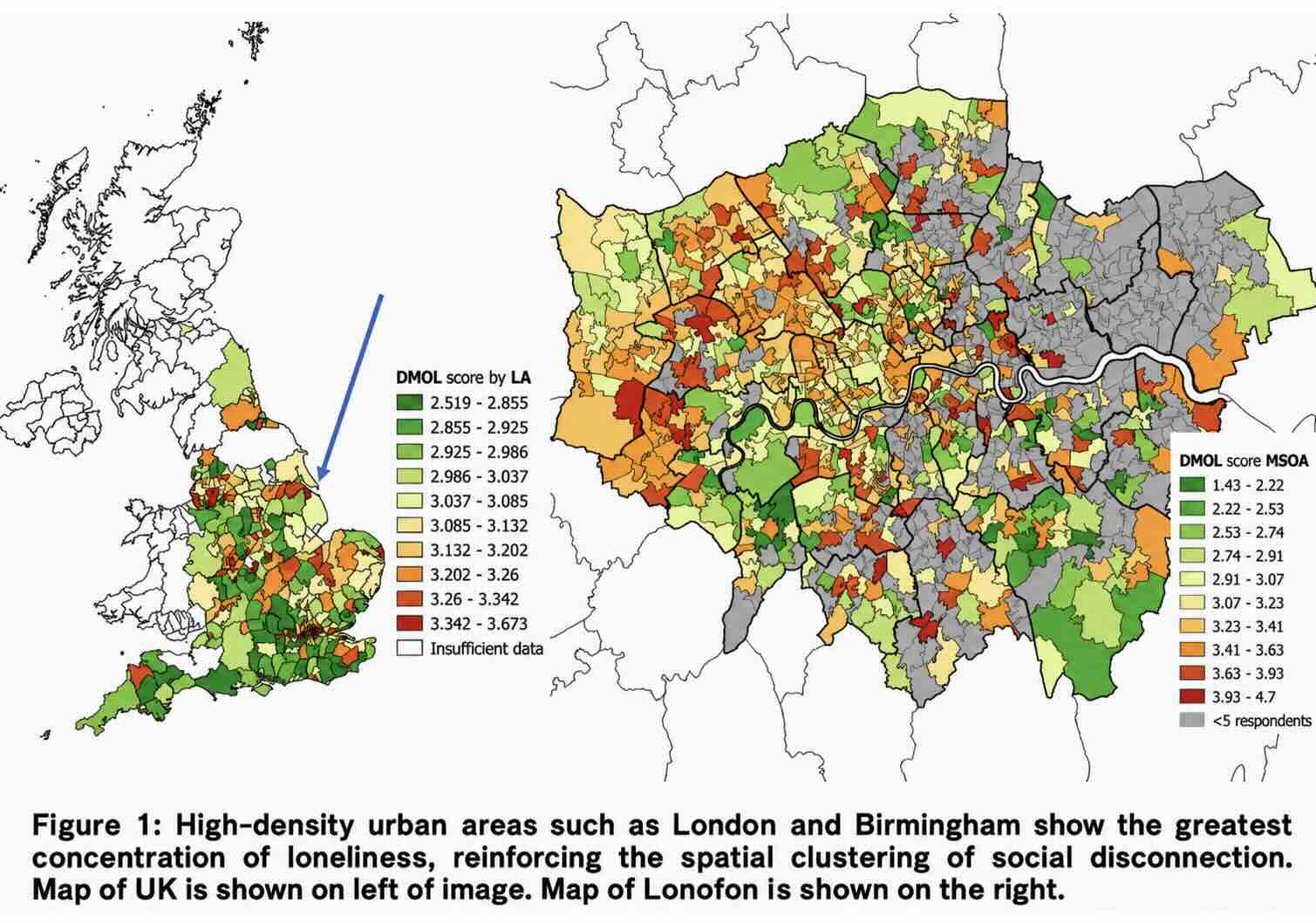
The first published paper in a series to report the findings of the Measuring Loneliness in England (INTERACT) Study, led by Imperial College London’s Self-Care Academic Research Unit (SCARU), provides an important starting point. More than 135,000 adults aged 16 and over participated. Among them, 16.5% reported feeling lonely “often or always”, while around one in five frequently reported lacking companionship, feeling left out or feeling isolated from others.

These findings are striking, but they require careful interpretation. INTERACT recruited a volunteer, non-probability sample, so the results describe the people who participated rather than providing a precise estimate of loneliness prevalence across England.

Its particular value lies elsewhere: in combining scale with geographical and social detail. INTERACT examines loneliness alongside social connection, neighbourhood trust, cohesion, health and socioeconomic circumstances. By linking responses anonymously to geographical areas, we can begin to move beyond asking simply: “How many people are lonely?” towards: “Where does loneliness appear to concentrate, among whom, and within what social and neighbourhood contexts?” For prevention, that distinction matters.

A map is not an intervention

Mapping loneliness can help identify patterns and generate hypotheses. But describing a problem is not the same as changing it. The real challenge is how evidence can inform decisions about where attention is needed, which community assets already exist, where gaps remain and which approaches should be tested. That is why SCARU has been working closely with the public-health teams serving Westminster and Kensington and Chelsea, alongside voluntary and community organisations, health partners and local networks. The aim is not simply to collect data about communities, but to develop research with the organisations and people who understand them.

Westminster’s Building a more connected Westminster Loneliness Action Plan creates an important opportunity to take this further. Rather than treating loneliness as the responsibility of a single service, the Action Plan seeks to bring together public services, communities and local organisations in a more coordinated response.

From INTERACT to LAP-IMPACT

This creates the next scientific question: Can a coordinated, place-based approach actually reduce loneliness and strengthen social connection? That is the thinking behind LAP-IMPACT, the research programme we are developing with our local partners. Subject to competitive funding, governance and the necessary approvals, the aim would be to move from mapping loneliness towards rigorously evaluating the response. The questions are practical and important. Who does a Loneliness Action Plan reach? Which components appear most promising? Are benefits distributed equitably? How does implementation vary between neighbourhoods and organisations? What role do community assets play? And what can other local authorities learn from the experience? These questions matter because an Action Plan should not be judged simply by whether activities happened. The more important question is whether the local system changed in ways that were meaningful for residents.

Prevention is not telling people to be less lonely

There is also a danger in framing loneliness only as an individual problem. Advice such as joining a group, volunteering or taking part in community activities may help some people. But it can obscure a more fundamental issue: Were meaningful opportunities for connection accessible in the first place?

A person cannot participate in an activity they cannot reach. Signposting has limited value if services have no capacity. Community assets cannot fulfil their potential if they remain disconnected from wider local systems.  This is why loneliness prevention must include the infrastructure of connection: the services, organisations, neighbourhood assets and relationships that make social participation possible. For SCARU, this also reflects a broader principle of self-care research. People exercise agency within environments that can either expand or constrain their options. Social wellbeing is no different.

From knowing where loneliness is to knowing what works

INTERACT has given us an unusually large window into loneliness and social connection in England. The next question is what we do with that knowledge.

Can local intelligence help communities organise prevention differently? Can services become better connected? Can existing community assets be strengthened? Can people be reached before loneliness becomes entrenched? And can we demonstrate which approaches work, for whom and under what conditions?

That is where loneliness research now needs to go. The INTERACT Study helps us understand the landscape. LAP-IMPACT is about understanding how that landscape might be changed. That is the Prevention Lab model in practice: moving from evidence, to action, to evaluation.

International Self-Care Day 2026: Advancing the Public Health Legacy of Self-Care

Every year, International Self-Care Day is marked on 24 July. The date (24/7) is a deliberate reminder that self-care is not confined to occasional acts of wellbeing, but is practised continuously: in the decisions people make about food, physical activity, sleep, medicines, relationships, symptoms, risk and when to seek professional support.

International Self-Care Day was established by the International Self-Care Foundation (ISF) in 2011 to promote self-care as an essential component of health and wellbeing. The Foundation’s work has helped provide a practical vocabulary for understanding self-care not as a single behaviour, but as a broad and multidimensional set of capabilities and practices.

In 2026, International Self-Care Day also marks the culmination of the World Health Organization’s Self-Care Month, held from 24 June to 24 July. The 2026 theme – “Self-Care puts your health in your hands: Test. Track. Thrive” – encourages people to understand their current health, monitor meaningful changes and use that knowledge to take appropriate action.

Yet International Self-Care Day should prompt us to consider a broader question: how do we move from viewing self-care principally as a personal practice to recognising it as an essential component of public health?

Self-care is more than “looking after yourself”
Self-care is sometimes presented narrowly through the language of rest, relaxation and personal wellbeing. These activities may be valuable, but they represent only one small part of a much wider concept. The World Health Organization distinguishes between everyday self-care actions, such as healthy eating, physical activity, sleep and maintaining social connections, and self-care interventions, including diagnostic tests, monitoring devices and appropriate medicines. Understood in this broader way, self-care includes:
• developing the knowledge and confidence needed to make informed health decisions;
   • adopting health-promoting behaviours;
   • recognising and responding appropriately to symptoms;
   • managing minor ailments safely;
   • using medicines and health products responsibly;
   • monitoring an existing condition;
   • maintaining social and psychological wellbeing;
   • avoiding or reducing preventable risks;
   • knowing when self-care is appropriate, and when professional care is required

Self-care is therefore neither an alternative to healthcare nor a justification for withdrawing services. At its best, it is part of a connected continuum in which individuals, families, communities, professionals and health systems work together.

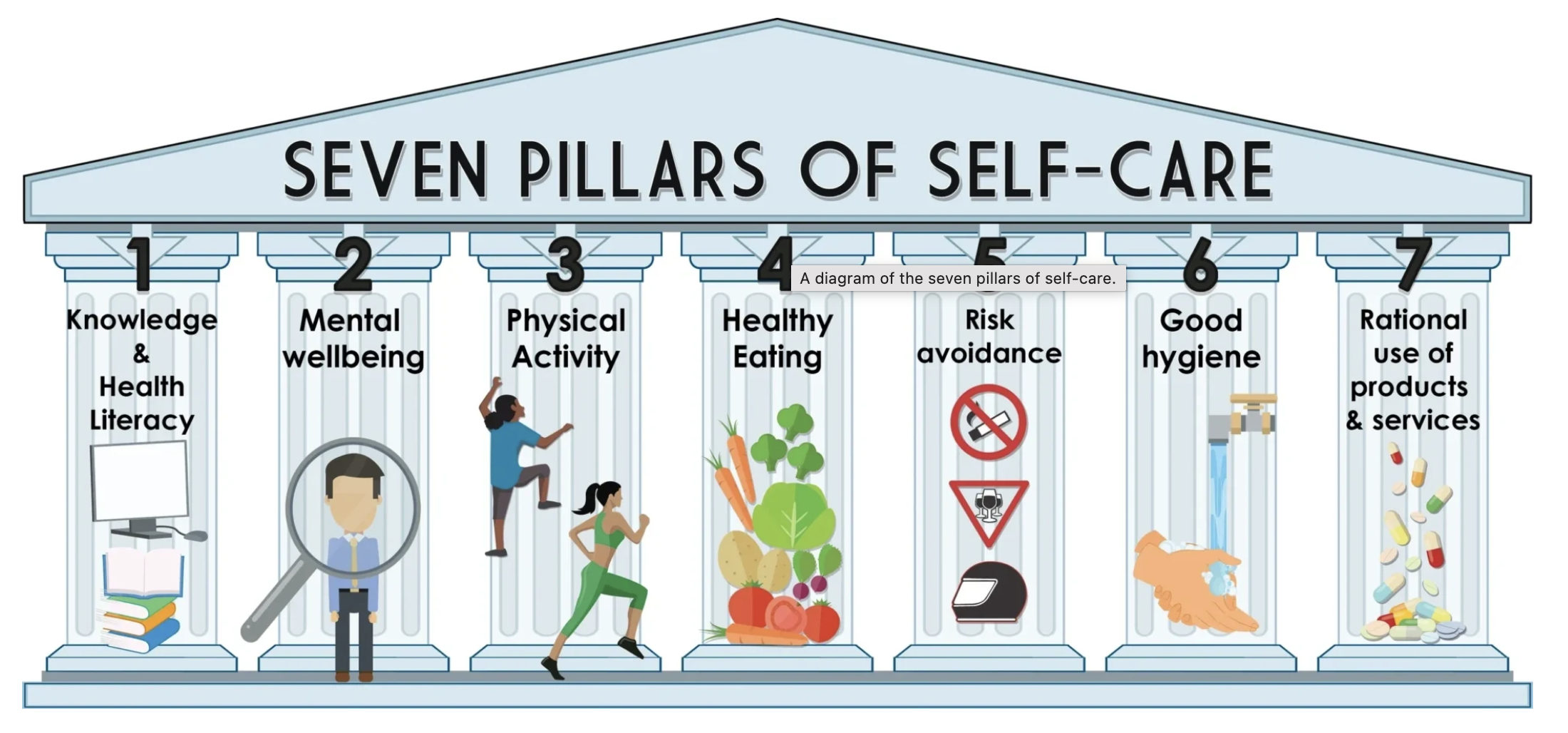
The seven pillars of self-care
One of the International Self-Care Foundation’s most influential contributions is its Seven Pillars of Self-Care framework. The framework recognises that effective self-care depends on several interconnected domains rather than on a single lifestyle choice or intervention. The seven pillars are:
   1. Knowledge and health literacy
   2. Mental wellbeing, self-awareness and agency
   3. Physical activity
   4. Healthy eating
   5. Risk avoidance and mitigation
   6. Good hygiene
   7. Rational and responsible use of self-care products and services


Together, these pillars provide a useful bridge between individual action and public-health practice and make clear that self-care is considerably more substantive than the popularised idea of occasionally “treating yourself.” It encompasses the knowledge, behaviours, resources and judgement required to protect health throughout everyday life.

Health happens beyond the clinic
Modern healthcare systems are often organised around consultations, treatments and clinical episodes. However, health itself is shaped predominantly outside healthcare settings. It is shaped in homes, schools, workplaces, pharmacies, supermarkets, community organisations and neighbourhoods. It is affected by daily routines, social relationships, environmental conditions and access to trustworthy information. People continually interpret symptoms, assess risks and make decisions that may influence their present and future health.

Self-care is where prevention becomes actionable in everyday life. Primary prevention may involve healthy eating, physical activity, maintaining social connections or avoiding tobacco. Secondary prevention may involve noticing a change, using an appropriate test, monitoring blood pressure or seeking timely advice. Tertiary prevention may involve managing medicines, monitoring symptoms and adapting daily life while living with a long-term condition.

The seven pillars operate across this entire prevention continuum. Health literacy can support early symptom recognition. Mental wellbeing and agency can influence whether someone feels able to seek help. Physical activity, healthy eating and risk mitigation contribute to disease prevention. Hygiene can reduce communicable disease transmission. Responsible use of products and services can support safe management while reducing avoidable harm.

These activities rarely occur in isolation since they are influenced by family members, peers, healthcare professionals, community networks, commercial environments, digital platforms and public policy. This is why self-care should be treated not merely as a private behaviour, but as part of the infrastructure of prevention.

From a day of recognition to a 24/7 commitment
International Self-Care Day is a useful reminder that health does not begin when someone enters a clinic, nor does it end when they leave. Self-care is practised 24 hours a day, seven days a week—but the responsibility for enabling it must be shared.

Individuals have an important role in protecting and managing their health. Healthcare professionals have a role in supporting safe and informed decisions. Communities can provide connection, knowledge and practical support. Researchers and organisations such as the International Self-Care Foundation can provide frameworks, evidence and tools. Governments and institutions must create conditions in which the seven pillars of self-care are realistic, equitable and evidence-informed.

The transition from personal practice to public health requires us to stop treating self-care as an optional addition to healthcare. It should instead be recognised as one of the principal ways in which prevention is understood, supported and enacted in everyday life..

On International Self-Care Day 2026, the challenge is not simply to ask people to do more for themselves. It is to build systems and communities that enable everyone to participate meaningfully in their health—across all seven pillars, every day and at every stage of life. Self-care is practised individually, but it must be enabled collectively

Celebrating the life of Dr David Webber OBE
This year, ISD 24/7 also brings a moment of reflection following the death of David Webber OBE, a longstanding champion of self-care and an influential figure in the development of the International Self-Care Foundation. His commitment to advancing self-care as a serious public-health priority helped shape the field and inspired many of those working within it. To honour his contribution and sustain that legacy, the Foundation is instituting anthe Annual David Webber Self-Care Lecture, creating a continuing platform for leadership, evidence and debate on the future of self-care.