Month: October 2026

Beyond the brand: what better OTC access should mean

Reflecting on the Asia Pacific Self-Medication Industry (APSMI) meeting this week, I keep returning to a distinction that deserves more attention: the diversity of over-the-counter (OTC) brands should not be confused with the diversity of therapeutic options.

The conference theme, “Self-Care in Healthcare: Scaling Partnerships for Better Health Outcomes”, provided a useful starting point. In my presentation, I argued that appropriate OTC use should become an affordable, supported and accountable part of primary care. That requires us to look closely at what people can actually access and achieve.

The difference between ingredients and products is substantial. In testimony to the US Congress in April 2025, an industry representative described less than 350 active pharmaceutical ingredients used in over 100,000 products within the OTC monograph system. These figures concern one US regulatory pathway, but they illustrate why product counts and therapeutic diversity are different questions.

Different formulations, strengths and combinations can offer meaningful benefits. However, a brand name alone tells us little about a product’s suitability. The FDA cautions that similarly named products can contain different active ingredients. Understanding the ingredient, dose and intended use matters.

For policymakers, the question should therefore be: which effective ingredients can people access, in appropriate formulations, at what cost, and with what support?

Putting the self-carer at the centre

At the centre of this question is the self-carer: the person making health decisions in everyday life, often alongside family members or carers. Their circumstances, preferences and confidence should shape how services are designed. The Self-Care Matrix connects the self-carer to policy by linking everyday activities and behaviours with the resources, services and wider conditions that enable or constrain people’s ability to care for their health. It also recognises people as active participants in their health, supported by an enabling environment and connections to professional care.

This means involving self-carers in designing information, care pathways and the outcomes we measure. Can someone understand the options, afford the treatment, use it appropriately and recognise when to seek help? Greater responsibility must come with practical support. Affordability should include the whole journey, including advice, travel and follow-up.

OTC medicines are not designed to provide comprehensive NCD management, although few can support selected aspects of prevention and symptom relief alongside appropriate diagnosis, treatment and ongoing monitoring. Nicotine replacement therapy can support smoking cessation, addressing an important preventable risk factor… For knee osteoarthritis, NICE recommends topical non-steroidal anti-inflammatory drugs (NSAIDs) alongside measures such as therapeutic exercise…. These limited examples show how medicines can support prevention and symptom management within a broader approach to care, but local authorisations and conditions of supply must guide their use in each country.

Turning shared ambition into practical action

These considerations underpin my recommendations for policymakers:

  • Give OTC self-care a national lead and a defined place in health plans.
  • Make access and reclassification decisions transparent and proportionate to risk.
  • Fund pharmacist advice alongside affordable access to appropriate medicines.
  • Involve self-carers in designing services and testing labels and information.
  • Set standards for trustworthy digital access, including privacy and routes to human help.
  • Generate local evidence on safety, appropriate use, equity and patient outcomes.

The Bangkok Joint Initiative already identifies health literacy, digital technology, partnerships, equity and governance as priorities for collective action. My recommendation is to give those priorities practical expression through funded care pathways.

I proposed a concrete commitment for the next 12 months: each participating country could nominate a national lead, fund one pharmacist-supported OTC care pathway and agree a small common set of measures. Regional partners could share the findings, with independent evaluation and transparent governance from the outset.

Those evaluations should show who benefited, who remained excluded and whether self-carers felt better supported. Locally grounded studies across Asia-Pacific/APAC would help countries decide which approaches could work in their own settings.

Strengthening the evidence base from the global majority

Meaningful OTC progress should be judged by people’s ability to obtain effective, affordable treatment and use it appropriately, with professional support within reach. We need to also broaden the evidence base beyond high-income Western settings and invest in locally generated studies across Asia-Pacific, including India, so that OTC self-care policy better reflects the needs and realities of the global majority.
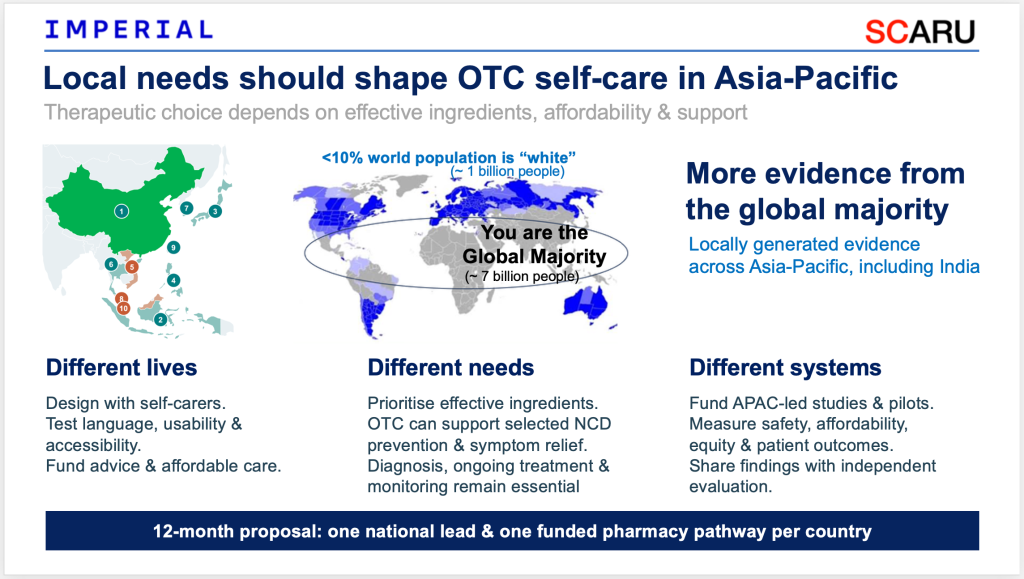
I am grateful to APSMI and the organising committee for facilitating this valuable exchange of knowledge and perspectives, and for bringing partners together. I look forward to seeing how partners across the region respond to this challenge and translate our shared ambition into practical, measurable improvements for self-carers.

We have counted loneliness. Now we need to change it.

Our new research examines loneliness and social capital in more than 135,000 adults. The challenge now is to turn those findings into better questions – and interventions worth investing in.

A loneliness score can tell us something important about someone’s life, but it cannot tell us what would make that life less lonely. That gap is where I believe the next chapter of loneliness research belongs. In our new paper in BMC Global and Public Health, we analysed data from 135,725 adults participating in the INTERACT study in England. We examined factors associated with loneliness using two established measures, alongside a separate analysis of social capital: people’s perceptions of neighbourhood trust, cohesion and reciprocity.

Among respondents, younger age, being single, unemployment and disability were consistently associated with greater loneliness. Larger friendship networks were associated with lower loneliness. Older, married and retired respondents more frequently reported high social capital, while people with disability or long-term conditions had lower adjusted odds of reporting it. These findings give us questions to pursue but they do not give us a ready-made intervention.

That distinction should shape everything we do next. The study used a volunteer sample and measured people’s circumstances at one point in time. It cannot establish what causes loneliness, estimate how common it is across England, or tell us which intervention would work. A large sample does not remove those limitations.

For me, this is the starting point for a more demanding research agenda: what would we actually change, for whom, and how would we know it helped? Consider the association between friendship networks and loneliness. It would be tempting to translate it into a simple instruction: help people make more friends. But an association cannot tell us whether expanding someone’s network will reduce their loneliness, whether loneliness makes relationships harder to sustain, or how other circumstances influence both. “More friends” is also an outcome to aspire to, rather than a sufficiently specified intervention. Who makes the introduction? Where does the first meeting happen? What helps someone return? What makes an encounter develop into a relationship that matters? Those are intervention-development questions. They deserve the same intellectual attention as the statistical models that bring them into view.

Imagine, as a design exercise, a community programme offering weekly group activities. Before commissioning it, I would want to ask what problem it is intended to address. A shortage of opportunities to meet people? Difficulty entering unfamiliar social settings? The loss of a close relationship? Practical barriers to leaving home?

Each answer points towards a different proposition to test. For someone who wants to attend but cannot reach the venue, transport support could be a candidate component. For someone apprehensive about arriving alone, a familiar person accompanying them might be worth testing. For someone seeking a close, dependable relationship, attendance at a large group may be the wrong primary outcome. These are hypotheses, not findings from our study… but their value lies in making the proposed route to benefit explicit – and therefore open to challenge!

Social capital adds another set of questions. Our paper examined it as a separate outcome; it did not establish that increasing neighbourhood trust reduces loneliness. Nevertheless, I would argue that intervention development should ask what happens beyond the individual referral. What kind of community is someone being invited into? Who feels welcome there? Can participants influence what happens? Are there opportunities to contribute as well as receive support? What resources would a local organisation need to sustain relationships beyond a short funding period?

I want self-care to sit within that discussion. Any call for people to strengthen their own social connections should be accompanied by serious questions about the opportunities and support available to them. “Take action” is an incomplete offer unless we also examine what makes action possible.

The next step should be a programme of co-designed, explicitly testable interventions. People experiencing loneliness should help define the problem, choose outcomes that matter and identify features that make participation acceptable. Their involvement should extend to interpreting why an approach succeeds, disappoints or reaches only some of its intended participants. Evaluation then needs to follow the whole journey.

Counting invitations, referrals and attendance can describe delivery. To establish benefit, we need to examine changes in loneliness and wellbeing, whether those changes last, and how outcomes compare with what would have happened without the intervention. Randomised evaluations should be used where feasible, with credible alternatives where they are not. We should also examine who never takes up the offer, who leaves, and whose circumstances make participation difficult. I would want a commissioner to see those findings alongside the average outcome and the cost. An intervention’s reach is part of its practical value.

Our study also offers a reason to think carefully about measurement. Educational attainment showed different associations depending on which loneliness measure we used. That finding cautions against treating different instruments as interchangeable. Future evaluations should specify what they seek to change and combine appropriate measures with accounts of participants’ experiences.

None of this requires abandoning observational research. It requires giving its findings a purposeful next step.

For the Prevention Lab, my challenge is to researchers, funders and commissioners alike: make room for the difficult work between identifying a pattern and delivering a useful intervention. Fund development, refinement and rigorous evaluation. Specify the benefit being sought. Be willing to adapt or stop an approach when the evidence disappoints.

I want the next paper to answer a harder question: what did we change, who benefited, and was the difference worth sustaining? The people behind our data deserve that next chapter – and a meaningful role in writing it. Through our ongoing qualitative research, we are exploring personal stories and journeys to understand what connection, belonging and support mean in everyday life. These accounts will inform the co-production of interventions grounded in people’s experiences, ready to be tested for the difference they make to their lives.