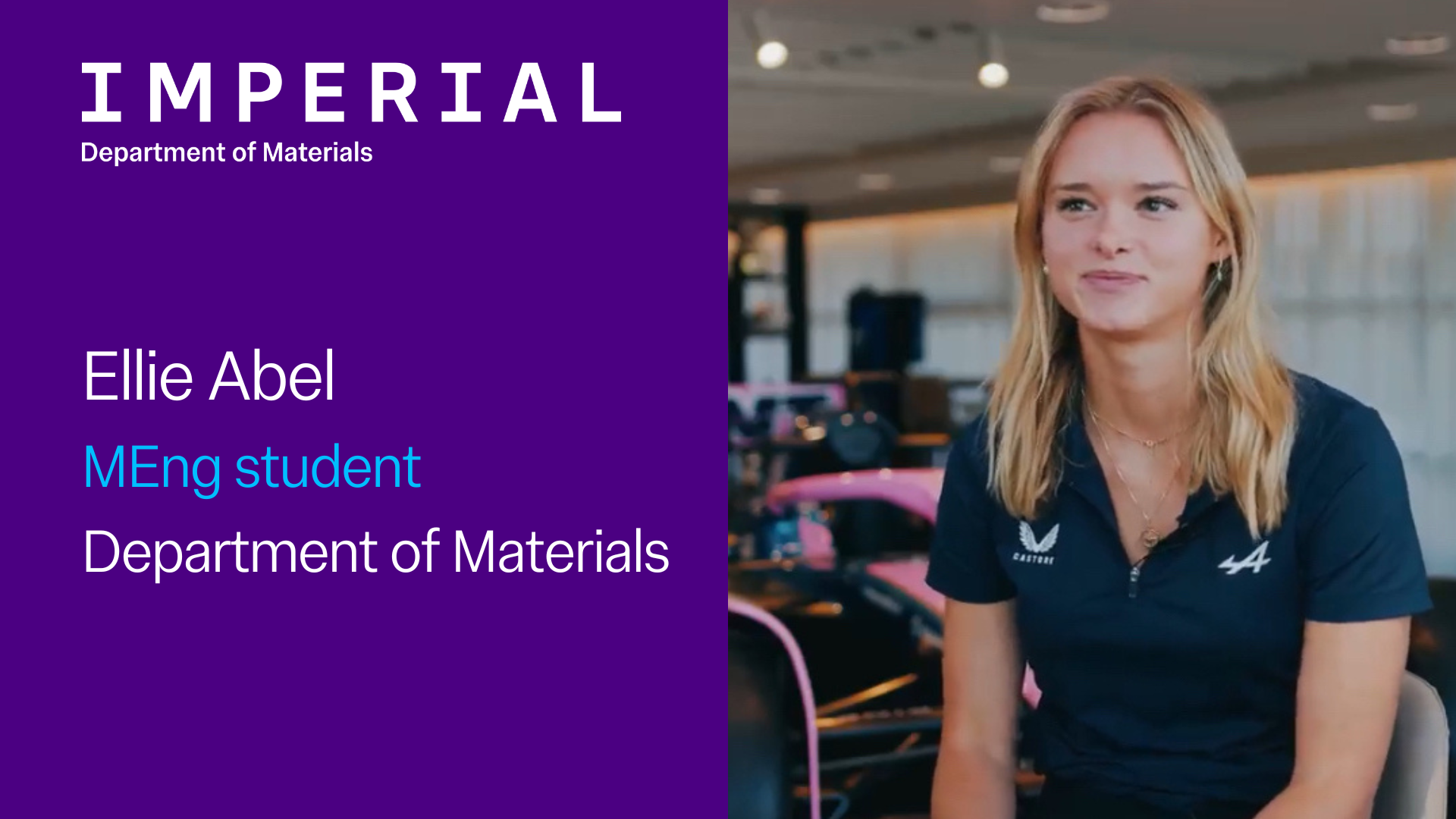
This week on our Imperial Materials blog, we’re featuring Ellie Abel, our MEng student who spent her summer as a Stress/Structures Intern with Alpine Formula One Racing. She shares her experiences working on high-performance car components, performing simulations, testing, and even developing tools to streamline engineering processes.
Over the summer, I had the opportunity to join Alpine Formula One Racing as a Stress/Structures Intern. It was an incredible experience through which I had some exciting opportunities: contributing to both the 2025 and 2026 cars, working alongside incredibly kind and talented engineers, meeting the drivers, and exploring the beautiful scenery the Cotswolds had to offer. Although the environment was fast-paced, demanding and the results weren’t always perfect, the team’s work ethic and motivation stood out to me. It really reaffirmed why I’m pursuing my material science and engineering degree.
In my role, I predominantly carried out finite element analysis on a variety of components, ranging from brackets & tailpipes to hydraulic pumps. I performed linear static, buckling, and frequency analysis and produced documentation for FIA approval, design iterations, and stress validation. I had the chance to oversee component testing, including the nose impact test and various rear wing and wheel hub fatigue tests (all mandatory tests the FIA request). Seeing first-hand how subjects I learned in my first two years, such as fatigue, fracture mechanics, structures and composites manifest in real-world high-performance components was incredibly exciting. Overall, it was a fantastic opportunity to develop my knowledge of vehicle dynamics, simulation and structures.
Another key responsibility I took on was overload identification. Using specialised software, I analysed both cable and telemetry data to detect peak overloads and reported them to technical directors. By the end of my internship, I managed to build upon a previous intern’s work to develop a demo app that enabled multi-parameter selection and automated reporting for specific overloads or full-season summaries.
I also worked on fastener stress sign-offs, where I interpreted load-displacement data to extract UTS values and assess whether components met required thresholds. To streamline this process, I created a Python application that automated data handling and even drafted scenario-dependent email templates.
Overall, this was an incredible experience that allowed me to work with brilliant people and grow into a more well-rounded engineer. Specifically it gave me the chance to further develop my coding, simulation and structural/material engineering skills. It reinforced my passion for Formula One and structural analysis.
To close they’re a hard-working team, so 2026 better watch out!