Reflecting on the Asia Pacific Self-Medication Industry (APSMI) meeting this week, I keep returning to a distinction that deserves more attention: the diversity of over-the-counter (OTC) brands should not be confused with the diversity of therapeutic options.
The conference theme, “Self-Care in Healthcare: Scaling Partnerships for Better Health Outcomes”, provided a useful starting point. In my presentation, I argued that appropriate OTC use should become an affordable, supported and accountable part of primary care. That requires us to look closely at what people can actually access and achieve.
The difference between ingredients and products is substantial. In testimony to the US Congress in April 2025, an industry representative described less than 350 active pharmaceutical ingredients used in over 100,000 products within the OTC monograph system. These figures concern one US regulatory pathway, but they illustrate why product counts and therapeutic diversity are different questions.
Different formulations, strengths and combinations can offer meaningful benefits. However, a brand name alone tells us little about a product’s suitability. The FDA cautions that similarly named products can contain different active ingredients. Understanding the ingredient, dose and intended use matters.
For policymakers, the question should therefore be: which effective ingredients can people access, in appropriate formulations, at what cost, and with what support?
Putting the self-carer at the centre
At the centre of this question is the self-carer: the person making health decisions in everyday life, often alongside family members or carers. Their circumstances, preferences and confidence should shape how services are designed. The Self-Care Matrix connects the self-carer to policy by linking everyday activities and behaviours with the resources, services and wider conditions that enable or constrain people’s ability to care for their health. It also recognises people as active participants in their health, supported by an enabling environment and connections to professional care.
This means involving self-carers in designing information, care pathways and the outcomes we measure. Can someone understand the options, afford the treatment, use it appropriately and recognise when to seek help? Greater responsibility must come with practical support. Affordability should include the whole journey, including advice, travel and follow-up.
OTC medicines are not designed to provide comprehensive NCD management, although few can support selected aspects of prevention and symptom relief alongside appropriate diagnosis, treatment and ongoing monitoring. Nicotine replacement therapy can support smoking cessation, addressing an important preventable risk factor… For knee osteoarthritis, NICE recommends topical non-steroidal anti-inflammatory drugs (NSAIDs) alongside measures such as therapeutic exercise…. These limited examples show how medicines can support prevention and symptom management within a broader approach to care, but local authorisations and conditions of supply must guide their use in each country.
Turning shared ambition into practical action
These considerations underpin my recommendations for policymakers:
- Give OTC self-care a national lead and a defined place in health plans.
- Make access and reclassification decisions transparent and proportionate to risk.
- Fund pharmacist advice alongside affordable access to appropriate medicines.
- Involve self-carers in designing services and testing labels and information.
- Set standards for trustworthy digital access, including privacy and routes to human help.
- Generate local evidence on safety, appropriate use, equity and patient outcomes.
The Bangkok Joint Initiative already identifies health literacy, digital technology, partnerships, equity and governance as priorities for collective action. My recommendation is to give those priorities practical expression through funded care pathways.
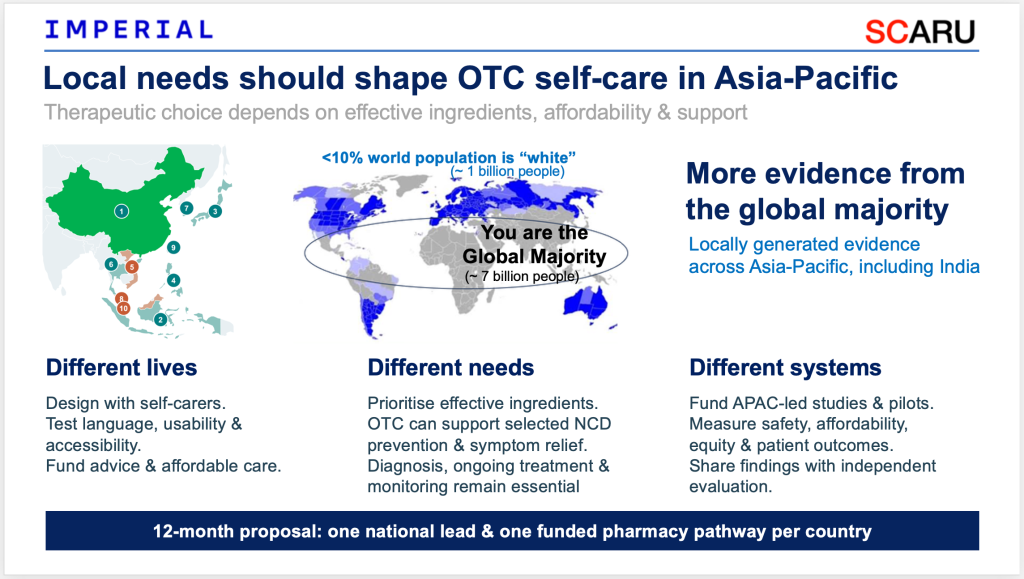
I proposed a concrete commitment for the next 12 months: each participating country could nominate a national lead, fund one pharmacist-supported OTC care pathway and agree a small common set of measures. Regional partners could share the findings, with independent evaluation and transparent governance from the outset.
Those evaluations should show who benefited, who remained excluded and whether self-carers felt better supported. Locally grounded studies across Asia-Pacific/APAC would help countries decide which approaches could work in their own settings.
Strengthening the evidence base from the global majority
Meaningful OTC progress should be judged by people’s ability to obtain effective, affordable treatment and use it appropriately, with professional support within reach. We need to also broaden the evidence base beyond high-income Western settings and invest in locally generated studies across Asia-Pacific, including India, so that OTC self-care policy better reflects the needs and realities of the global majority.
I am grateful to APSMI and the organising committee for facilitating this valuable exchange of knowledge and perspectives, and for bringing partners together. I look forward to seeing how partners across the region respond to this challenge and translate our shared ambition into practical, measurable improvements for self-carers.