International Self-Care Day 2026: Advancing the Public Health Legacy of Self-Care
Every year, International Self-Care Day is marked on 24 July. The date (24/7) is a deliberate reminder that self-care is not confined to occasional acts of wellbeing, but is practised continuously: in the decisions people make about food, physical activity, sleep, medicines, relationships, symptoms, risk and when to seek professional support.
International Self-Care Day was established by the International Self-Care Foundation (ISF) in 2011 to promote self-care as an essential component of health and wellbeing. The Foundation’s work has helped provide a practical vocabulary for understanding self-care not as a single behaviour, but as a broad and multidimensional set of capabilities and practices.
In 2026, International Self-Care Day also marks the culmination of the World Health Organization’s Self-Care Month, held from 24 June to 24 July. The 2026 theme – “Self-Care puts your health in your hands: Test. Track. Thrive” – encourages people to understand their current health, monitor meaningful changes and use that knowledge to take appropriate action.
Yet International Self-Care Day should prompt us to consider a broader question: how do we move from viewing self-care principally as a personal practice to recognising it as an essential component of public health?
Self-care is more than “looking after yourself”
Self-care is sometimes presented narrowly through the language of rest, relaxation and personal wellbeing. These activities may be valuable, but they represent only one small part of a much wider concept. The World Health Organization distinguishes between everyday self-care actions, such as healthy eating, physical activity, sleep and maintaining social connections, and self-care interventions, including diagnostic tests, monitoring devices and appropriate medicines. Understood in this broader way, self-care includes:
• developing the knowledge and confidence needed to make informed health decisions;
• adopting health-promoting behaviours;
• recognising and responding appropriately to symptoms;
• managing minor ailments safely;
• using medicines and health products responsibly;
• monitoring an existing condition;
• maintaining social and psychological wellbeing;
• avoiding or reducing preventable risks;
• knowing when self-care is appropriate, and when professional care is required
Self-care is therefore neither an alternative to healthcare nor a justification for withdrawing services. At its best, it is part of a connected continuum in which individuals, families, communities, professionals and health systems work together.
The seven pillars of self-care
One of the International Self-Care Foundation’s most influential contributions is its Seven Pillars of Self-Care framework. The framework recognises that effective self-care depends on several interconnected domains rather than on a single lifestyle choice or intervention. The seven pillars are:
1. Knowledge and health literacy
2. Mental wellbeing, self-awareness and agency
3. Physical activity
4. Healthy eating
5. Risk avoidance and mitigation
6. Good hygiene
7. Rational and responsible use of self-care products and services
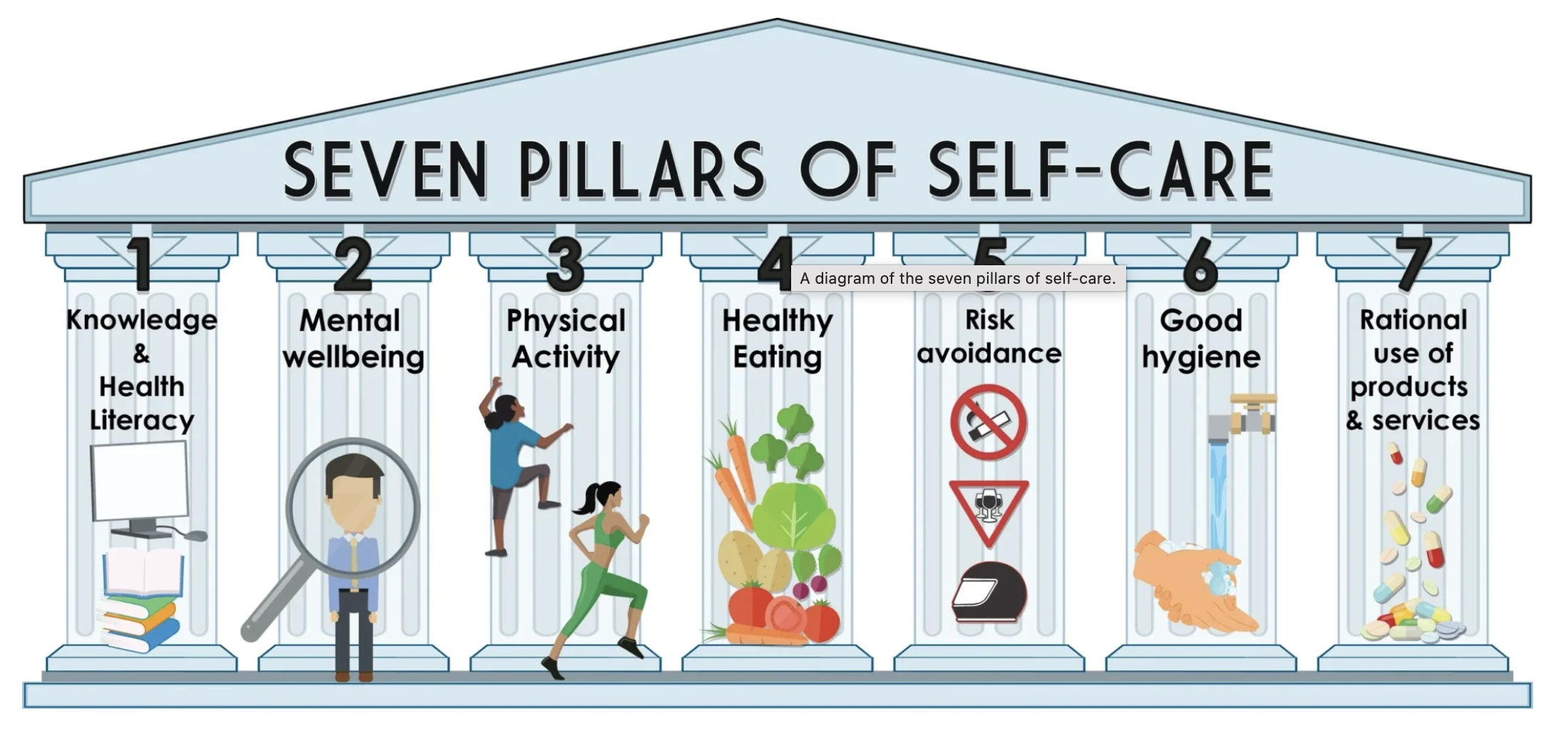
Together, these pillars provide a useful bridge between individual action and public-health practice and make clear that self-care is considerably more substantive than the popularised idea of occasionally “treating yourself.” It encompasses the knowledge, behaviours, resources and judgement required to protect health throughout everyday life.
Health happens beyond the clinic
Modern healthcare systems are often organised around consultations, treatments and clinical episodes. However, health itself is shaped predominantly outside healthcare settings. It is shaped in homes, schools, workplaces, pharmacies, supermarkets, community organisations and neighbourhoods. It is affected by daily routines, social relationships, environmental conditions and access to trustworthy information. People continually interpret symptoms, assess risks and make decisions that may influence their present and future health.
Self-care is where prevention becomes actionable in everyday life. Primary prevention may involve healthy eating, physical activity, maintaining social connections or avoiding tobacco. Secondary prevention may involve noticing a change, using an appropriate test, monitoring blood pressure or seeking timely advice. Tertiary prevention may involve managing medicines, monitoring symptoms and adapting daily life while living with a long-term condition.
The seven pillars operate across this entire prevention continuum. Health literacy can support early symptom recognition. Mental wellbeing and agency can influence whether someone feels able to seek help. Physical activity, healthy eating and risk mitigation contribute to disease prevention. Hygiene can reduce communicable disease transmission. Responsible use of products and services can support safe management while reducing avoidable harm.
These activities rarely occur in isolation since they are influenced by family members, peers, healthcare professionals, community networks, commercial environments, digital platforms and public policy. This is why self-care should be treated not merely as a private behaviour, but as part of the infrastructure of prevention.
From a day of recognition to a 24/7 commitment
International Self-Care Day is a useful reminder that health does not begin when someone enters a clinic, nor does it end when they leave. Self-care is practised 24 hours a day, seven days a week—but the responsibility for enabling it must be shared.
Individuals have an important role in protecting and managing their health. Healthcare professionals have a role in supporting safe and informed decisions. Communities can provide connection, knowledge and practical support. Researchers and organisations such as the International Self-Care Foundation can provide frameworks, evidence and tools. Governments and institutions must create conditions in which the seven pillars of self-care are realistic, equitable and evidence-informed.
The transition from personal practice to public health requires us to stop treating self-care as an optional addition to healthcare. It should instead be recognised as one of the principal ways in which prevention is understood, supported and enacted in everyday life..
On International Self-Care Day 2026, the challenge is not simply to ask people to do more for themselves. It is to build systems and communities that enable everyone to participate meaningfully in their health—across all seven pillars, every day and at every stage of life. Self-care is practised individually, but it must be enabled collectively
Celebrating the life of Dr David Webber OBE
This year, ISD 24/7 also brings a moment of reflection following the death of David Webber OBE, a longstanding champion of self-care and an influential figure in the development of the International Self-Care Foundation. His commitment to advancing self-care as a serious public-health priority helped shape the field and inspired many of those working within it. To honour his contribution and sustain that legacy, the Foundation is instituting anthe Annual David Webber Self-Care Lecture, creating a continuing platform for leadership, evidence and debate on the future of self-care.