Category: Accessibility

Accessibility is Excellence – webinar reflections

by Katie Stripe, Senior Learning Designer

For Disability History Month in 2025, ICT’s Digital Accessibility Officer, Bouquette Kabatape joined forces with me (Katie Stripe, Senior Learning Designer) and industry expert Susi Miller to deliver a webinar on accessible learning content for the Imperial community.

Susi is an accomplished speaker and educator who specialises in e-Learning accessibility. Her award-winning company eLaHub offers training, auditing, and consultancy to help those delivering education improve their content and understand the impact of making learning content accessible and inclusive as standard. She mentions her awards to highlight that applying and receiving these awards is part of a business strategy to help mainstream and legitimise the work they do. I would like to see this kind of strategy adopted more to support and reward those working in education. Day-to-day teaching innovation can often get lost in such a large institution and we need to be intentional about finding and rewarding teaching excellence.

At the webinar, we were joined by over 50 colleagues and I hope that hearing Susi speak inspired the audience into thinking more broadly about accessibility and inclusion in education.

Persistent myths

In addressing persistent myths, this webinar raised some key barriers that can be faced by those promoting accessible education, e.g. making education accessible can somehow detract from the overall learning experience. Through practical examples and clear commentary, Susi showed the audience that this is fundamentally untrue. Clear, accessible, and inclusive content benefits everyone.

From my own perspective which forefronts inclusion (not accessibility) in education it was heartening to hear Susi push the idea that you can’t have one without the other. Use of language and appropriate imagery is as important to Susi’s definition of accessibility as meeting the technical elements is to my definition of inclusion. One beautiful example, which I had not considered, was changing the language of buttons from ‘click’ to ‘select’ to include users that do not use a mouse.

Accessibility and the law

The webinar also brought the legal requirements of accessibility to the forefront of the conversation. It was an important reminder that Imperial, as an educational institution not only has an ethical and moral obligation to provide accessible content, but a legal one. This was shared to help the audience understand that the legal implications’ core frameworks and guidance can help individuals and institutions improve the way they deliver content.

From my own research, I know that educators feel relatively comfortable with the legislation but less comfortable actually delivering content that meets the needs of all students. Susi shared a range of resources from the Custom CGPT alternative text assistant, which helps users add alternative text to complex diagrams, to the HMRC’s Virtual Empathy Hub which shows how people with different accessibility needs can be affected by poor content and how that content can be improved.

Personae

Both Susi and I use personae in our work, and the Imperial Inclusive Personae is a resource available for the whole Imperial community to develop. These characters are particularly useful for exploring the impact of different elements of accessibility and inclusion on the student body and a way of controlling the visual elements of diversity in our delivery which, as Susi describes is extremely important for inclusive, accessible educational content.

Susi ended her session by linking accessibility to our Imperial Values in a way that resonated with me and I hope with others.

Final reflections

Accessibility is providing an excellent learning experience that shows respect for learners. This can be achieved through collaboration with people internal and external to the institution and innovating in the way we deliver education, but most importantly having the personal integrity to understand that this work can be challenging and that it is ok to ask for help.

Perhaps the most inspiring and influential quote from Susi’s session was that we should strive for progress, not perfection. Mistakes will be made, but that is how we learn and develop, and as a community of educators we can share that burden, collaborate, innovate, and create content that is inclusive of and designed for all our students.

While approaches can be different, we all have the same ultimate goal, which is to make excellent education for all students.

Further information

Watch the webinar recording

Digital accessibility training course

Contact accessibility@imperial.ac.uk if you need to discuss the accessibility of a digital product or service you manage or own.

Building digital ramps: Imperial’s commitment to digital accessibility

Bouquette Kabatepe
Bouquette Kabatepe, Digital Accessibility Officer

At Imperial, inclusivity does not stop at physical infrastructure — it extends to the digital world too. In a recent conversation with Bouquette Kabatepe, Digital Accessibility Officer, we dive into the importance of creating an accessible digital environment and the ongoing efforts to ensure no one is excluded from online content.

Why Digital Accessibility matters

Bouquette likens digital accessibility to building ramps in physical spaces for those with disabilities. She stresses that universities’ online platforms must provide equal access to everyone, especially those with additional needs. The need stems from legal requirements such as the Public Sector Bodies Accessibility Regulations (PSBAR) and the Web Content Accessibility Guidelines (WCAG). Beyond the law, Imperial holds the status of an ‘inclusive leader,’ meaning we aim to go above and beyond our legal obligations.

“Digital inclusion is like building ramps in digital spaces. In physical places, we build ramps for wheelchair users; we build the equivalent on digital platforms to make sure everyone with additional needs has the same experience as those who don’t.”

Bouquette’s role really matters! Her day-to-day activities providing accessibility guidance and training raise awareness to the wider community of how to meet compliance. More importantly, her collaboration with procurement teams, testing teams and in-house developers means we buy and create accessible platforms and services, ensuring compliance with legislation and regulations from the outset. Bouquette also works closely with the Central Communications’ Digital team to implement accessible websites and apps, as well as writing specific guidance for Imperial.

Find out more about Bouquette Kabatepe’s, Digital Accessibility Officer role

WCAG 2.2: What is new?

The previous standards were WCAG 2.1 AA. This is the minimum requirement for the legislation.
With the new WCAG 2.2, there is new guidance with nine new success criteria. Six of these are A and AA levels, which is the minimum requirement for us:

  1. Consistent help (Level A) – an accessibility statement within one click from all web pages, so contact details, including email addresses are reachable.
  2. Redundant entry (Level A) – pre- populated fields, therefore we are not asking users to enter the same information repeatedly.
  3. Focus not obscured (Level AA) – making sure when an item gets keyboard focus it is at least partially visible and you can click back onto it.
  4. Dragging movements (level AA) – For any action that involves dragging, provide a simple pointer alternative.
  5. Minimum target size (Level AA) – Ensuring targets (clickable elements/areas) meet a minimum size, or have sufficient spacing around them, especially for mobile use.
  6. Accessible authentication (level AA) – Do not make people solve a puzzle, recall something, or transcribe something to log in. Examples include clicking parts of lorries on a picture or typing obscured letters in.

The new success criteria extend the requirements for users with low vision, cognitive impairments, and limited fine motor skills. The newly added requirements also address the aging population’s needs. Bouquette points out that the updated changes should not be too difficult for Imperial to achieve.

One of the updates ‘consistent help’ requires that accessibility statements be placed in more prominent locations. Another criterion involves offering alternatives for drag-and-drop actions, as not everyone can use a mouse. So, if you are featuring something with drag and drop, you should also offer alternative methods for this action, ensuring that those who cannot use a mouse are not excluded.

“If an organisation is compliant with WCAG 2.1 AA, they’re really not far from WCAG 2.2 AA. The new criteria aren’t difficult to achieve but are designed to make the web experience better for everyone.”

Navigating complex audits

One of the most significant challenges Bouquette and Imperial faced recently was the Cabinet Office’s recent unannounced accessibility audit on our public-facing website.

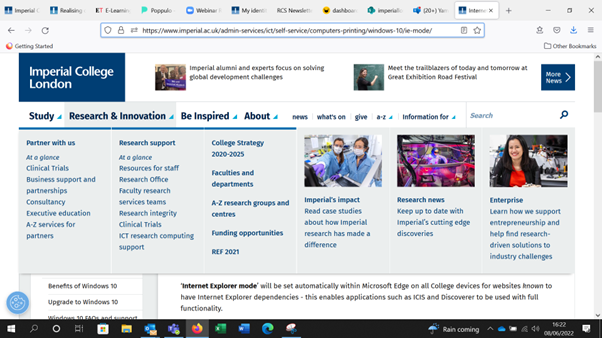
This process, designed to test how well public bodies comply with PSBAR, highlighted several issues with Imperial’s website. The issues raised included problems with our website’s navigation, AKA the ‘Mega Menu,’ especially when using a high zoom level and the inaccessibility of our vacancies’ job descriptions in PDF format when using screen readers.

Despite Bouquette letting the auditors know we were launching our new updated website, which would fix these issues, Imperial were told to resolve these issues within 12 weeks of the audit. Since then the issues have been fixed, including the mega menu, on our new site which launched on 17 September 2024.

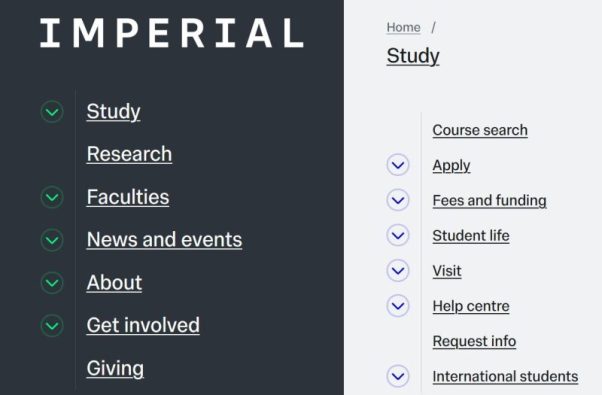
Screenshot showing the old mega menu
The old website mega menu was not accessible
Screenshot of new website menu
New website navigation

Bouquette stayed connected with the Cabinet Office throughout the 12-week improvement work schedule to ensure they were aware of the development challenges, to check compliance and to show that we genuinely cared about the changes.

Bouquette suggested that ‘in certain cases, institutions can just take the easy route of claiming a ‘disproportionate burden’ – meaning that to fix an issue would significantly impact on cost or resources – but for large institutions like Imperial, it would require detailed financial justification.’

However, Bouquette agreed with the government that even if a new website is in the works, accessibility cannot wait: “If someone with additional needs wants to apply for a job that day, they need access now.”

With this in mind, Bouquette collaborated with ICT’s Cross Functional squad and the Digital team, including Lea Yurkovetskaya, Senior Digital Designer and Fenton Chambers, Senior Digital Product Manager, to re-prioritise work and tirelessly update and fix the issues on the website; we are continuously improving access.

From PDFs to procurement: Continuous effort

Solving the audit issues was challenging, but it also led to broader improvements. The new website is easier to navigate, and the HR team has redesigned the job description templates to ensure they met accessibility, as well as our new branding guidelines.

This work is a reminder that improving accessibility often fixes other problems and makes things better for everyone.

The new website redesign work involved accessibility integrated from the design phase. Continuous testing with external agencies ensured compliance. But Imperial’s approach to accessibility goes beyond just fixing the website. Imperial has introduced accessibility guidelines for content creators, like how to make accessible videos, and procurement processes ensure that any external services meet compliance standards.

“Accessibility isn’t a box to be ticked. It is a continuous effort. What we have in place needs to be tested, retested, and updated every year because content changes and standards evolve.”

Cultural change and the path forward

Bouquette is happy to report that the Cabinet Office closed our case with no further action required, which is important because they will report everything to the Equality and Human Rights Commission (EHRC).

Bouquette suggests that ‘this result, in terms of accessibility compliance, is particularly good and prestigious.

To keep up this ‘prestigious state,’ the biggest hurdles are cultural. Bouquette emphasises that digital accessibility is about a fundamental change in how people approach websites and content creation. Bouquette calls for stronger policies from the top, more resources, and ongoing training to embed accessibility into everyday practices across the university.

With continued effort and collaboration, Imperial aims to lead by example, creating a digital environment as inclusive as the physical one.

Imperial’s journey toward digital inclusivity is a work in progress, but with dedicated individuals like Bouquette, it is clear that we are committed to ensuring no one is left behind.

Further support

You can contact Bouquette to discuss digital accessibility or find out what support is available at Imperial:

Bonus materials